All species › Passerines › Ovenbirds and woodcreepers › Bar-bellied Woodcreeper
Bar-bellied Woodcreeper | Hylexetastes stresemanni
Bandbuikmuisspecht | Trepatroncos ventribarrado | Arapaçu-de-barriga-pintada
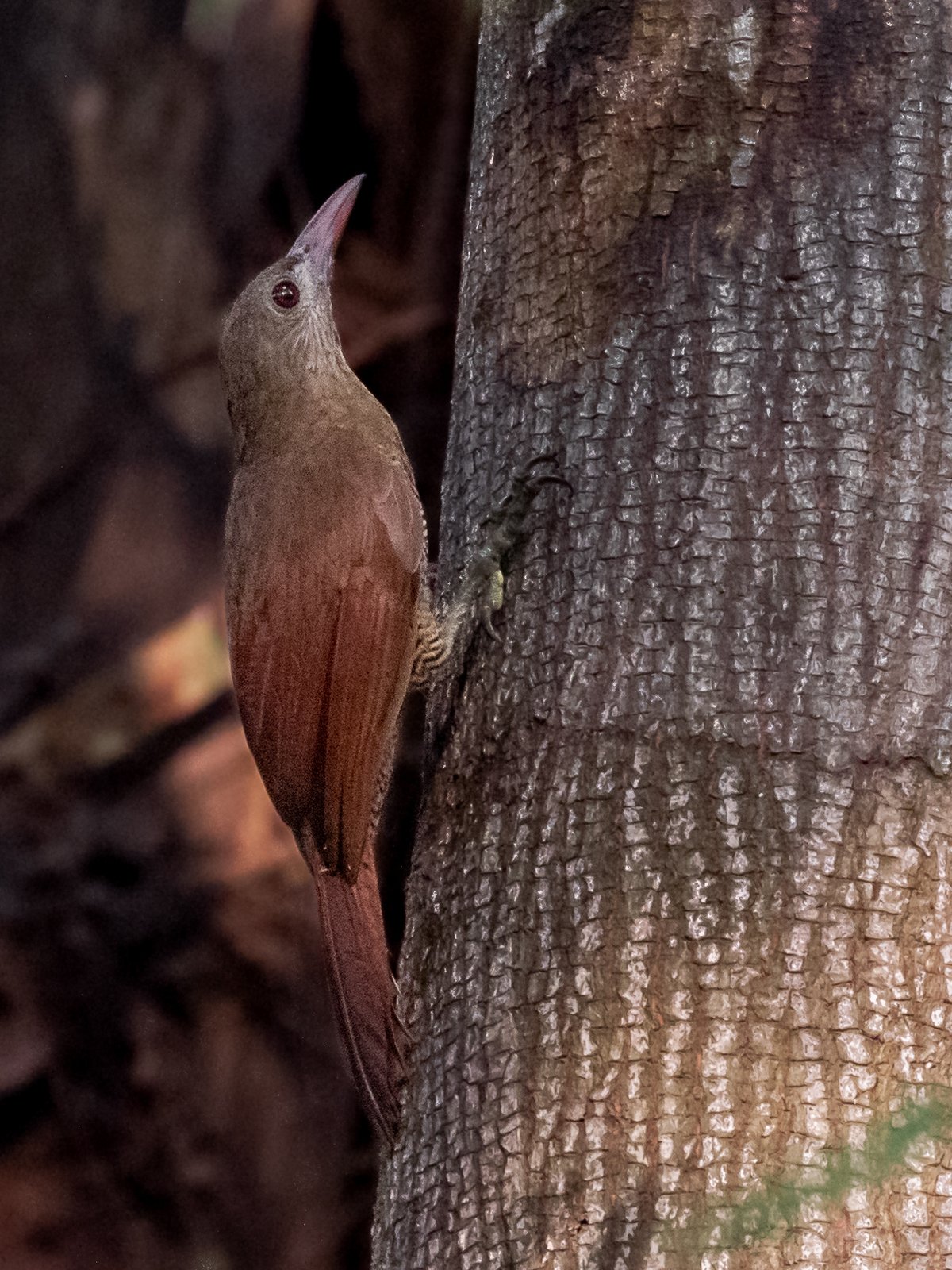
The Bar-bellied Woodcreeper is one of the heaviest woodcreepers, with a short, massive, dark red bill and a short tail. It lives in the interior of undisturbed rainforest in western Amazonia and is recorded infrequently everywhere. Relatively little is known about its behaviour.
Voice
It sings almost only at first light: a loud, somewhat shrill series of four to six nearly disyllabic whistles on roughly the same pitch.
Recording: John V. Moore — CC BY-NC-SA 4.0 · xeno-canto
Identification
27–30 cm, heavily built, with a short tail and a short, very heavy, dark red to reddish-brown bill. The head, upper back and wing coverts are brown to olive-brown; the lower back, wings and tail rufous. The throat is whitish with heavy dark streaks, the upper breast olive and streaked, and the belly olive with narrow blackish bars. Juveniles have a browner bill. The sexes are alike.
Confusion species
Amazonian Barred Woodcreeper Dendrocolaptes certhia is barred all over and has a slimmer bill. Black-banded Woodcreeper Dendrocolaptes picumnus has a longer, dark bill and pale streaks on the head and breast. Strong-billed Woodcreeper Xiphocolaptes promeropirhynchus has a longer, dark, slightly decurved bill. Red-billed Woodcreeper Hylexetastes perrotii, which lives outside the guide area, has a plain, unbarred belly.
Habitat
The interior of undisturbed humid terra firme rainforest, outside Colombia also flooded forest, in the lowlands up to about 300 m. It forages on trunks at middle levels, joins mixed flocks and sometimes follows army-ant swarms. Little is known about the nest; probably in a tree cavity.
Where the bird is most at home, classified by the vegetation units of the Andes and the west coast.


Range and movements
Colombia: only in the far south-east, north of the Río Vaupés. Ecuador: only in the far east. Peru: in the eastern lowlands. Bolivia: in the lowlands of the north. Absent from the Galápagos. Outside the guide area in western Amazonian Brazil.
- Resident
- dark = core range, pale = thinly spread
How and when to look
At first light in undisturbed terra firme forest, listen for the loud series of whistles; later in the day the bird is silent and hidden. At ant swarms, also look for a heavy woodcreeper with a red bill.
Conservation status
Least Concern. The species has a large range, but is scarce to rare everywhere and very sensitive to forest disturbance; the population is probably declining.
Scientific name
Hylexetastes stresemanni | Snethlage, HMMEE, 1925
Snethlage, HMMEE described the species in 1925 and placed it straight away in the genus where it still stands. The genus Hylexetastes was introduced in 1889 by Sclater. The genus name comes from Greek hulē, 'forest', and exetastēs, 'examiner': 'forest examiner'. The species name honours Erwin Stresemann (1889–1972), German ornithologist in Berlin. The specimen the first description was based on came from Acajatuba, Rio Negro, Brazil.