All species › Passerines › Ovenbirds and woodcreepers › Mouse-colored Thistletail
Mouse-colored Thistletail | Asthenes griseomurina
Muisgrijze distelstaart | Colicardo murino | Cauda-de-cardo-murino
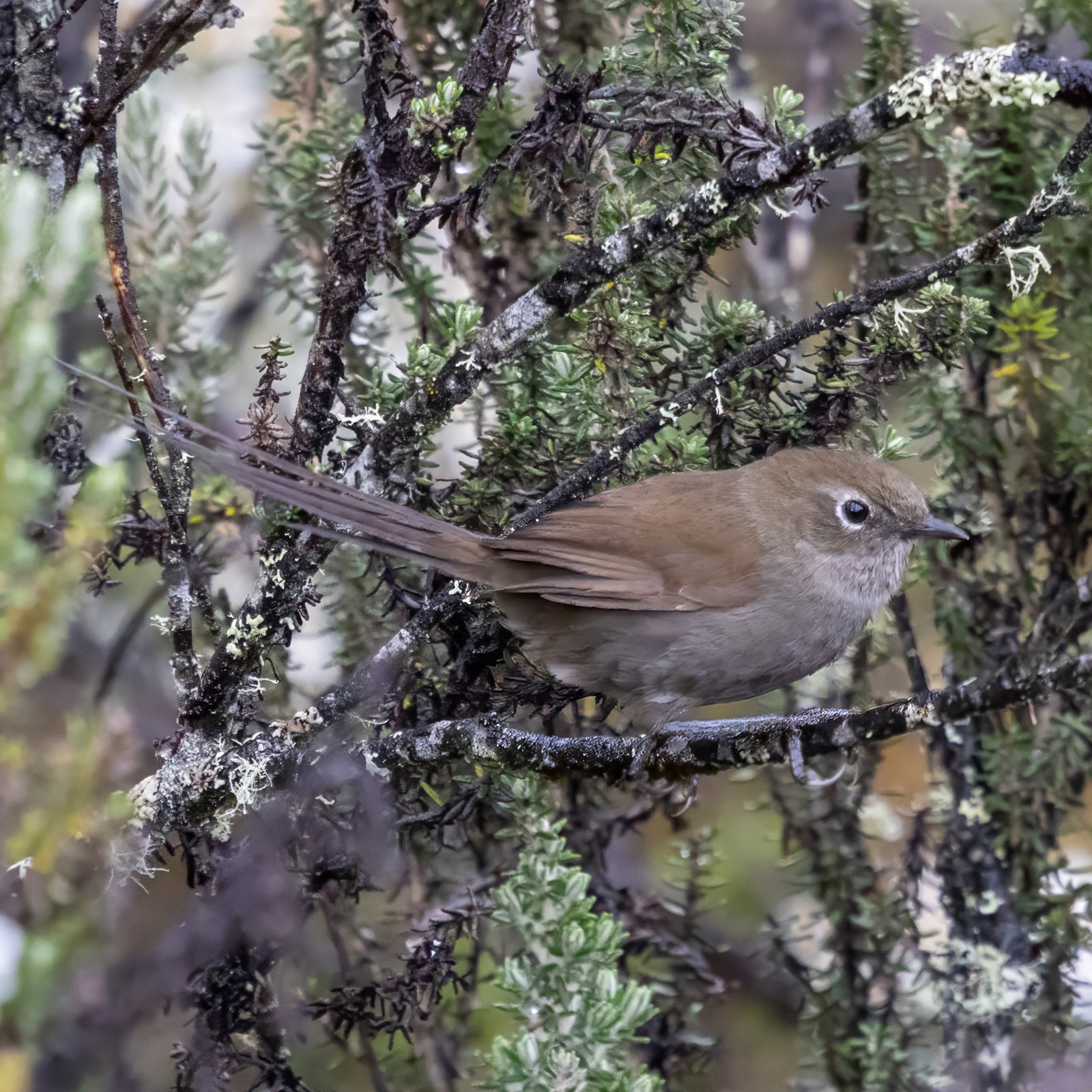
The Mouse-colored Thistletail is a dull, olive-brown thistletail of the páramo and the treeline in southern Ecuador and the far north of Peru. It lacks the warm rufous tones and the obvious chin patch of most relatives. It lives hidden in dense scrub and is mainly found by its song.
Voice
The song is a trill of about two seconds that speeds up and drops slightly, repeated at intervals of some six seconds. One call is a high, descending whistle, like pseeeeuw.
Recording: Charlie Vogt — CC BY-NC-SA 4.0 · xeno-canto
Identification
18–21 cm, with a short, pointed bill and a long, deeply forked tail whose tips look ragged because of the loose barbs. Crown, back, rump, wings and tail are dull olive-brown. The face is grey, with a faint pale grey-brown supercilium and a white eye-ring. The throat is pale grey or greyish brown, often with faint white streaks on the chin; the rest of the underparts are pale greyish brown. The legs are blue-grey. The sexes are alike.
Confusion species
White-chinned Thistletail Asthenes fuliginosa, further north, is warmer rufous-brown, with a dark face and a white chin. White-browed Spinetail Hellmayrea gularis is smaller, with a short tail, a rufous back and a white supercilium. Many-striped Canastero Asthenes flammulata is heavily streaked and lives in open grassland.
Habitat
Páramo, the transition zone between páramo and cloud forest at the treeline, and Polylepis woodland. In Ecuador mostly between 2800 and 4000 m, sometimes from 2500 m; in the Peruvian Andes between 2900 and 3300 m and in the Cordillera del Cóndor at about 2150 m. It searches for insects in dense shrubs. Little is known about the nest.
Where the bird is most at home, classified by the vegetation units of the Andes and the west coast.


Range and movements
Ecuador: on both slopes of the Andes, from Azuay and Morona-Santiago south through Loja and Zamora-Chinchipe. Peru: in the far north, in Piura and Cajamarca, and isolated in the Cordillera del Cóndor in Amazonas. Absent from Colombia, Bolivia and the Galápagos.
- Resident
- dark = core range, pale = thinly spread
How and when to look
Search the páramo and elfin forest of the Cajanuma sector of Podocarpus National Park near Loja; listen for the accelerating trill from dense scrub.
Conservation status
Least Concern. Fires and grazing in the páramo locally degrade the habitat; part of the range lies in protected areas.
Scientific name
Asthenes griseomurina | (Sclater, 1882) (GBIF: Schizoeaca griseomurina)
Sclater described the species in 1882 as Synallaxis griseo-murina; because it was later moved to another genus, the author and year stand in brackets. The genus Asthenes was introduced in 1853 by Reichenbach. The genus name comes from Ancient Greek asthenēs, 'insignificant', 'weak'. The species name comes from Latin griseus, 'grey', and murinus, 'mouse-like', for the mouse-grey plumage. The specimen the first description was based on came from San Lucas, Loja, Ecuador.