All species › Passerines › New World sparrows › Grasshopper Sparrow
Grasshopper Sparrow | Ammodramus savannarum
Sprinkhaangors | Chingolo saltamontes | Tico-tico-gafanhoto
The Grasshopper Sparrow is a small, flat-headed sparrow of open grassland, named for its song, which resembles the buzz of a grasshopper. The species has a large range in North and Central America and the Caribbean. In the guide area only a small, isolated population lives in south-western Colombia, treated as a subspecies of its own.
Voice
The song is a thin, insect-like buzz, introduced by one to four short ticks, roughly tik-tik-tsssssss; the male sings from a grass tussock, small shrub or post. The call is a short, sharp tsik.
Recording: Anne McCormack — CC BY-NC-SA 4.0 · xeno-canto
Identification
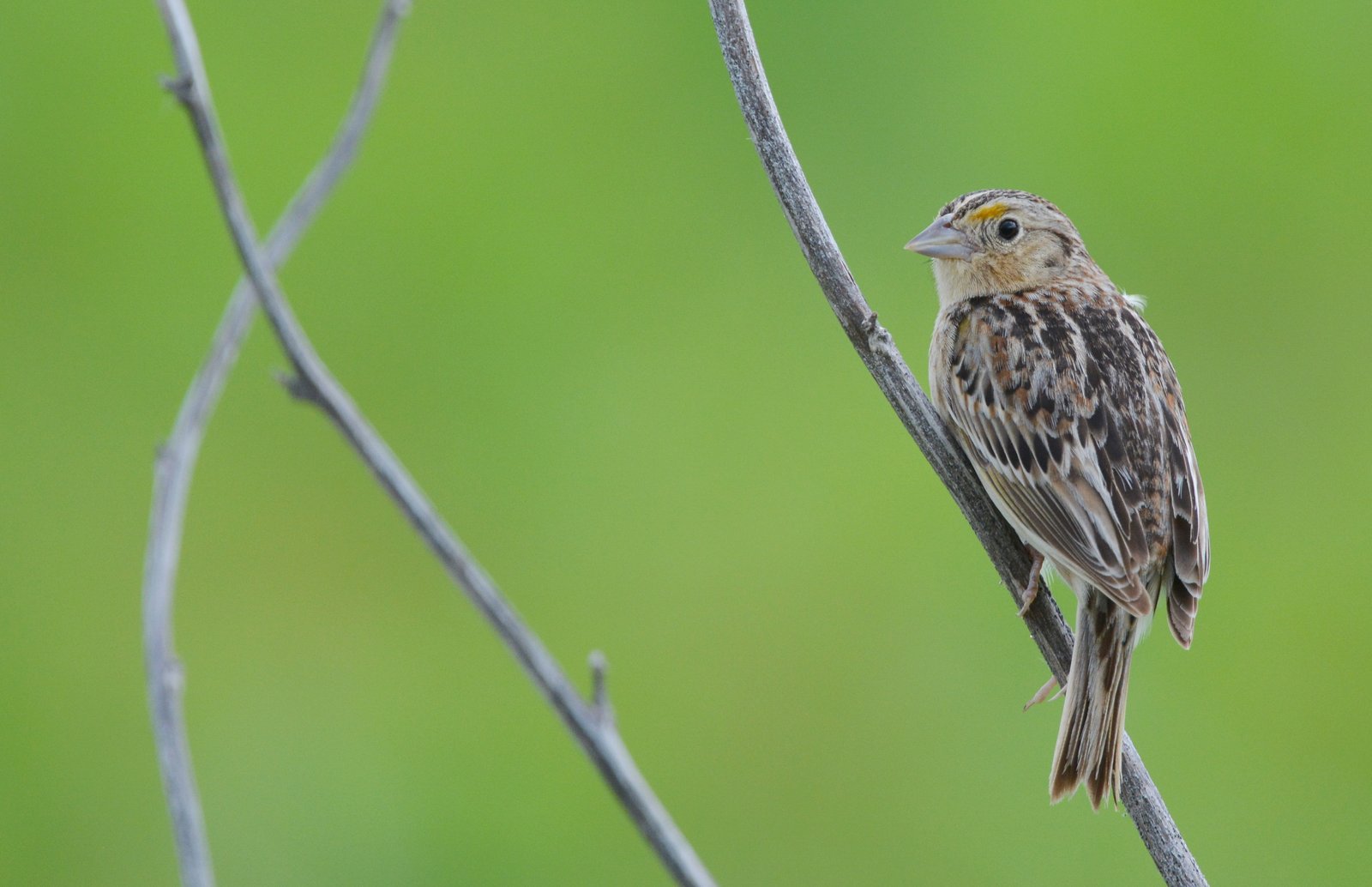
11–12 cm, stocky, with a flat head, a fairly heavy, conical bill and a short, narrow tail. The crown is dark with a pale central stripe; the face is plain buff, with a yellow-orange spot in front of the eye and a pale eye-ring. The upperparts are scaled with rufous, grey and black. The breast and flanks are unstreaked buff, and the belly is whitish. There is a small yellow patch at the bend of the wing. The sexes are alike. Juveniles have a finely streaked breast.
Confusion species
Grassland Sparrow Ammodramus humeralis is greyer, with a streaked crown lacking a clear central stripe, a grey breast and a longer tail, and lives in the lowlands. Yellow-browed Sparrow Ammodramus aurifrons has a plain grey-brown face with a yellow brow and lives east of the Andes. Rufous-collared Sparrow Zonotrichia capensis is larger, with a small crest, a rufous collar and a black patch on the side of the breast. Female Grassland Yellow Finch Sicalis luteola is yellower below and has a streaked back without scaling.
Habitat
Dry, short to medium-tall grassland with some bare ground and few shrubs, also old pastures. It avoids dense scrub and forest. It walks hidden through the grass, feeding on insects, especially grasshoppers, and seeds. The nest is a cup of grass on the ground, often with a canopy of grass.
Where the bird is most at home, classified by the vegetation units of the Andes and the west coast.


Range and movements
In Colombia rare and very local in the upper Cauca Valley and the Patía Valley, and in Nariño up to about 2600 m. Only a few records are known from Ecuador; absent from Peru, Bolivia and the Galápagos. Outside the guide area in North and Central America, the Greater Antilles and on Bonaire and Curaçao; northern birds migrate in winter to the southern United States, Mexico and Central America.
- Resident
- dark = core range, pale = thinly spread
How and when to look
Search dry grassland with scattered tussocks in the early morning, when males sing from a raised perch. The high buzz resembles that of an insect, so watch for a bird sitting on top of a tussock or post.
Conservation status
Least Concern, although the species is declining in North America through the loss of grassland. The small Colombian population is under pressure from the conversion of grassland to sugar cane and other farmland.
Scientific name
Ammodramus savannarum | (Gmelin, 1789)
Gmelin described the species in 1789 as Fringilla savannarum; because it was later moved to another genus, the author and year stand in brackets. The genus Ammodramus was introduced in 1827 by Swainson. The genus name comes from Greek ammos, 'sand', and dromos, 'runner': 'sand-runner'. The species name is Latin for 'of the savannas', after the open grassland the species lives in. The specimen the first description was based on came from Jamaica.