All species › Swifts › Swifts › Great Dusky Swift
Great Dusky Swift | Cypseloides senex
Roetgierzwaluw | Vencejo canoso | Taperuçu-velho
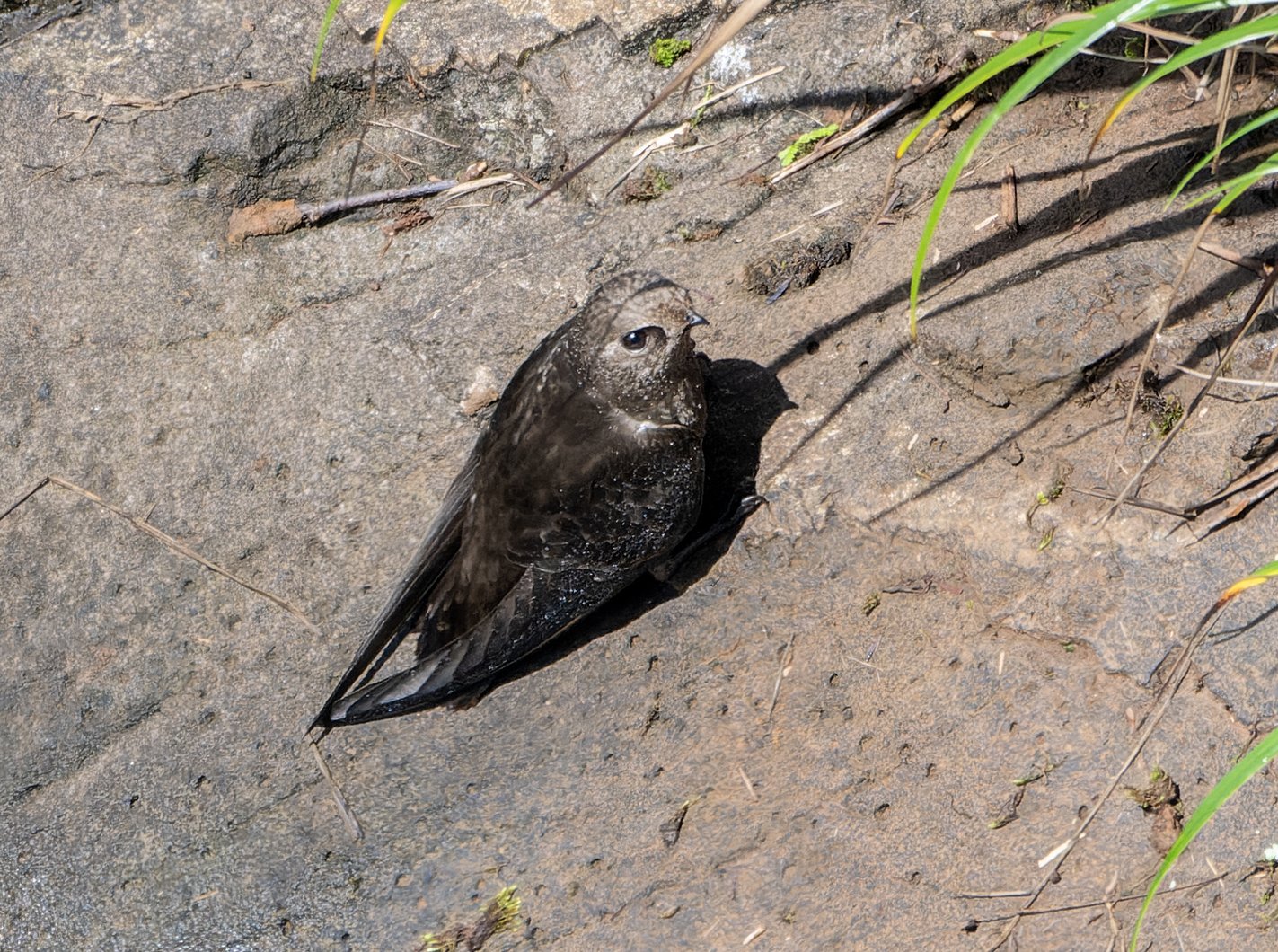
The Great Dusky Swift is a large, dark brown swift with a frosted greyish-white head, which breeds and roosts behind waterfalls in south-eastern South America, as at Iguazú. In the guide area it is only a very rare vagrant in eastern Bolivia. At the falls, large groups fly through the falling water to their roosts.
Voice
Harsh, shrill chattering notes and chirping calls, mainly at roosts at waterfalls.
Recording: Dante Buzzetti — CC BY-NC-SA 4.0 · xeno-canto
Identification
18 cm, large and heavily built, with broad wings and a short, square tail without spines. Uniformly dark sooty brown, the head and throat paler, frosted greyish white, with a pale forehead. From below it looks brown, not black. The sexes are alike.
Confusion species
White-collared Swift Streptoprocne zonaris is larger and blacker, with a complete white collar. Chestnut-collared Swift Streptoprocne rutila is smaller, with a rufous collar in adults. Rothschild's Swift Cypseloides rothschildi is smaller and uniformly darker, without a pale head. White-chinned Swift Cypseloides cryptus is smaller, with a small white chin.
Habitat
In the breeding range at large waterfalls and gorges in forested lowlands and hills; it forages far beyond over forest and open country. It hunts flying insects high up, often in groups. The nest is a cup of moss and plant material on a ledge behind or beside falling water.
Where the bird is most at home, classified by the vegetation units of the Andes and the west coast.


Range and movements
In the guide area only a few records in the lowlands of eastern Bolivia. Not recorded in Colombia, Ecuador, Peru or the Galápagos. Outside the guide area in southern and central Brazil, in Paraguay and in north-eastern Argentina.
How and when to look
A large, brown swift with a pale head in eastern Bolivia merits documentation with photographs. In the breeding range the birds are best seen at the Iguazú falls, where they return in large numbers at dusk.
Conservation status
Least Concern. The species is locally numerous at the large waterfalls; dams that dry out waterfalls may affect breeding colonies.
Scientific name
Cypseloides senex | (Temminck, 1826)
Temminck described the species in 1826 as Cypselus senex; because it was later moved to another genus, the author and year stand in brackets. The genus Cypseloides was introduced in 1848 by Streubel. The genus name combines the genus Cypselus (from Greek kupselos, 'swift') with Greek -oidēs, 'resembling'. The species name comes from Latin senex, 'old man', after the greyish head. The specimen the first description was based on came from Brazil.