All species › Passerines › Tanagers and allies › Great Inca Finch
Great Inca Finch | Incaspiza pulchra
Grote incagors | Incaspiza alirrufo | Tico-tico-inca-grande
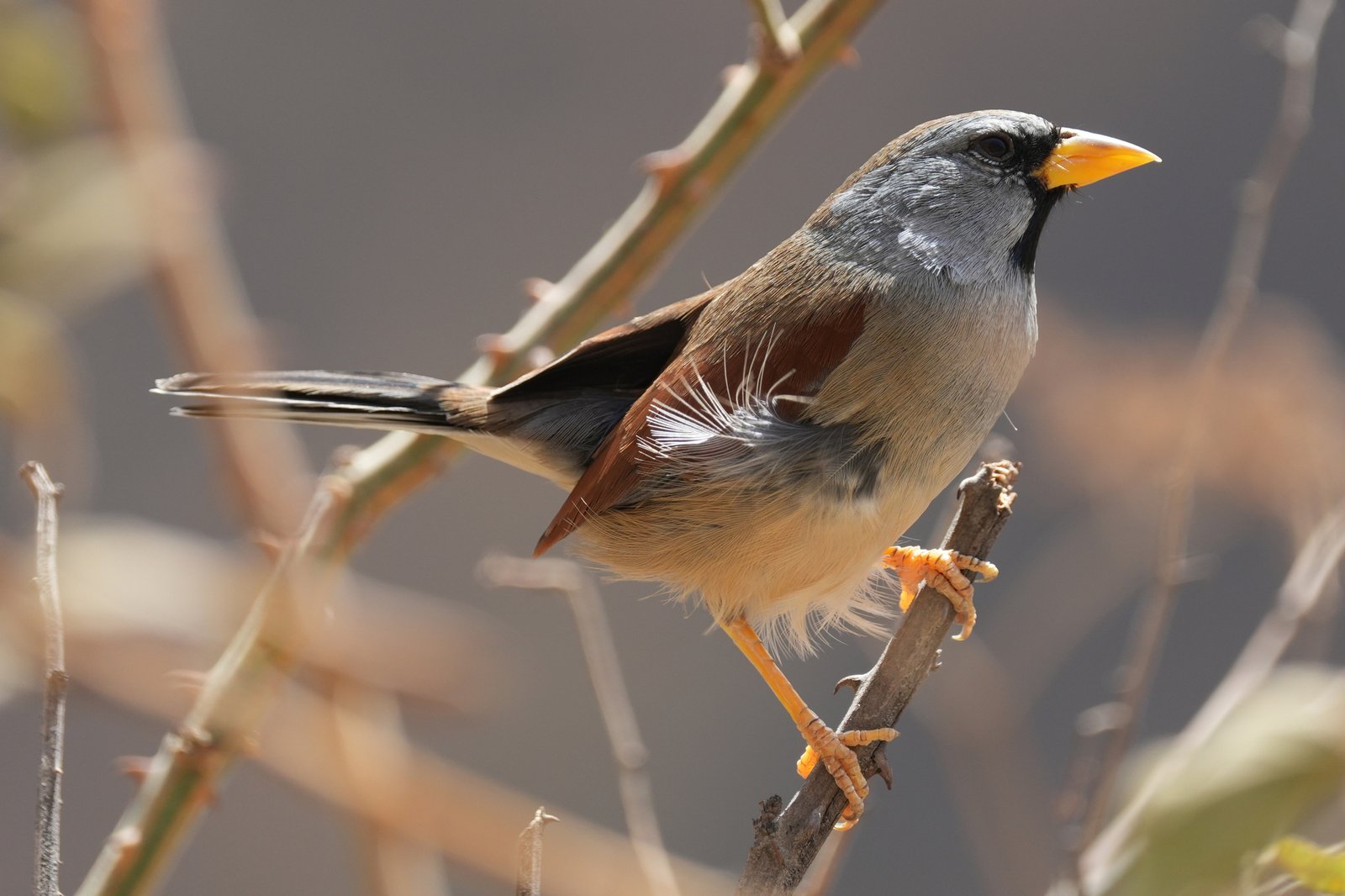
The Great Inca Finch is the largest of the five inca finches, a genus found only in Peru. It lives in dry scrub with cacti on the west slope of the Andes in central Peru. The rufous back and the grey head with a black throat distinguish it from other finches in its range.
Voice
The song is a high, thin series of notes, such as tsee-tsee-tseeu, often from a cactus or shrub. The call is a short, high tsip.
Recording: L Martin Vallejos Bardales — CC BY-NC-SA 4.0 · xeno-canto
Identification
16 cm, with a pointed, orange-yellow bill and yellowish legs. Head, nape and breast are grey, with black around the base of the bill continuing into a black throat. Back and wing coverts are rufous-brown, the belly pale grey to whitish and the tail dark with white outer feathers. The sexes are nearly alike. Young birds are duller and browner, with less black on the throat.
Confusion species
Rufous-backed Inca Finch Incaspiza personata has more black on the face and lives mainly in the upper Marañón and higher in the Andes of the north and centre. Grey-winged Inca Finch Incaspiza ortizi has grey wings and lives in the Marañón valley. Buff-bridled Inca Finch Incaspiza laeta and Little Inca Finch Incaspiza watkinsi are smaller and also live in the Marañón valley; their ranges do not overlap with that of Great Inca Finch.
Habitat
Dry scrub on steep, rocky slopes with columnar cacti, bromeliads and scattered shrubs, also along dry ravines, roughly between 1500 and 2500 m. It forages on the ground and low in shrubs for seeds and insects, often in pairs. Little is known about the nest.
Where the bird is most at home, classified by the vegetation units of the Andes and the west coast.


Range and movements
Endemic to Peru: on the west slope of the Andes, from Ancash to Lima department. Absent from Colombia, Ecuador, Bolivia and the Galápagos.
- Resident
- dark = core range, pale = thinly spread
How and when to look
On dry, rocky slopes with cacti in the valleys of Lima and Ancash, for example in the Santa Eulalia valley, look for a grey finch with a rufous back walking on the ground among stones and shrubs.
Conservation status
Least Concern. The range is small, but the dry scrub on the west slope is largely intact; grazing by goats and expanding fields are local threats.
Scientific name
Incaspiza pulchra | (Sclater, 1886)
Sclater described the species in 1886 as Haemophila pulchra; because it was later moved to another genus, the author and year stand in brackets. The genus Incaspiza was introduced in 1898 by Ridgway. The genus name combines the Incas with Greek spiza, 'finch'. The species name comes from Latin pulcher, 'pretty, handsome'. The specimen the first description was based on came from Matucana, Lima, Peru.