All species › Passerines › Tanagers and allies › White-shouldered Tanager
White-shouldered Tanager | Loriotus luctuosus
Witschoudertangare | Tangara hombriblanca | Tem-tem-de-dragona-branca
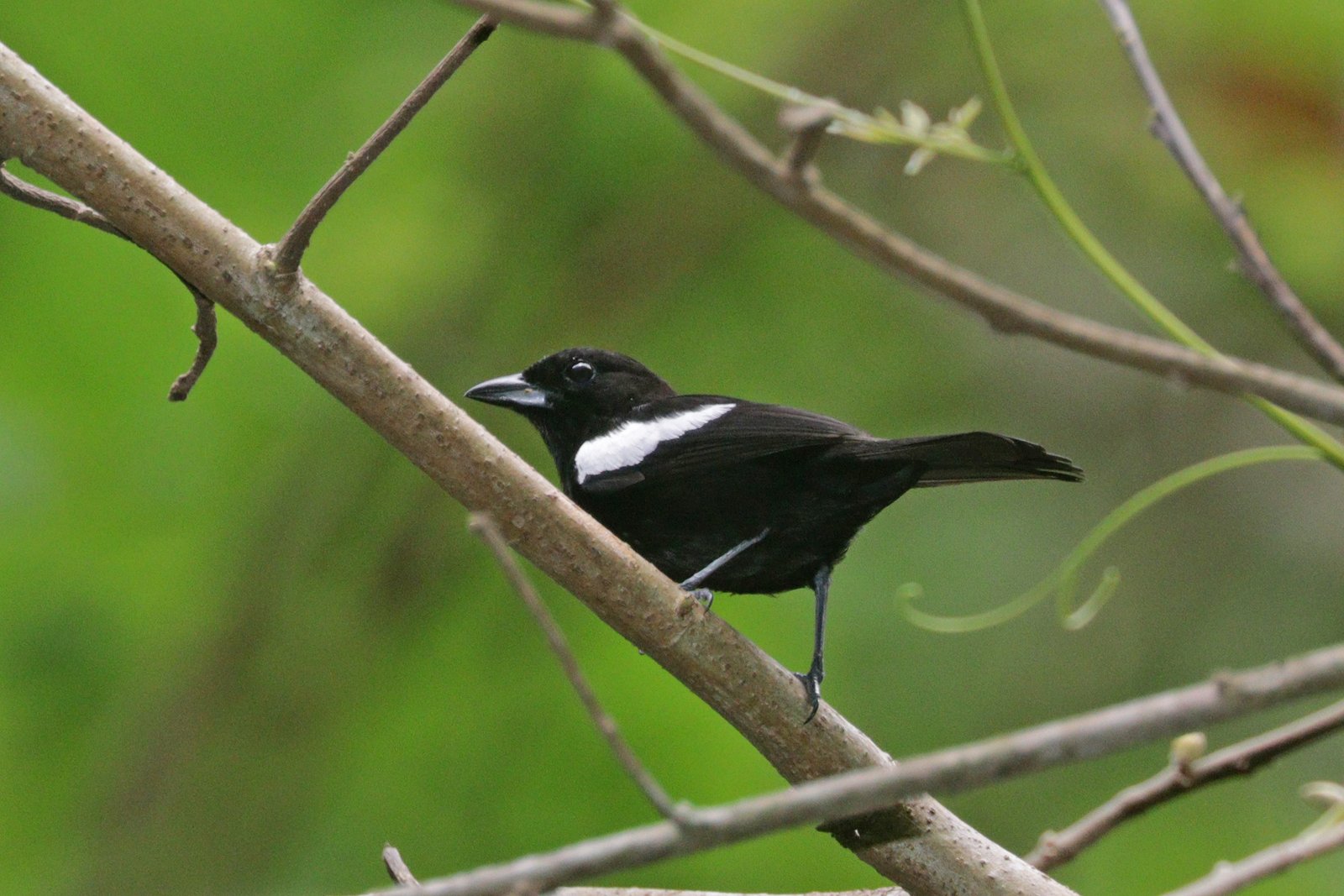
The White-shouldered Tanager is a small, black tanager of lowland forest on both sides of the Andes. The male has a large white shoulder patch; the female is grey, olive-green and yellow. Pairs travel with mixed flocks in the middle levels and the canopy.
Voice
High, sharp chip and tsit calls; the song is a rapid series of high, repeated notes.
Recording: Juan Freile — CC BY-NC-SA 4.0 · xeno-canto
Identification
13–14 cm, with a pointed bill: the upper mandible blackish, the lower mandible bluish grey. The male is glossy black, with a large white patch on the wing coverts and white underwing coverts. The female has a grey head, olive-green upperparts, a pale grey throat and a yellow breast and belly. Juveniles resemble the female.
Confusion species
Male White-lined Tanager Tachyphonus rufus is larger, with a heavier bill and only a narrow white edge at the bend of the wing, and lives in open country and along forest edges. Male Flame-crested Tanager Loriotus cristatus has an orange-red crown and a pale throat patch. Male Scarlet-browed Tanager Heterospingus xanthopygius is larger, with a yellow rump and a red stripe behind the eye. Female Yellow-crested Tanager Loriotus rufiventer is ochre, not yellow, below.
Habitat
Middle levels and canopy of humid lowland and foothill forest, also forest edges, tall secondary forest and várzea, up to roughly 1000 m, locally higher. In mixed flocks it searches leaves for insects and also eats fruit. The nest is an open cup in a tree or shrub.
Where the bird is most at home, classified by the vegetation units of the Andes and the west coast.


Range and movements
In Colombia in the Pacific lowlands, the north, the Magdalena valley and the lowlands east of the Andes. In Ecuador in both the western lowlands and the Amazonian lowlands. In Peru in the Amazonian lowlands and foothills. In Bolivia in the lowlands of the north and centre. Absent from the Galápagos. Outside the guide area from Honduras to Panama, in Venezuela, the Guianas, Trinidad and Amazonian Brazil.
- Resident
- dark = core range, pale = thinly spread
How and when to look
Check mixed flocks along forest edges and in the canopy of lowland forest; the white shoulder patch of the male shows even in the dim light of the forest.
Conservation status
Least Concern. The species is widespread and fairly common, and tolerates secondary forest.
Scientific name
Loriotus luctuosus | (d'Orbigny, ACVMD & de Lafresnaye, 1837)
D'Orbigny, ACVMD & de Lafresnaye described the species in 1837 as T[achyphonus] luctuosus; because it was later moved to another genus, the author and year stand in brackets. The genus Loriotus was introduced in 1821 by Jarocki. The genus name is derived from French loriot, the name for the Old World orioles. The species name comes from Latin luctuosus, 'mournful', after the male's black plumage. The specimen the first description was based on came from Guarayos, Santa Cruz, Bolivia.