All species › Passerines › Tanagers and allies › Yellow-crested Tanager
Yellow-crested Tanager | Loriotus rufiventer
Geelkuiftangare | Tangara crestiamarilla | Tem-tem-de-crista-amarela
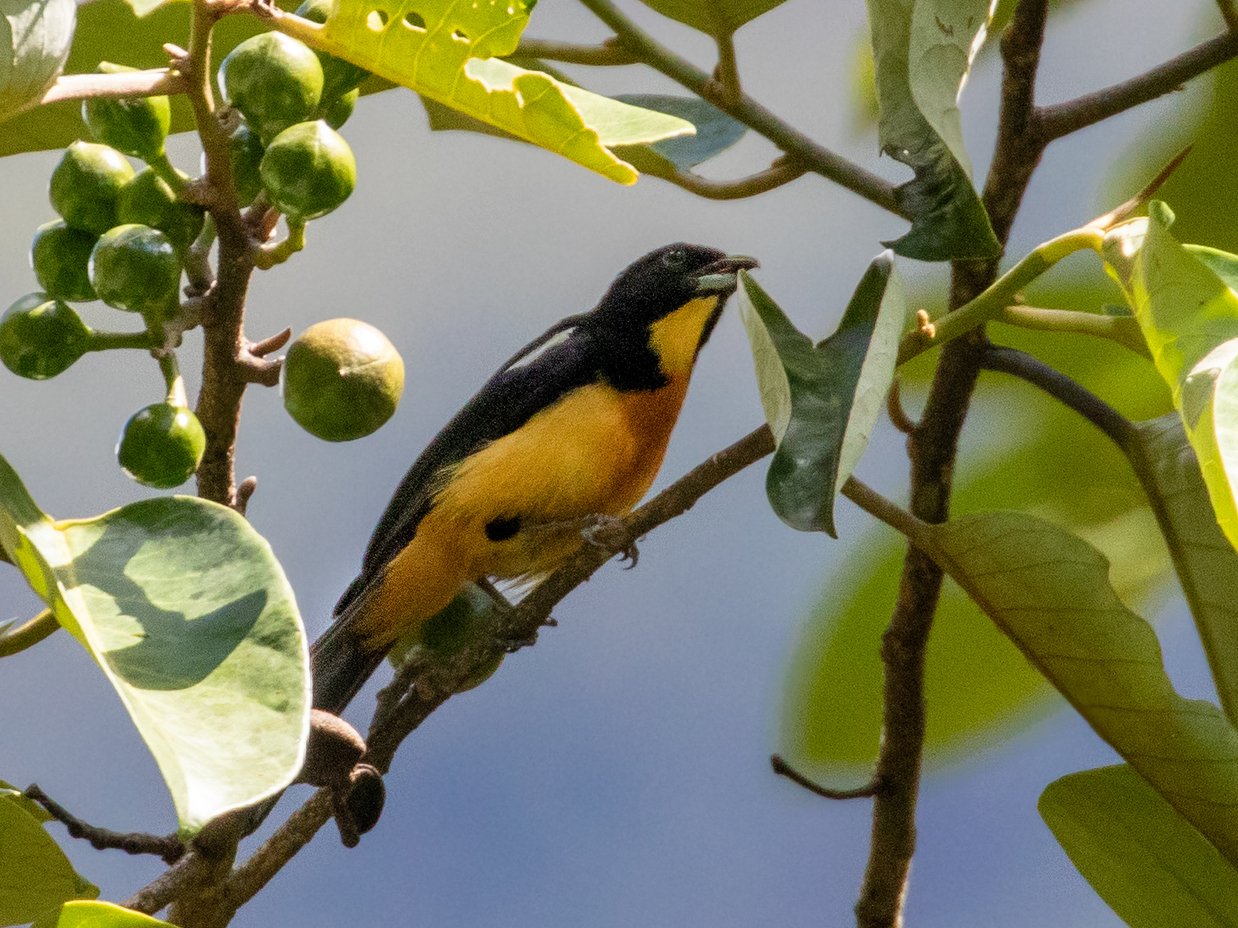
The Yellow-crested Tanager is a small tanager of the foothills and adjacent lowlands on the eastern side of the Andes in Peru and Bolivia. The male is black above and warm ochre-yellow below, with a yellow crown; the female is grey, olive and ochre. It lives in pairs or small groups in mixed flocks in the middle and upper levels of the forest.
Voice
High, thin tsit calls and a rapid chatter; the song is a series of high, thin notes. Poorly described.
Recording: GABRIEL LEITE — CC BY-NC-SA 4.0 · xeno-canto
Identification
15–16 cm, with a pointed bill: the upper mandible blackish, the lower mandible bluish grey. The male has a black head with a buffy yellow to yellow crown that is often partly hidden, a black nape and mantle, an ochre lower back and rump, a black tail and black wings with white scapulars. The throat is dark yellowish buff, bordered by a narrow black band; the centre of the breast is tawny and the rest of the underparts yellowish ochre. The female has a grey head, olive upperparts, a whitish throat and an ochre breast and belly. Juveniles resemble the female.
Confusion species
Male Flame-crested Tanager Loriotus cristatus has an orange-red crown, a pale throat patch and black underparts, and lives lower, in the Amazonian lowlands. Male White-shouldered Tanager Loriotus luctuosus is all black with a large white shoulder patch; the female has yellow, not ochre, underparts. Male Fulvous-crested Tanager Tachyphonus surinamus is black below with chestnut flank feathers.
Habitat
Middle and upper levels of humid forest in the foothills and on the lower slopes, also terra firme forest and várzea in the adjacent lowlands and tall secondary forest, up to about 1250 m in Peru and 1650 m in Bolivia. In mixed flocks it searches leaves and branches for insects and also eats small fruits. Little is known about the nest.
Where the bird is most at home, classified by the vegetation units of the Andes and the west coast.


Range and movements
In Peru on the eastern slope of the Andes and in the adjacent lowlands, from western Loreto south to northern Cusco. In Bolivia in a narrow band along the foot of the Andes to north-western Cochabamba. Absent from Colombia and the Galápagos; not known with certainty from Ecuador. Outside the guide area only in the far west of Brazil (Acre and western Amazonas).
- Resident
- dark = core range, pale = thinly spread
How and when to look
Check mixed flocks along forest edges and roads in the foothills, for example on the lower part of the Manu road or in the hills around Tarapoto, for a tanager with an ochre-yellow belly and a black back.
Conservation status
Least Concern. The range is fairly small, but within it the species is locally fairly common; deforestation in the foothills is the main threat.
Scientific name
Loriotus rufiventer | (Spix, 1825)
Spix described the species in 1825 as Tanagra rufiventer; because it was later moved to another genus, the author and year stand in brackets. The genus Loriotus was introduced in 1821 by Jarocki. The genus name is derived from French loriot, the name for the Old World orioles. The species name comes from Latin rufus, 'red', and venter, 'belly', after the rufous belly. The specimen the first description was based on came from São Paulo de Olivença, Amazonas, Brazil.