All species › Passerines › Tanagers and allies › Flame-crested Tanager
Flame-crested Tanager | Loriotus cristatus
Vuurkuiftangare | Tangara crestifuego | Tiê-galo
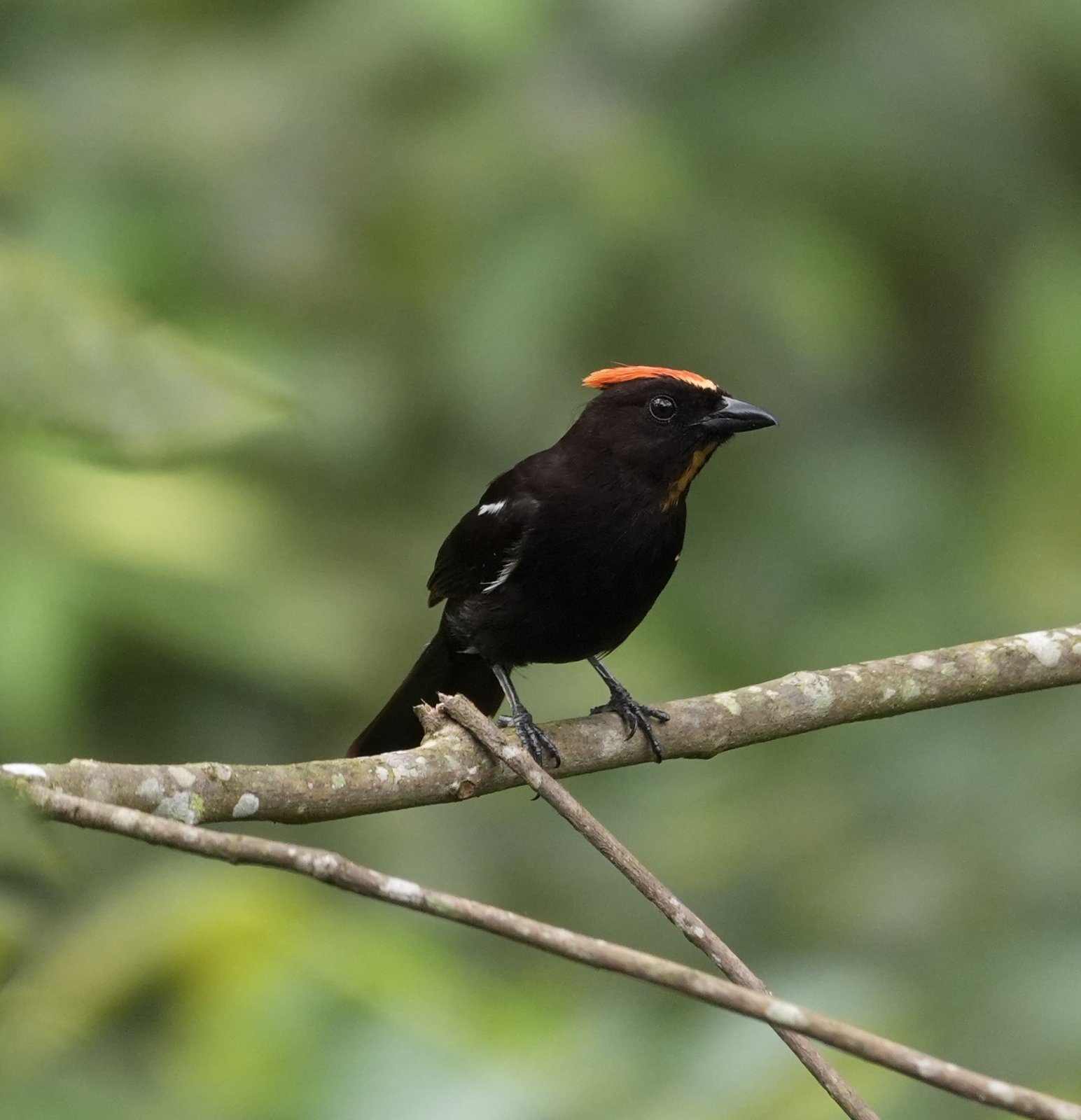
The Flame-crested Tanager is a small, black tanager of the canopy of Amazonian lowland forest. The male has a flat, orange-red crown with a pale border, an ochre-yellow throat patch and an ochre-yellow rump. It travels, often in pairs, with mixed canopy flocks.
Voice
High, thin tsit calls; the song is a simple series of high, thin notes.
Recording: Mateus Gonçalves Santos — CC BY-NC-SA 4.0 · xeno-canto
Identification
15–16 cm, with a pointed, dark bill. The male is mostly black, with a flat, flame-red to orange crown narrowly bordered ochre-yellow at the sides, an ochre-yellow throat patch, an ochre-yellow rump and white underwing coverts that show in flight. The female is brown above with a greyish head and a rufous-brown crown, and ochre-brown below. Juveniles resemble the female.
Confusion species
Male White-shouldered Tanager Loriotus luctuosus has a large white shoulder patch and no coloured crown or throat patch. Yellow-crested Tanager Loriotus rufiventer has a yellow crown and a rufous belly, and lives mainly on the lower Andean slopes of Peru and Bolivia. Male Fulvous-crested Tanager Tachyphonus surinamus has an ochre-yellow crown and ochre-yellow flank patches. Female White-lined Tanager Tachyphonus rufus is uniform rufous-brown.
Habitat
The canopy and middle levels of terra firme forest, also várzea, tall secondary forest and forest edges, up to roughly 900 m. In mixed flocks it searches leaves and branches for insects and also eats small fruits. Little is known about the nest.
Where the bird is most at home, classified by the vegetation units of the Andes and the west coast.


Range and movements
In Colombia in the lowlands east of the Andes. In Ecuador in the Amazonian lowlands. In Peru in the Amazonian lowlands, mainly in the north and east, with an isolated subspecies in the Chinchipe valley. In Bolivia only in the north (Pando, northern Beni). Absent from the Galápagos. Outside the guide area in Venezuela, the Guianas and Amazonian and eastern Brazil.
- Resident
- dark = core range, pale = thinly spread
How and when to look
Check mixed canopy flocks in lowland forest, for example from a canopy tower or along riverbanks, for a black tanager with an orange-red crown and a pale throat patch.
Conservation status
Not Evaluated in its current species limits. The species is widespread and fairly common; no direct threats are known.
Scientific name
Loriotus cristatus | (Linnaeus, 1766)
Linnaeus described the species in 1766 as Tanagra cristata; because it was later moved to another genus, the author and year stand in brackets. The genus Loriotus was introduced in 1821 by Jarocki. The genus name is derived from French loriot, the name for the Old World orioles. The species name comes from Latin cristatus, 'crested', after the male's coloured crest. The specimen the first description was based on came from Cayenne, French Guiana.