All species › Passerines › Tanagers and allies › Long-tailed Reed Finch
Long-tailed Reed Finch | Donacospiza albifrons
Witbrauwgrasgors | Cachilo canela | Tico-tico-do-banhado
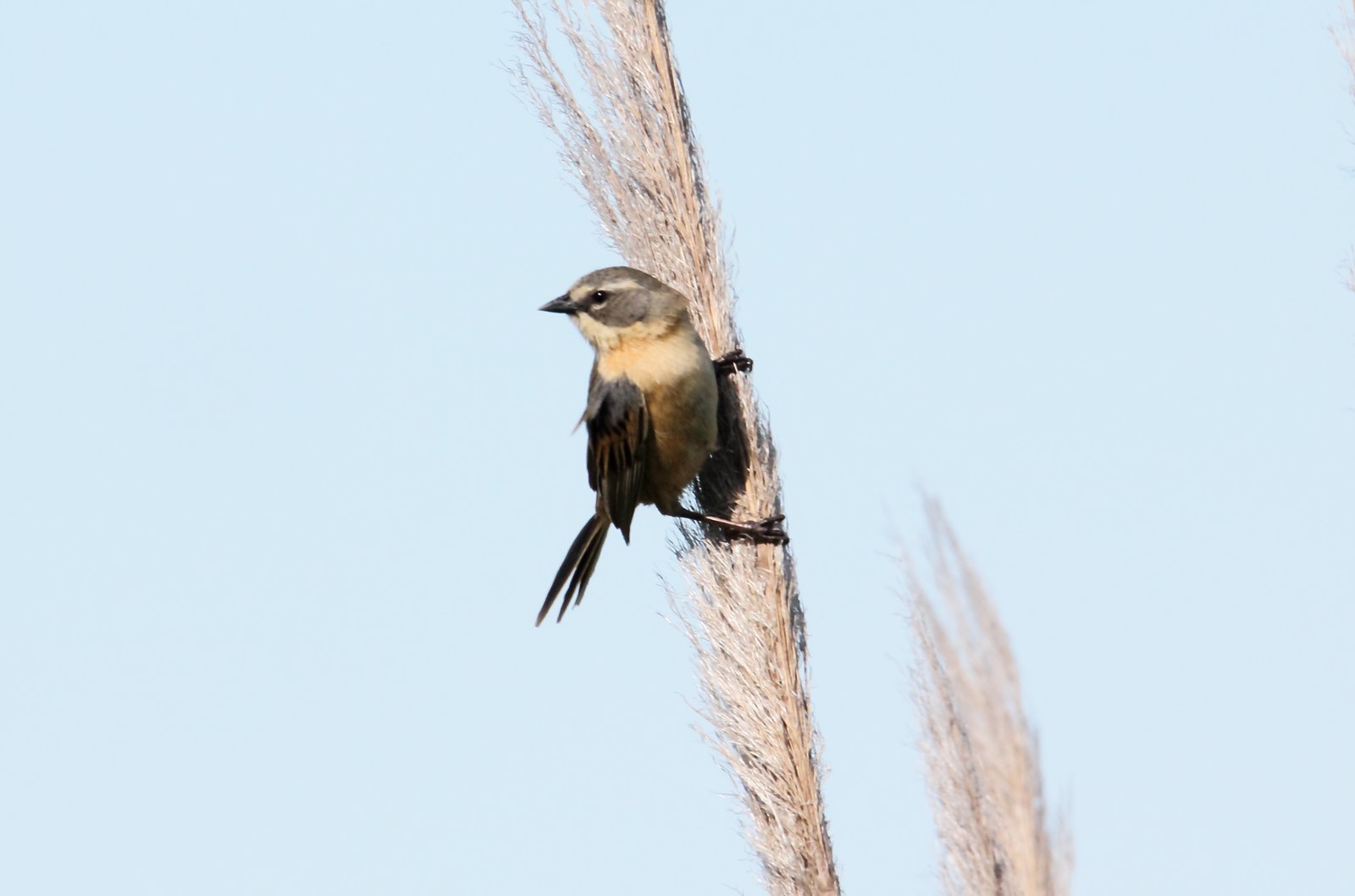
The Long-tailed Reed Finch is a slender, long-tailed finch of marshes and tall grassland in south-eastern South America. It climbs reed and grass stems and often perches on top of a stem. In the guide area it occurs only in eastern Bolivia.
Voice
The song is a short, scratchy series of notes, often from a tall stem. The call is a thin tsip.
Recording: JAYRSON ARAUJO DE OLIVEIRA — CC BY-NC-SA 4.0 · xeno-canto
Identification
15–16 cm, much of it tail; the tail is long and graduated. The bill is pointed, dark above and pale below. The head is grey with a whitish to pale buff supercilium; the back is brown with dark streaks, the shoulders grey. The underparts are cinnamon to buff, paler on the belly. The sexes are similar; the female is slightly duller. Young birds are paler and less clearly marked.
Confusion species
Wedge-tailed Grass Finch Emberizoides herbicola is larger, with whitish underparts, yellow at the bend of the wing and a streaked crown. Pampa Finch Embernagra platensis is much heavier, olive-grey, with an orange bill.
Habitat
Tall grass, reedbeds and sedges at the edges of marshes and lakes, wet grassland with scattered shrubs and damp pastures, in the guide area in the lowlands. It forages among the stems for insects and seeds, mostly in pairs. The nest is a cup low in dense grass or reeds.
Where the bird is most at home, classified by the vegetation units of the Andes and the west coast.


Range and movements
In the guide area only in eastern Bolivia, mainly in the savannas and marshes of Beni and Santa Cruz, where it is local. Absent from Colombia, Ecuador, Peru and the Galápagos. Outside the guide area in southern and south-eastern Brazil, Paraguay, Uruguay and north-eastern Argentina.
- Resident
- dark = core range, pale = thinly spread
How and when to look
In tall, wet grassland and along reed fringes, look for a cinnamon bird with a long tail that comes up to perch on top of a stem, especially in the early morning.
Conservation status
Least Concern. Scarce and local in the guide area; drainage and burning of wet grasslands can make it disappear locally.
Scientific name
Donacospiza albifrons | (Vieillot, 1817)
Vieillot described the species in 1817 as Sylvia albifrons; because it was later moved to another genus, the author and year stand in brackets. The genus Donacospiza was introduced in 1851 by Cabanis. The genus name comes from Greek donax, 'reed', and spiza, 'finch'. The species name comes from Latin albus, 'white', and frons, 'forehead': white-fronted. The specimen the first description was based on came from Paraguay.