All species › Passerines › Tanagers and allies › Masked Mountain Tanager
Masked Mountain Tanager | Tephrophilus wetmorei
Maskerbergtangare | Tangara de Wetmore | Sanhaço-montanhês-mascarado
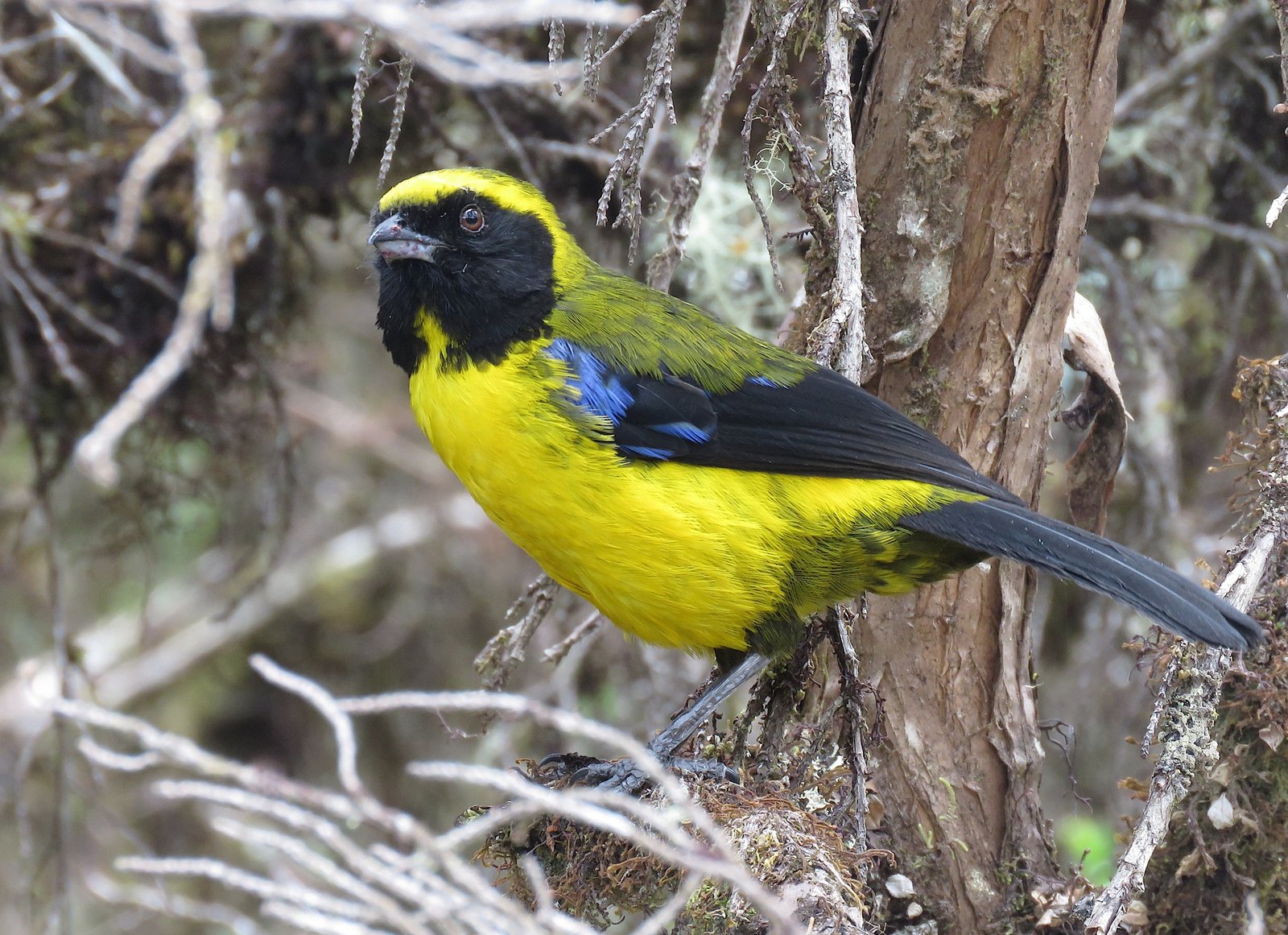
The Masked Mountain Tanager is a rare mountain tanager of the upper tree line in southern Colombia, Ecuador and northern Peru. A black mask is framed by a yellow forehead; the bird lives in pairs or small groups in elfin forest and scrub at the edge of the páramo.
Voice
Poorly documented; gives high, thin calls and short, shrill series.
Recording: John V. Moore — CC BY-NC-SA 4.0 · xeno-canto
Identification
20 cm, with a short, blackish bill. The forehead and a band around the face are bright yellow, enclosing a black mask over the lores, cheek and ear coverts. The crown and nape are yellowish olive, the back olive-green, the rump yellow. The underparts are mustard yellow, with olive streaks on the breast and flanks. The wings and tail are blackish, with two blue wing bars. The female is slightly duller. Juveniles are duller and more olive.
Confusion species
Hooded Mountain Tanager Buthraupis montana is larger, with an all-black hood, a blue back and red eyes. Black-chested Mountain Tanager Cnemathraupis eximia has a blue crown and a black throat and chest, without a yellow forehead. Lacrimose Mountain Tanager Anisognathus lacrymosus is smaller, with a dark slate back and yellow spots below the eye and on the side of the neck.
Habitat
Elfin forest, mossy scrub and dwarf forest at the upper tree line, often at the transition to páramo, also with bamboo, from about 2900 to 3650 m. It forages low to mid-height for fruit and insects, in pairs, small groups or with mixed flocks. Little is known about the nest.
Where the bird is most at home, classified by the vegetation units of the Andes and the west coast.


Range and movements
In Colombia locally in the Central Andes and in Nariño in the south. In Ecuador very locally at the tree line, mainly in the north (Carchi) and the south (Loja). In Peru only in the far north. Not in Bolivia or on the Galápagos. Not known outside the guide area.
- Resident
- dark = core range, pale = thinly spread
How and when to look
Search elfin forest at the tree line, for example around Cajanuma in Podocarpus National Park in Ecuador; the species occurs at low density and sometimes joins mixed flocks with other mountain tanagers and brushfinches.
Conservation status
Vulnerable. The small, fragmented population depends on a narrow belt of forest at the tree line, which is being lost to fires, grazing and conversion to pasture.
Scientific name
Tephrophilus wetmorei | Moore, 1934
Moore described the species in 1934 and placed it straight away in the genus where it still stands. He introduced the genus Tephrophilus in that same work. The genus name combines Greek tephra, 'ashes' (of a volcano), with philos, 'loving'. The species name honours the American ornithologist Alexander Wetmore (1886–1978), long associated with the Smithsonian Institution. The specimen the first description was based on came from Culebrillas Valley near Sangay, Ecuador.