All species › Passerines › Ovenbirds and woodcreepers › Great Rufous Woodcreeper
Great Rufous Woodcreeper | Xiphocolaptes major
Grote muisspecht | Trepatroncos colorado | Arapaçu-do-campo
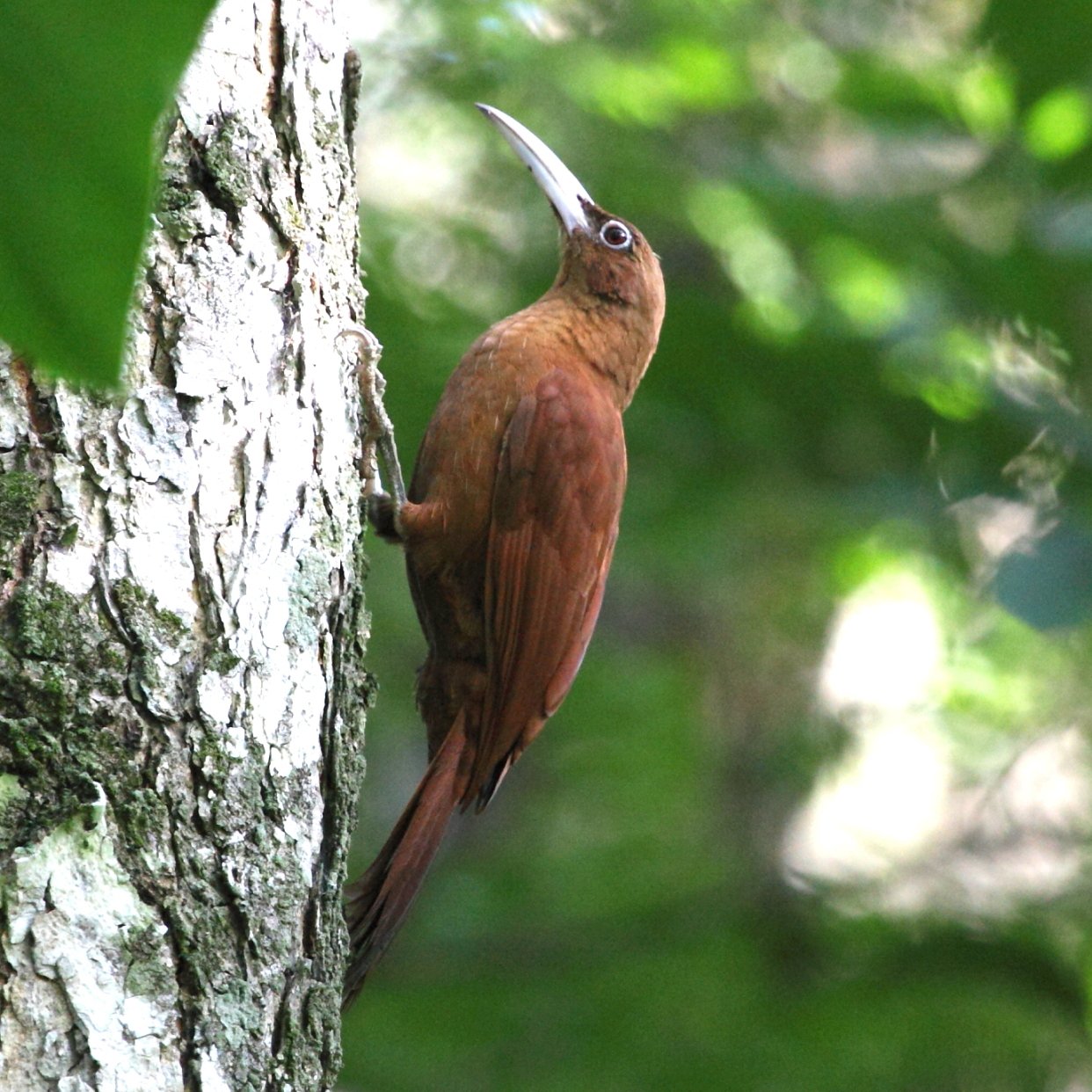
The Great Rufous Woodcreeper is a very large, mainly rufous woodcreeper of dry forest in central South America. With its long, heavy, pale bill it probes bark and dead wood for large insects. In the guide area it occurs only in Bolivia.
Voice
The song is a slightly descending series of five to eight loud, ringing double whistles, mainly around dawn and at dusk. The call is an emphatic, two-part note.
Recording: Niels Krabbe — CC BY-NC-SA 4.0 · xeno-canto
Identification
28–32 cm, large, with a long, heavy, slightly decurved, horn-coloured bill. The plumage is largely warm rufous to cinnamon; the crown is slightly darker, with fine pale streaks. The lores are blackish. The throat is paler buff. The breast shows narrow pale streaks and the belly often fine dark barring. The wings and tail are chestnut, the primaries with dark tips. The sexes are alike; juveniles are brighter and more heavily streaked on the breast.
Confusion species
Black-banded Woodcreeper Dendrocolaptes picumnus is smaller and browner, with a dark, straight bill, a streaked breast and a clearly barred belly. Scimitar-billed Woodcreeper Drymornis bridgesii has a long, strongly decurved bill and white stripes on the face. Strong-billed Woodcreeper Xiphocolaptes promeropirhynchus is more olive-brown and more heavily streaked and lives in humid montane forest. Narrow-billed Woodcreeper Lepidocolaptes angustirostris is much smaller, with a white supercilium and pale underparts.
Habitat
Dry and semi-deciduous forest, Chaco woodland and Chiquitano dry forest, gallery forest, woodlots in savanna and cerrado, mainly in the forest interior; mostly below 1500 m, occasionally up to about 1800 m. It searches trunks, thick branches and also the ground for large insects, larvae and small vertebrates. The nest is in a tree cavity.
Where the bird is most at home, classified by the vegetation units of the Andes and the west coast.


Range and movements
Bolivia: in the lowlands and foothills of the centre, east and south, including Santa Cruz, Chuquisaca and Tarija. Absent from Colombia, Ecuador, Peru and the Galápagos. Outside the guide area in south-western Brazil, Paraguay and northern Argentina.
- Resident
- dark = core range, pale = thinly spread
How and when to look
In the dry forest and Chaco of eastern and southern Bolivia, listen in the early morning for the loud series of whistles. The bird often climbs low on trunks or forages on the ground among leaves and dead wood.
Conservation status
Least Concern. Clearance for agriculture and cattle ranching in the Chaco and the Chiquitano region locally reduces its habitat.
Scientific name
Xiphocolaptes major | (Vieillot, 1818)
Vieillot described the species in 1818 as Dendrocopus major; because it was later moved to another genus, the author and year stand in brackets. The genus Xiphocolaptes was introduced in 1840 by Lesson. The genus name comes from Greek xiphos, 'sword', and kolaptēs, 'chiseller' (woodpecker), referring to the strong bill. The species name comes from Latin major, 'greater'. The specimen the first description was based on came from Paraguay.