All species › Passerines › Ovenbirds and woodcreepers › Scimitar-billed Woodcreeper
Scimitar-billed Woodcreeper | Drymornis bridgesii
Sabelmuisspecht | Trepatroncos chinchero | Arapaçu-platino
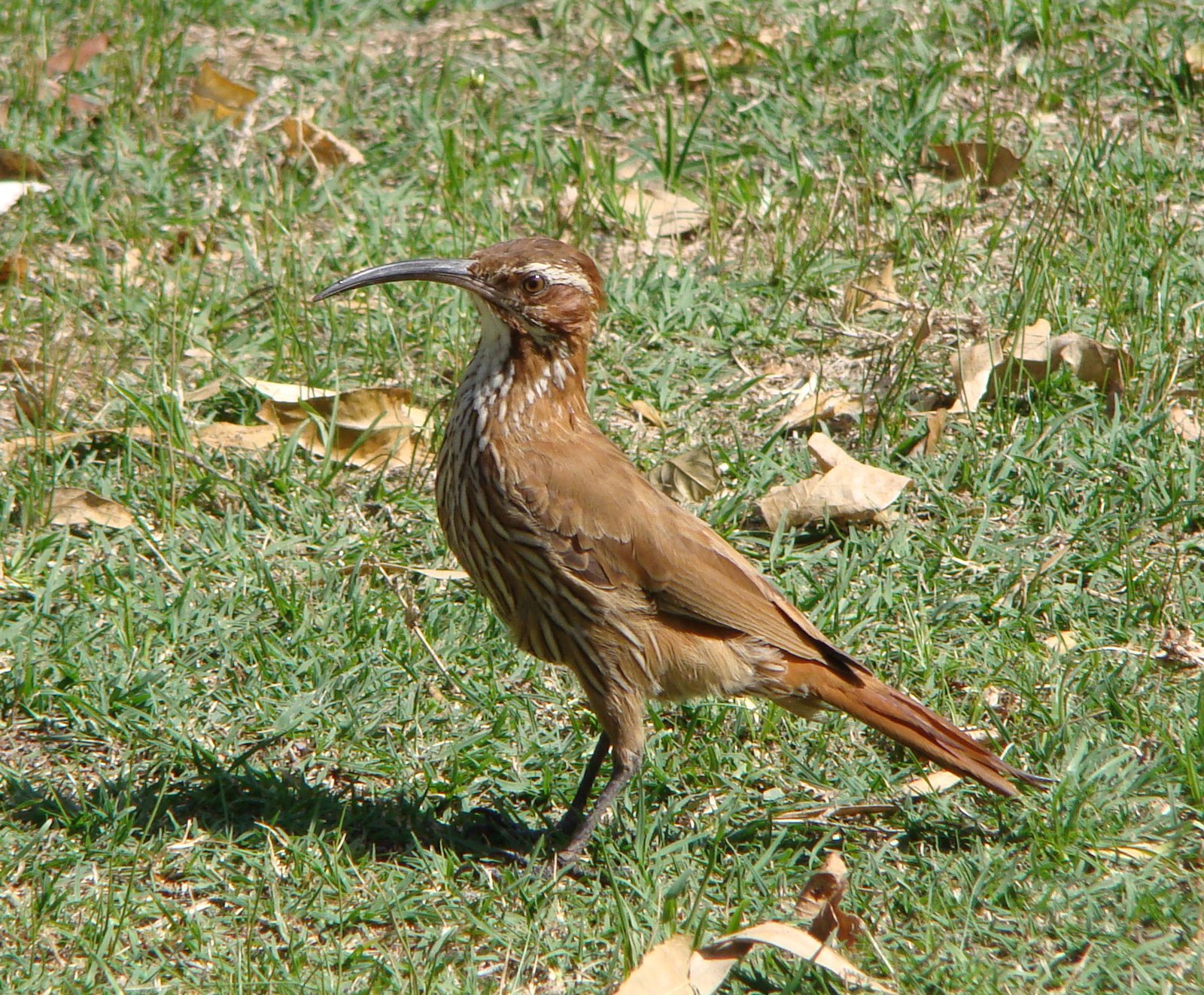
The Scimitar-billed Woodcreeper is a large woodcreeper of the Chaco with a very long, strongly decurved bill. Unlike most woodcreepers it finds much of its food on the ground, where it walks with long strides. It is the only species in its genus and in the guide area is restricted to the far south-east of Bolivia.
Voice
The song is a loud, descending series of whistles that slows towards the end; also a series of nearly level whistles. Pairs sometimes sing in duet. Calls are short, sharp notes.
Recording: Guillermo Treboux — CC BY-NC-SA 4.0 · xeno-canto
Identification
29–32 cm, large, with a relatively short, rufous tail and a long, scimitar-shaped, dark bill. The upperparts are warm rufous-brown, the crown darker brown. The face shows a white supercilium and a white malar stripe, separated by a dark eyestripe. The throat is white, and the underparts are dull white with brown streaking and scaling on the breast and flanks. The sexes are alike.
Confusion species
Narrow-billed Woodcreeper Lepidocolaptes angustirostris shares the white supercilium and the same dry woodland, but is much smaller, with a shorter, thinner, pale bill. Great Rufous Woodcreeper Xiphocolaptes major is also large and rufous, but has a heavy, less decurved bill and no clear facial pattern. Red-billed Scythebill Campylorhamphus trochilirostris also has a strongly decurved bill, but is smaller, more rufous, lacks the white supercilium and stays in the trees.
Habitat
Dry Chaco woodland, thorn scrub, open woodland with cacti and savanna with scattered trees, also abandoned pasture and woodland fragments in farmland, mainly below 500 m. It searches the ground, trunks and cacti for arthropods, snails and small vertebrates such as lizards and frogs. The nest is in a cavity in a tree or palm.
Where the bird is most at home, classified by the vegetation units of the Andes and the west coast.


Range and movements
Bolivia: only in the Chaco of the far south-east. Absent from Colombia, Ecuador, Peru and the Galápagos. Outside the guide area in western Paraguay, northern and central Argentina, Uruguay and southern Brazil.
- Resident
- dark = core range, pale = thinly spread
How and when to look
In open Chaco woodland in south-eastern Bolivia, look for a large rufous bird walking on the ground and probing soil and leaf litter with its long bill. In the early morning the descending series of whistles reveals its presence.
Conservation status
Least Concern. The population is thought to be stable, but the species is sensitive to fragmentation of dry woodland.
Scientific name
Drymornis bridgesii | (Eyton, 1849)
Eyton described the species in 1849 as Nasica bridgesii; because it was later moved to another genus, the author and year stand in brackets. The genus Drymornis was introduced in 1853 by Eyton. The genus name comes from Ancient Greek drumos, 'woodland', and ornis, 'bird'. The species name honours Thomas Charles Bridges (1807–1865), English botanist, zoologist and collector, active in tropical America from 1822 to 1865. The specimen the first description was based on came from Probably Mendoza, Argentina.