All species › Passerines › Ovenbirds and woodcreepers › Slender-billed Xenops
Slender-billed Xenops | Xenops tenuirostris
Streepstaartxenops | Picolezna picofino | Bico-virado-fino
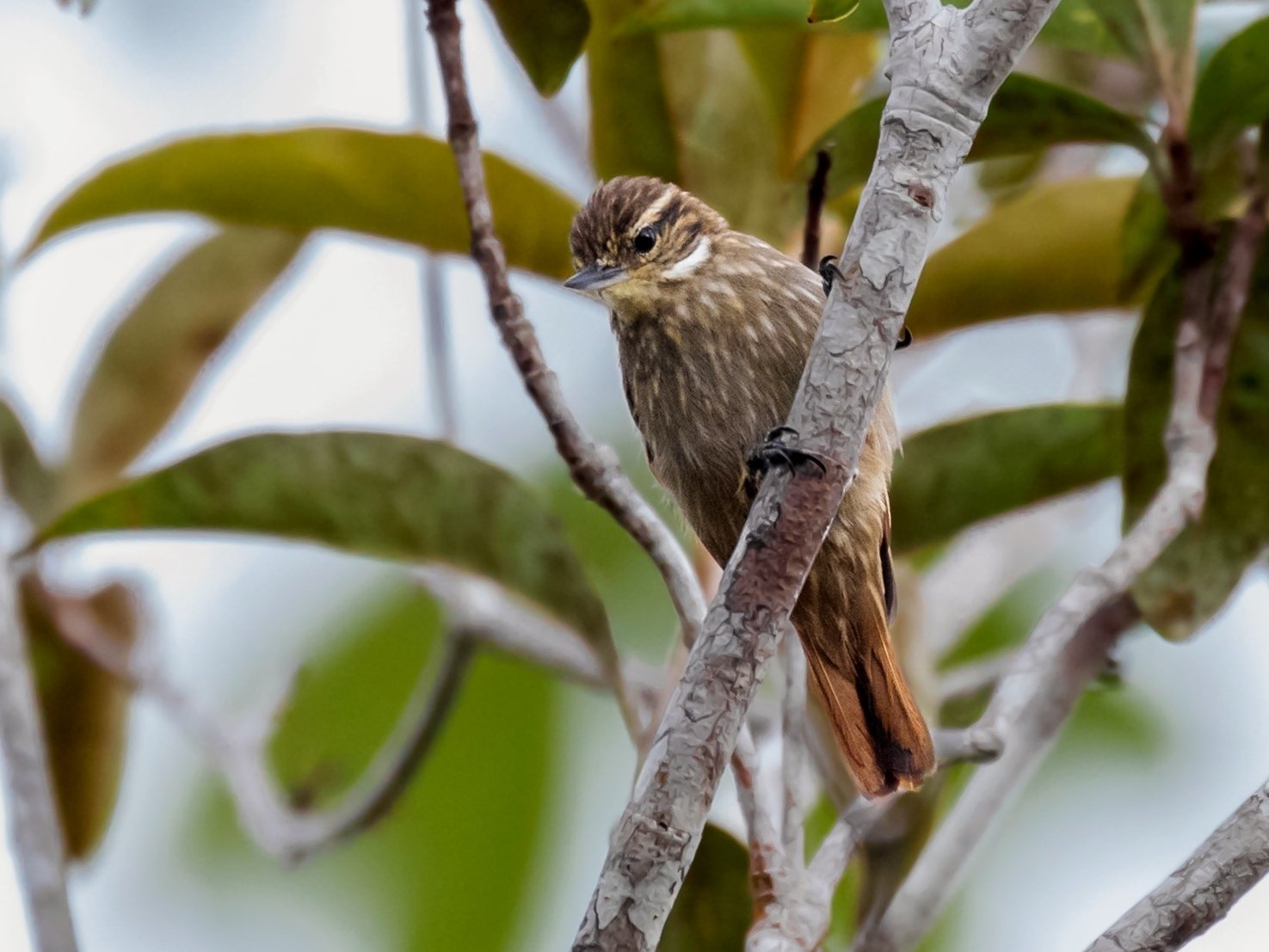
The Slender-billed Xenops is a small, streaked xenops of the Amazonian forest canopy. Like other xenops it forages hanging and twisting along thin branches and vines in search of insects. It differs from Streaked Xenops mainly in its thinner, less upturned bill and more black in the tail.
Voice
The song is a short series of four to seven high, thin, sharp notes, tsee-tsee-tsee-tsee. The call is a single high tseet.
Recording: Jaime Suárez — CC BY-NC-SA 4.0 · xeno-canto
Identification
11–12 cm, small, with a thin, nearly straight bill with only a slightly upturned lower mandible. The upperparts are brown with pale streaks on the crown and mantle; the rump and tail are rufous, the tail with much black on the inner feathers. A buff supercilium and a white stripe below the eye and across the cheek. The underparts are olive-brown with dense pale streaks. In flight a cinnamon band shows across the wing. The sexes are alike.
Confusion species
Streaked Xenops Xenops rutilans has a shorter, clearly upturned bill, less black in the tail and lives mainly in montane forest. Amazonian Plain Xenops Xenops genibarbis has unstreaked upperparts and almost unstreaked underparts. Rufous-tailed Xenops Microxenops milleri has a straight bill, no white cheek stripe and an all-rufous tail without black.
Habitat
The canopy and midstorey of humid lowland forest on terra firme and in várzea, also forest edges and mature secondary forest, mostly below 1000 m. It searches thin branches, vines and dead twigs for insects and larvae, often hanging from the underside, and joins mixed flocks. The nest is in a cavity in dead wood.
Where the bird is most at home, classified by the vegetation units of the Andes and the west coast.


Range and movements
Colombia: scattered and local in the Amazonian lowlands in the south-east. Ecuador: local in the eastern lowlands. Peru: scattered in the Amazonian lowlands. Bolivia: in the lowlands of the north. Absent from the Galápagos. Outside the guide area in Venezuela, the Guianas and Brazilian Amazonia.
- Resident
- dark = core range, pale = thinly spread
How and when to look
Check mixed flocks in the canopy, for example from a canopy tower, for a small bird clambering along thin branches. The series of high notes helps to locate it.
Conservation status
Least Concern. The species has a large range, but is scarce and local throughout; it depends on tall forest.
Scientific name
Xenops tenuirostris | Pelzeln, 1859
Pelzeln described the species in 1859 and placed it straight away in the genus where it still stands. The genus Xenops was introduced in 1811 by Illiger. The genus name comes from Greek xenos, 'strange, unusual', and ōps, 'face'. The original description stresses the bill, with a straight upper edge and an upturned lower edge. The species name comes from Latin tenuis, 'thin', and rostrum, 'bill'. The specimen the first description was based on came from Salto do Girão, Rio Madeira, Brazil.