All species › Jacamars and puffbirds › Jacamars › Green-tailed Jacamar
Green-tailed Jacamar | Galbula galbula
Groenstaartglansvogel | Jacamará coliverde | Ariramba-de-cauda-verde
The Green-tailed Jacamar is the jacamar of north-eastern South America, from the Guianas to the Orinoco and Amazon drainages. The guide area only touches the western edge of its range, in the far east of Colombia. It is closely related to the Rufous-tailed Jacamar and looks very similar.
Voice
A high, sharp pee, and a series of plaintive, high notes that speeds up and ends in a trill, similar to that of Rufous-tailed Jacamar.
Recording: JAYRSON ARAUJO DE OLIVEIRA — CC BY-NC-SA 4.0 · xeno-canto
Identification
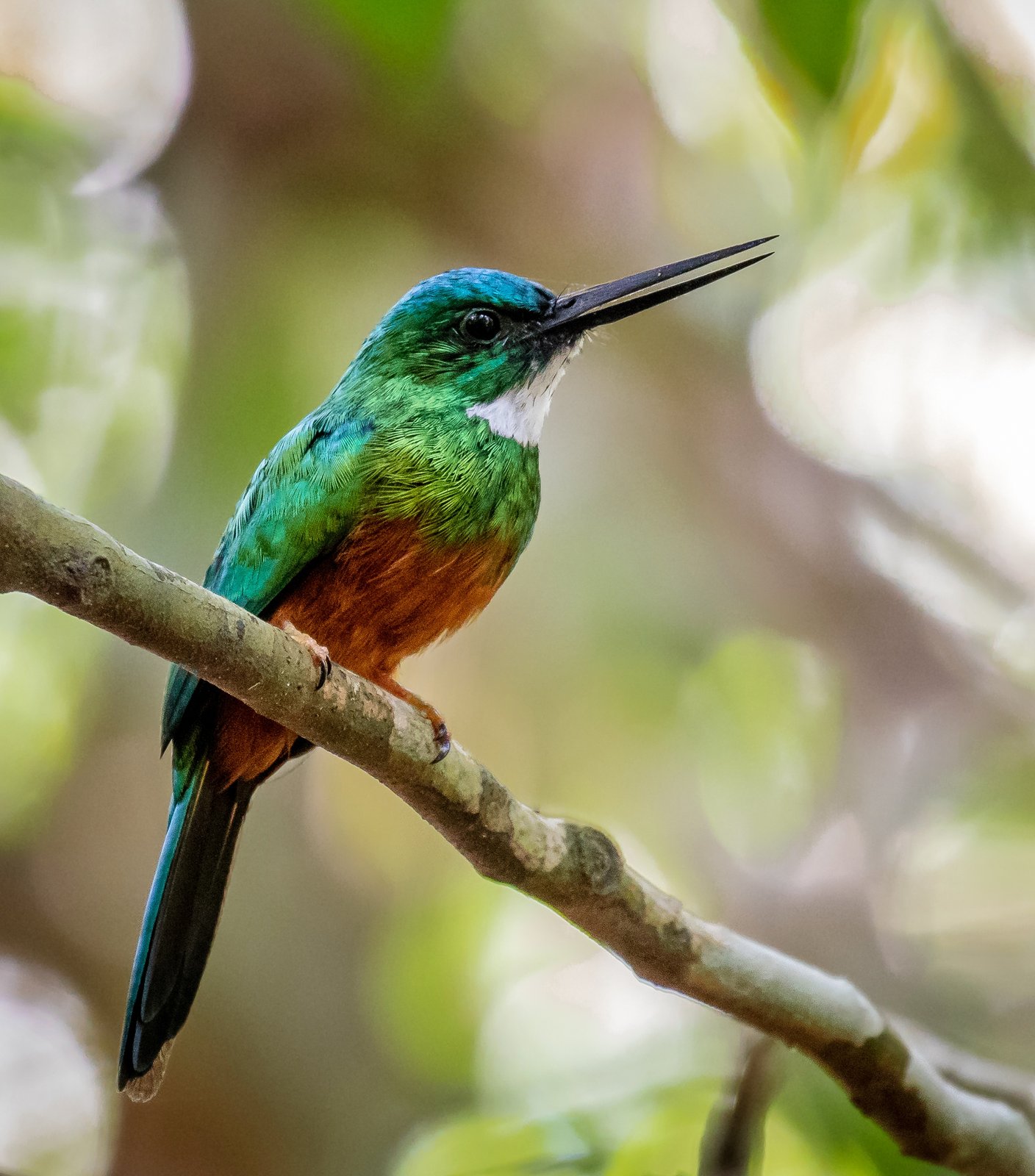
19–21 cm, with a long, thin, black bill. The upperparts and breast band are glossy green, the crown with a bluish gloss. The male has a white throat, the female a paler, buff throat. The belly is dark rufous. The tail is green to blue-green and dark from below too, without rufous. Juveniles are duller.
Confusion species
Rufous-tailed Jacamar Galbula ruficauda has rufous outer tail feathers, so the tail looks rusty from below. Bronzy Jacamar Galbula leucogastra is smaller and darker bronze, with a white belly. Yellow-billed Jacamar Galbula albirostris has a yellow bill and lives inside the forest.
Habitat
Edges of humid forest, gallery forest, várzea forest and white-sand forest along blackwater rivers, also secondary woodland, in the lowlands up to about 500 m. It perches on a shaded branch at the forest edge or over water and sallies for butterflies, dragonflies and other flying insects. It nests in a tunnel in a bank or a termite nest.
Where the bird is most at home, classified by the vegetation units of the Andes and the west coast.


Range and movements
In Colombia only in the far east, in the Orinoco and Río Negro drainages (Vichada, Guainía and Vaupés). Absent from Ecuador, Peru, Bolivia and the Galápagos. Most of the range lies outside the guide area: Venezuela, the Guianas and Brazil along the Amazon and its northern tributaries.
- Resident
- dark = core range, pale = thinly spread
How and when to look
Along the edges of gallery forest and blackwater rivers in eastern Colombia, for example around Puerto Inírida. The bird often perches on a low branch over the water.
Conservation status
Least Concern. The species has a large range and is fairly common in suitable habitat.
Scientific name
Galbula galbula | (Linnaeus, 1766)
Linnaeus described the species in 1766 as Alcedo Galbula; because it was later moved to another genus, the author and year stand in brackets. The genus Galbula was introduced in 1760 by Brisson. The genus name comes from Latin galbula, the name for a small yellow bird. The species name repeats the genus name, Latin galbula, 'small yellow bird'. The specimen the first description was based on came from Cayenne, French Guiana.