All species › Jacamars and puffbirds › Jacamars › Rufous-tailed Jacamar
Rufous-tailed Jacamar | Galbula ruficauda
Roodstaartglansvogel | Jacamar colirrufo | Ariramba-de-cauda-ruiva
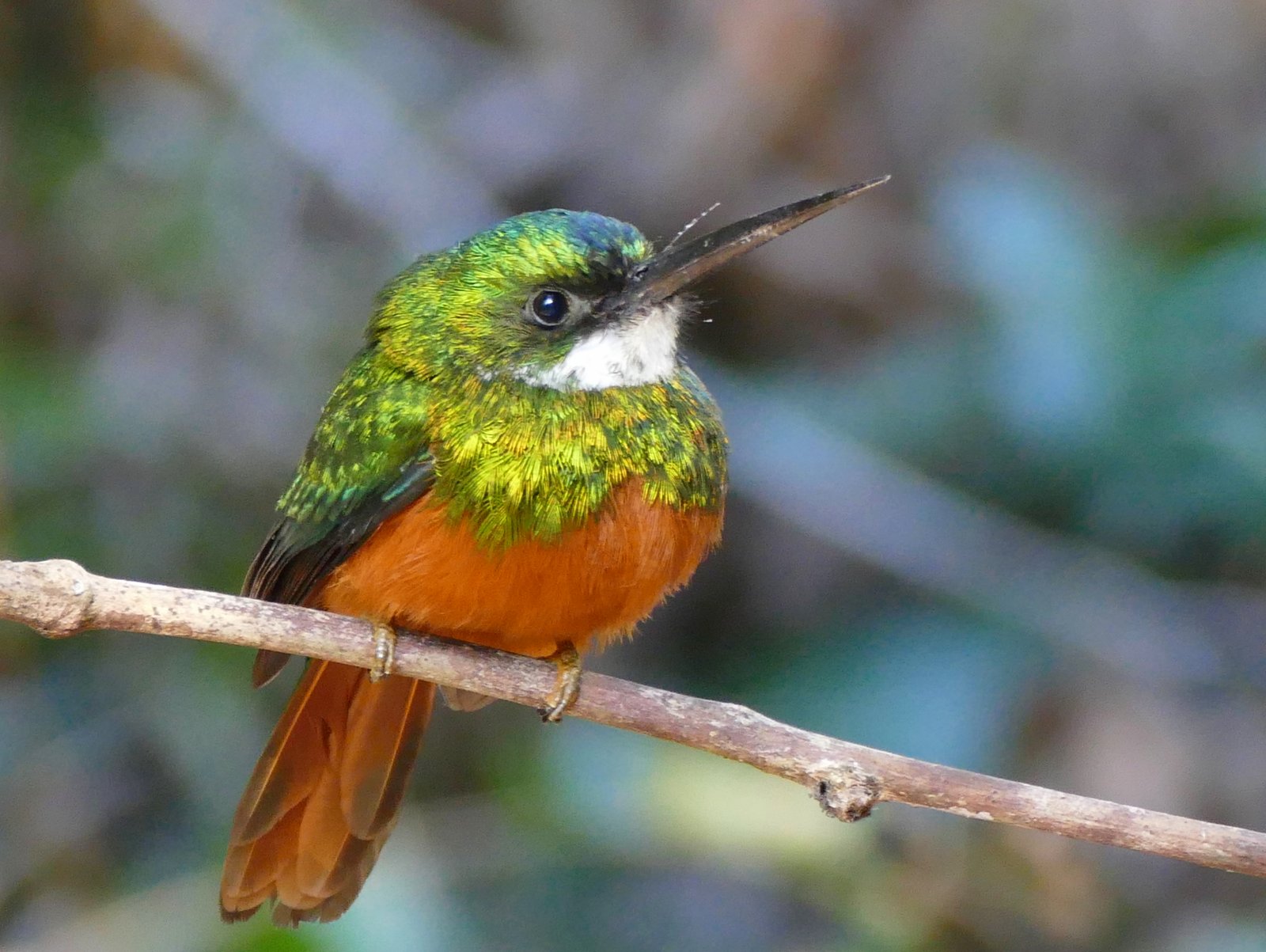
The Rufous-tailed Jacamar is the most widespread jacamar, from southern Mexico to northern Argentina. In the guide area it lives mainly in Colombia, western Ecuador and eastern Bolivia, along forest edges and in open woodland. With its long, needle-like bill and glossy green upperparts it sits upright on an open branch and sallies for butterflies and dragonflies.
Voice
A sharp, high peek or peeyew, and a long, accelerating series of high notes ending in a trill; pairs often sing together.
Recording: JAYRSON ARAUJO DE OLIVEIRA — CC BY-NC-SA 4.0 · xeno-canto
Identification
22–25 cm, including the long tail, with a long, thin, black bill. The upperparts and a broad breast band are glossy metallic green with a golden or coppery sheen. The male has a white throat, the female a buff throat. The belly is rufous. The outer tail feathers are rufous, so that the tail looks largely rusty from below. Birds west of the Andes (melanogenia group) have a black chin and less rufous in the tail. Juveniles are duller.
Confusion species
Green-tailed Jacamar Galbula galbula has a green tail without rufous on the underside and lives in the far east of Colombia. Bronzy Jacamar Galbula leucogastra is smaller and darker, with a white belly. Yellow-billed Jacamar Galbula albirostris has a yellow bill and lives inside the forest. Brown Jacamar Brachygalba lugubris is smaller and dark brown, with a shorter tail.
Habitat
Forest edges, open and secondary woodland, gallery forest, dry and semi-humid forest, scrub with trees and plantations, from the lowlands up to about 1200 m, locally higher. It perches on an open, shaded branch at low to middle height and sallies for butterflies, dragonflies, bees and wasps, which it beats against a branch before eating. It nests in a tunnel in an earth bank, a riverbank or a termite nest.
Where the bird is most at home, classified by the vegetation units of the Andes and the west coast.


Range and movements
In Colombia widespread in the lowlands: the Caribbean coastal region, the Magdalena and Cauca valleys, the Pacific coast and the llanos. In Ecuador in the western lowlands and foothills. In Bolivia in the north and east, in the lowlands of Beni and Santa Cruz. Absent from Peru and the Galápagos. Outside the guide area from southern Mexico through Central America to Venezuela, Trinidad, the Guianas, Brazil, Paraguay and northern Argentina.
- Resident
- dark = core range, pale = thinly spread
How and when to look
Along forest edges and trails with clearings in the lowlands of northern Colombia and western Ecuador. After a sally the bird often returns to the same branch, so it can be watched for a long time.
Conservation status
Least Concern. The species has a very large range and tolerates secondary woodland and the edges of farmland.
Scientific name
Galbula ruficauda | Cuvier, GLCFD, 1816
Cuvier, GLCFD described the species in 1816 and placed it straight away in the genus where it still stands. The genus Galbula was introduced in 1760 by Brisson. The genus name comes from Latin galbula, the name for a small yellow bird. The species name comes from Latin rufus, 'rufous', and cauda, 'tail': 'rufous-tailed'. The specimen the first description was based on came from the Guianas.