All species › Jacamars and puffbirds › Jacamars › Blue-necked Jacamar
Blue-necked Jacamar | Galbula cyanicollis
Purperhalsglansvogel | Jacamará cariazul | Ariramba-da-mata
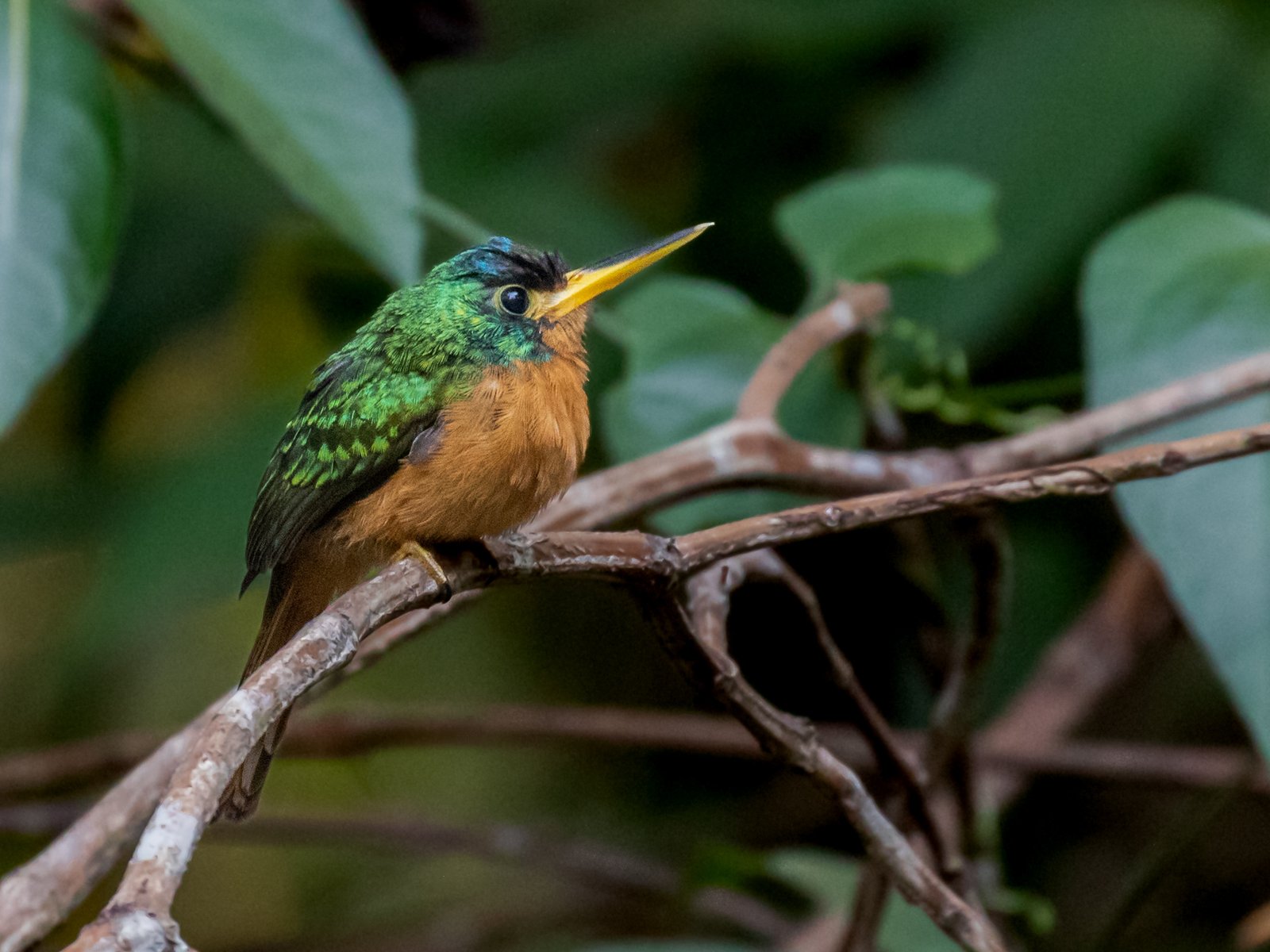
The Blue-necked Jacamar is the southern counterpart of the Yellow-billed Jacamar: a small jacamar with a largely yellow bill and blue-purple sides to the head, living in the interior of lowland forest south of the Amazon. It hunts low in the shade for flying insects, sitting still for long periods.
Voice
A high, thin whistle, often repeated, and an accelerating series of high notes that runs into a trill.
Recording: JAYRSON ARAUJO DE OLIVEIRA — CC BY-NC-SA 4.0 · xeno-canto
Identification
19–21 cm, with a long, straight bill that is largely yellow, with a dark tip and a dark ridge to the upper mandible. The crown, sides of the head and sides of the neck are blue to violet-blue, the upperparts glossy green. The throat and underparts are rufous, without a white throat patch; the outer tail feathers are also rufous. The female has a paler, more buff throat and belly. Juveniles are duller.
Confusion species
Yellow-billed Jacamar Galbula albirostris has a white (male) or buff (female) throat patch and green sides to the head, and lives north of the Amazon. Bluish-fronted Jacamar Galbula cyanescens is larger, with an all-black bill and a green breast band, and lives more at forest edges. Paradise Jacamar Galbula dea is dark, with a white throat and a long, pointed tail, and perches higher in the trees.
Habitat
The lower and middle levels of humid terra firme forest and tall secondary forest, locally also bamboo, from the lowlands up to about 700 m. It sits still on a horizontal branch or liana and sallies for butterflies and other flying insects. It nests in a tunnel in an earth bank or in the root plate of a fallen tree.
Where the bird is most at home, classified by the vegetation units of the Andes and the west coast.


Range and movements
In Peru in the Amazonian lowlands south of the Amazon and the Marañón, south to Madre de Dios. In Bolivia in the north, mainly in Pando and northern La Paz and Beni. Absent from Colombia, Ecuador and the Galápagos. Outside the guide area in Amazonian Brazil south of the Amazon.
- Resident
- dark = core range, pale = thinly spread
How and when to look
Search the forest interior around lodges in Madre de Dios and along trails in southern Loreto. Watch for a small bird sitting still in the shade that suddenly sallies after an insect.
Conservation status
Least Concern. The species has a large range and is fairly common in undisturbed forest.
Scientific name
Galbula cyanicollis | Cassin, 1851
Cassin described the species in 1851 and placed it straight away in the genus where it still stands. The genus Galbula was introduced in 1760 by Brisson. The genus name comes from Latin galbula, the name for a small yellow bird. The species name comes from Greek kuanos, 'dark blue', and Latin collis, 'neck': 'blue-necked'. The specimen the first description was based on came from Pará, Brazil.