All species › Jacamars and puffbirds › Jacamars › Yellow-billed Jacamar
Yellow-billed Jacamar | Galbula albirostris
Geelsnavelglansvogel | Jacamará piquiamarillo | Ariramba-de-bico-amarelo
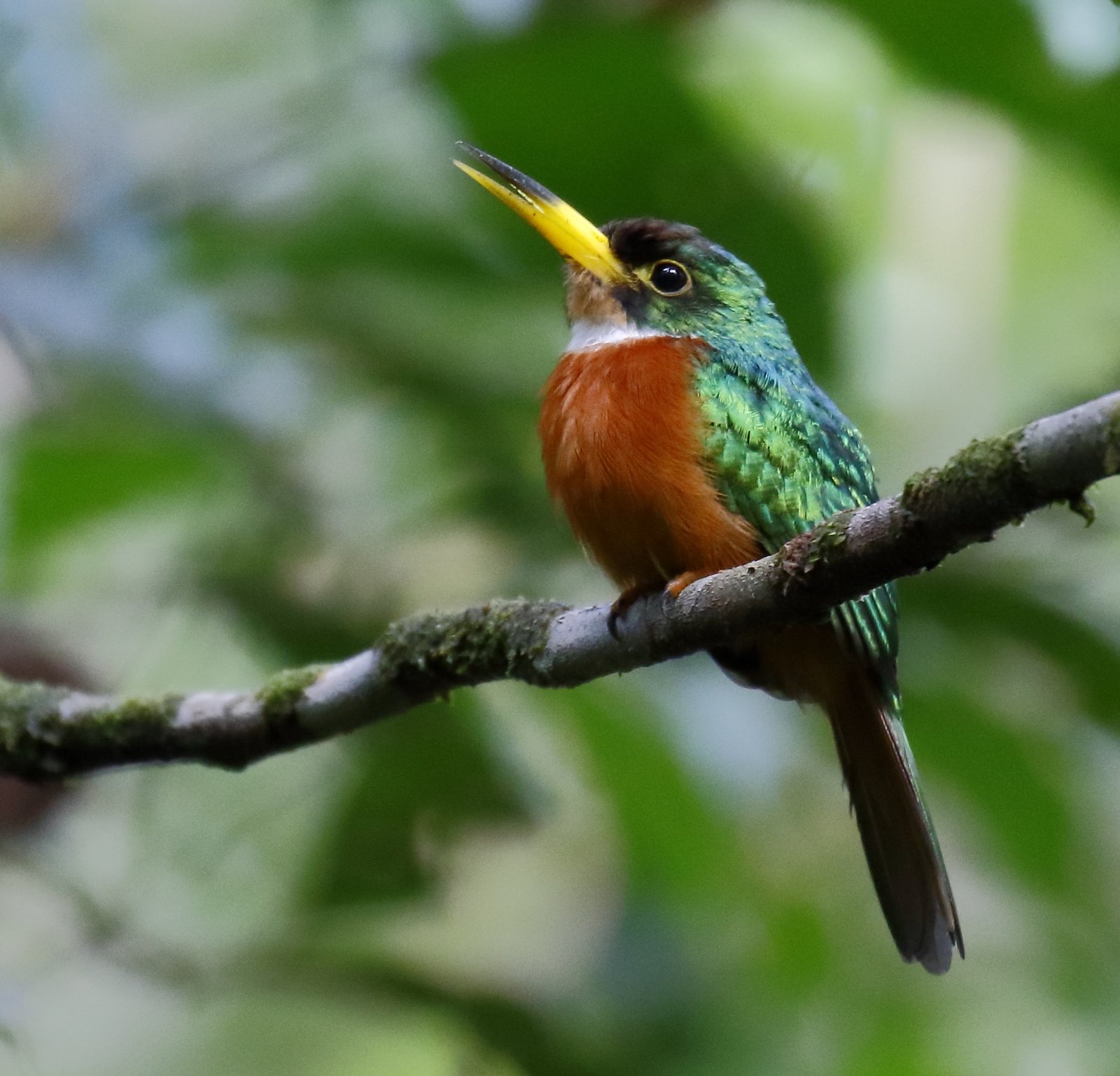
The Yellow-billed Jacamar is a small jacamar of the interior of humid lowland forest in northern Amazonia. Unusually for the family, it has a largely yellow bill, and it hunts low in the shade of the forest. In the west of the range the form chalcocephala has a blue-purple gloss on the crown; some authors treat it as a separate species.
Voice
A high, sharp pee, and a series of high notes that speeds up and ends in a trill.
Recording: Paul Lenrumé — CC BY-NC-SA 4.0 · xeno-canto
Identification
18–20 cm, with a long, straight bill that is yellow, with a dark ridge to the upper mandible and a dark tip. The upperparts are glossy green with a bronze sheen; in the guide area the crown has a bluish to purplish gloss. The male has a white throat patch, the female a buff throat. The rest of the underparts is rufous, as are the outer tail feathers. Juveniles are duller, with a shorter bill.
Confusion species
Blue-necked Jacamar Galbula cyanicollis is very similar, but has blue sides to the head and no white or buff throat patch; it replaces Yellow-billed Jacamar south of the Amazon. White-chinned Jacamar Galbula tombacea and Bluish-fronted Jacamar Galbula cyanescens are larger, with an all-black bill, and live more at forest edges and along water. Purplish Jacamar Galbula chalcothorax is dark purplish, with a black bill.
Habitat
The lower and middle levels of humid terra firme forest and tall secondary forest, also white-sand forest and clearings and streams inside the forest, from the lowlands up to about 1000 m in the foothills. It sits still on a branch in the shade and sallies for butterflies, flies and other flying insects. It nests in a tunnel in an earth bank or in the root plate of a fallen tree.
Where the bird is most at home, classified by the vegetation units of the Andes and the west coast.


Range and movements
In Colombia east of the Andes, in Amazonia and the Orinoco drainage. In Ecuador in the eastern lowlands and foothills. In Peru in the northern Amazonian lowlands, mainly north of the Amazon and the Marañón. Absent from Bolivia and the Galápagos. Outside the guide area in southern Venezuela, the Guianas and Amazonian Brazil north of the Amazon.
- Resident
- dark = core range, pale = thinly spread
How and when to look
Search inside the forest along trails and streams in the lowlands of eastern Ecuador and south-eastern Colombia. The bird often sits still at 1–3 m and gives itself away by its high call or by short sallies after insects.
Conservation status
Not Evaluated, because the limits of the species differ between taxonomic lists. The range is large and the bird is fairly common in undisturbed forest; deforestation is a local threat.
Scientific name
Galbula albirostris | Latham, 1790
Latham described the species in 1790 and placed it straight away in the genus where it still stands. The genus Galbula was introduced in 1760 by Brisson. The genus name comes from Latin galbula, the name for a small yellow bird. The species name comes from Latin albus, 'white', and rostrum, 'bill': 'white-billed'. The specimen the first description was based on came from Cayenne, French Guiana.