All species › Passerines › Tanagers and allies › Green Warbler-Finch
Green Warbler-Finch | Certhidea olivacea
Olijfboszangervink | Pinzón reinita verde | Tentilhão-cantor-verde
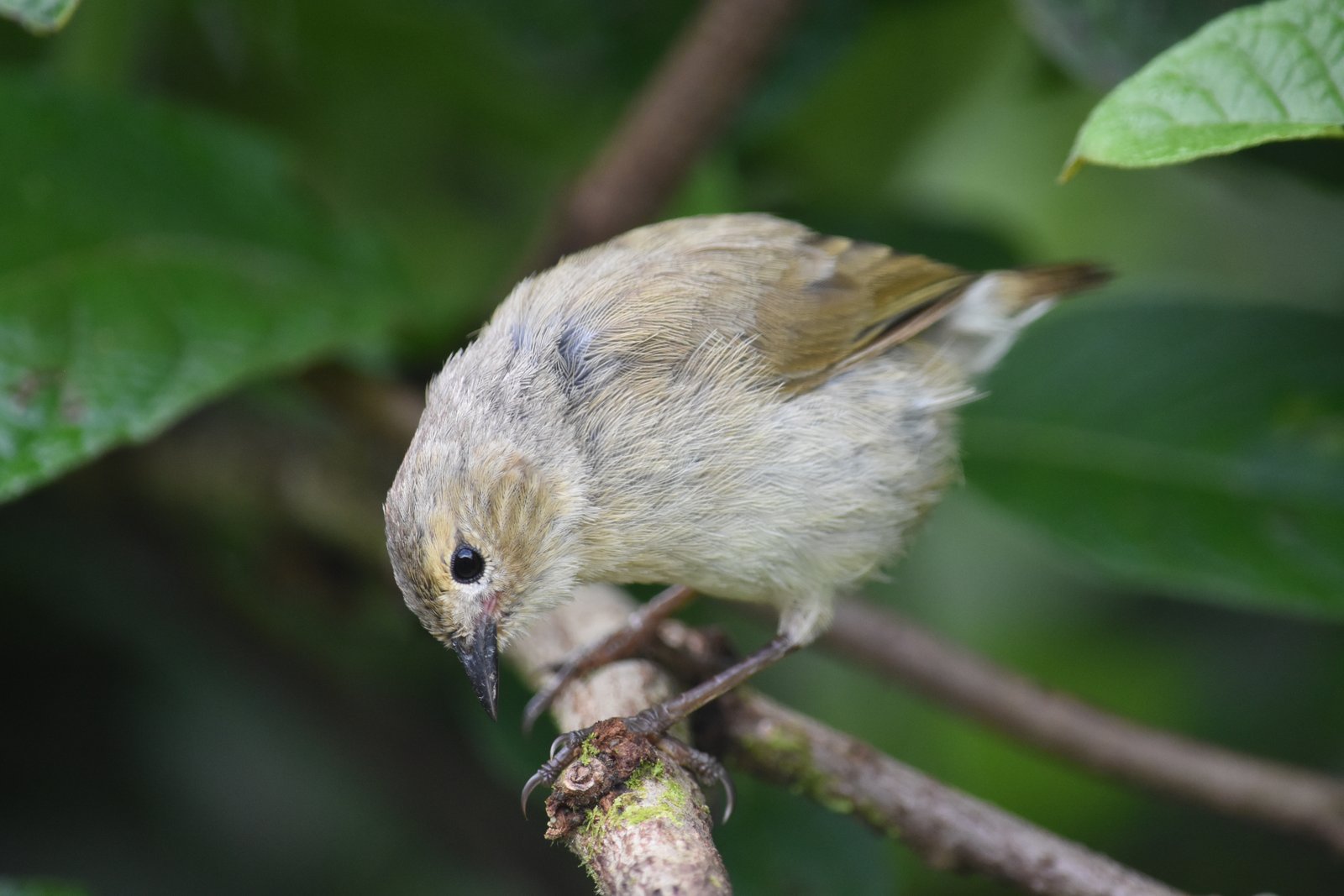
The Green Warbler-Finch is one of the two warbler-finches of the Galápagos: a small Darwin's finch with a thin, pointed bill that recalls a warbler more than a finch. It lives on the central, higher islands of the archipelago and feeds mainly on insects in the humid highlands. On Santa Cruz its population has declined sharply within a short time.
Voice
The song is a fast, high series of notes, often ending in a trill or buzzy flourish; it differs from that of Grey Warbler-Finch. The call is a thin, high tsip.
Recording: Bram Vogels — CC BY-NC-SA 4.0 · xeno-canto
Identification
10 cm, slender, with a thin, pointed, straight bill. Upperparts olive-green, underparts paler, greyish to pale buff. Some birds show a faint orange-buff tinge on the throat. No streaking. It moves constantly and often flicks its wings. The sexes are alike; juveniles are duller.
Confusion species
Grey Warbler-Finch Certhidea fusca is greyer and less green and occurs on other islands; the two do not share islands. Females and young of Mangrove Warbler Setophaga petechia are yellower, with yellow tail spots. Small Tree Finch Camarhynchus parvulus and Small Ground Finch Geospiza fuliginosa have a much thicker, conical bill.
Habitat
Mainly humid Scalesia forest and the humid highland zone, less so the transition zone and the arid lowland zone. It forages actively in foliage, on branches and among flowers for small insects and spiders and also takes some nectar. The nest is a globular structure with a side entrance, in a shrub or tree.
Where the bird is most at home, classified by the vegetation units of the Andes and the west coast.


Range and movements
Endemic to the Galápagos, on the central, higher islands: Santa Cruz, Isabela, Fernandina, Santiago, Rábida and Pinzón. Absent from mainland Colombia, Ecuador, Peru and Bolivia.
- Resident
How and when to look
In the highlands of Santa Cruz, for example in the Scalesia forest at Los Gemelos, and on the slopes of the volcanoes of Isabela. Watch for small, active olive-green birds moving through the foliage with flicking wings.
Conservation status
Vulnerable. On Santa Cruz the population fell by almost half between the late 1990s and around 2010, especially in the humid highlands, where the invasive blackberry Rubus niveus alters the forest and reduces insect food. The introduced parasitic fly Philornis downsi, whose larvae attack nestlings, and habitat loss to agriculture are further threats.
Scientific name
Certhidea olivacea | Gould, 1837
Gould described the species in 1837 and placed it straight away in the genus where it still stands. He introduced the genus Certhidea in that same work. The genus name is a diminutive of Certhia, the treecreeper genus: a bird resembling a treecreeper. The species name is Latin olivaceus, 'olive-coloured', referring to the greenish plumage. The specimen the first description was based on came from Isla Santiago, Galápagos.