All species › Passerines › Tanagers and allies › Black-masked Finch
Black-masked Finch | Coryphaspiza melanotis
Campogors | Cachilo de antifaz | Tico-tico-de-máscara-negra
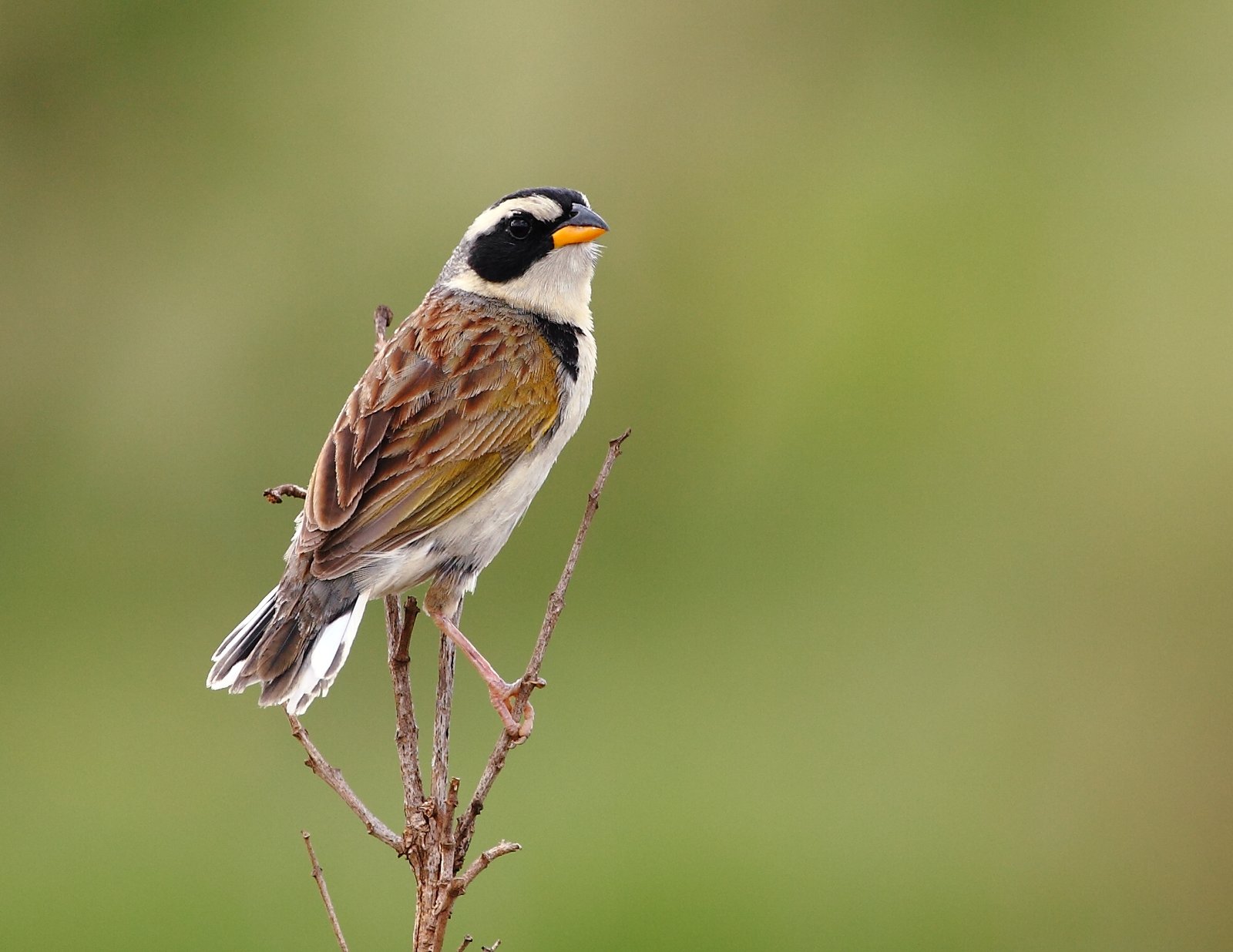
The Black-masked Finch is a small finch of tall, open grassland with scattered shrubs, the campos and cerrado of central South America. In the guide area it occurs only in a few savannas in south-eastern Peru and northern and eastern Bolivia. The male has a black head with a long white supercilium.
Voice
The song is a very high, thin, insect-like series tsee-tsee-tsee, often from a grass stem or small shrub. The call is a short, high tsip.
Recording: Jacob Wijpkema — CC BY-NC-SA 4.0 · xeno-canto
Identification
13 cm, with a pointed bill that is black above and yellow below and a fairly long, graduated tail with white tips. The male has a black crown and cheeks, a long white supercilium, a brown, dark-streaked back, yellow at the bend of the wing and white underparts. The female lacks the black mask: her head is brown with an ochre supercilium and her underparts are white with an ochre wash. Young birds resemble the female.
Confusion species
Grassland Sparrow Ammodramus humeralis has a grey, brown-streaked head with a yellow loral spot and no black mask. Wedge-tailed Grass Finch Emberizoides herbicola is larger, with a long, pointed tail and a streaked head without a mask. The female Grassland Yellow Finch Sicalis luteola is yellowish below and has a shorter tail without white tips.
Habitat
Tall, dry to moist grassland with scattered shrubs and termite mounds, in the lowlands up to about 1000 m. It forages on and just above the ground for seeds and insects. The nest is a cup of grass, low in a grass tussock.
Where the bird is most at home, classified by the vegetation units of the Andes and the west coast.


Range and movements
In Peru only in the Pampas del Heath in Madre de Dios, on the border with Bolivia. In Bolivia locally in the savannas of Beni, northern La Paz and north-eastern Santa Cruz. Absent from Colombia, Ecuador and the Galápagos. Outside the guide area in central Brazil, on Marajó Island and in Paraguay; probably extirpated in north-eastern Argentina.
- Resident
- dark = core range, pale = thinly spread
How and when to look
In the wet season, search tall grassland with scattered shrubs for singing males on a grass stem; outside that season it usually stays low in the grass.
Conservation status
Vulnerable. The population is declining through conversion of cerrado and savanna to cropland and pasture, too frequent burning and overgrazing. In the guide area important sites lie in protected savannas such as the Pampas del Heath.
Scientific name
Coryphaspiza melanotis | (Temminck, 1822)
Temminck described the species in 1822 as Emberizoides melanotis; because it was later moved to another genus, the author and year stand in brackets. The genus Coryphaspiza was introduced in 1840 by Gray. The genus name combines Greek koruphē, 'crown of the head', and spiza, 'finch'. The species name comes from Greek melas, 'black', and -ōtis, 'eared': 'black-eared'. The specimen the first description was based on came from Ipanema, São Paulo, Brazil.