All species › Passerines › Tanagers and allies › Sulphur-throated Finch
Sulphur-throated Finch | Sicalis taczanowskii
Geelkinsaffraangors | Chirigüe de Taczanowski | Canário-de-garganta-amarela
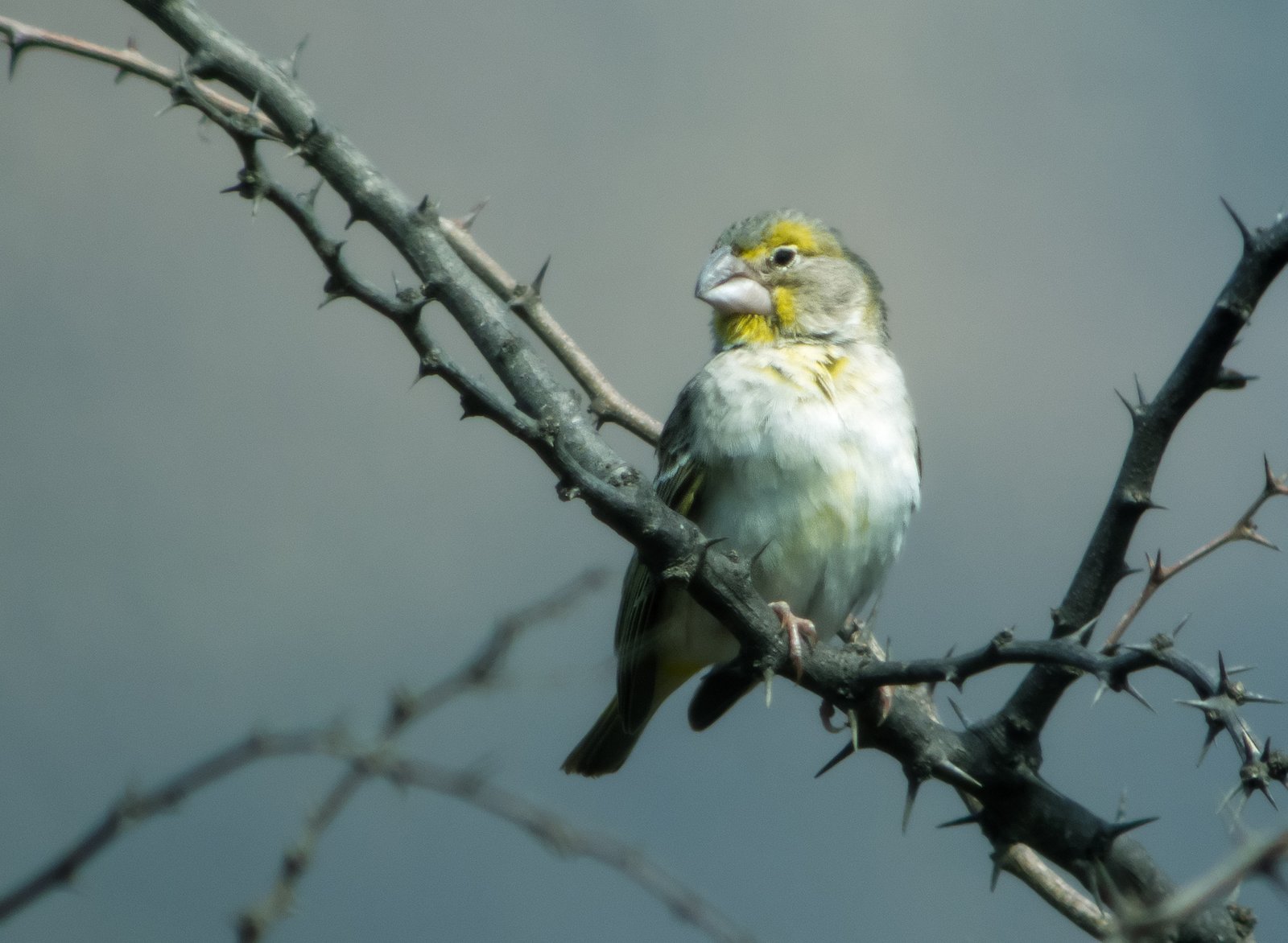
The Sulphur-throated Finch is a stocky, sparrow-like finch with a heavy bill of the dry lowlands of south-western Ecuador and north-western Peru. Only the small sulphur-yellow throat patch hints at its relationship with the other yellow finches. It lives in flocks that wander and sometimes appear in large numbers after rain.
Voice
Flocks give a dry, constant twittering. The song is a short series of harsh, chirping notes; poorly described.
Recording: Lelis Navarrete — CC BY-NC-SA 4.0 · xeno-canto
Identification
11–12 cm, with a heavy, conical, pale bill. The upperparts are greyish brown with dark streaks, and the rump is greyer. The throat has a small sulphur-yellow patch; the rest of the underparts is dull white, with a greyish breast and faint streaks on the flanks. The female resembles the male but has little or no yellow on the throat. Young birds are browner and more heavily streaked.
Confusion species
Female and young Grassland Yellow Finches Sicalis luteola have a thinner bill and a yellow wash on the breast. Females of the species of the genus Sporophila are smaller and plain olive-brown, without streaks, with a more rounded bill. Saffron Finch Sicalis flaveola shows more yellow in all plumages. Raimondi's Yellow Finch Sicalis raimondii occurs farther south and has a yellow head and a finer bill.
Habitat
Desert scrub, dry grassland, open thorn woodland and fallow fields on the coastal plain and the lowest foothills, from sea level to about 600 m. It feeds in flocks on the ground on seeds. It breeds in the rainy season; the nest is poorly described.
Where the bird is most at home, classified by the vegetation units of the Andes and the west coast.


Range and movements
In Ecuador in the dry south-west, mainly on the Santa Elena Peninsula and in Guayas and El Oro. In Peru in the dry north-west, from Tumbes and Piura south to about Lambayeque. Absent from Colombia, Bolivia and the Galápagos. It does not occur outside the guide area.
- Resident
- dark = core range, pale = thinly spread
How and when to look
In the rainy season (roughly January to April), search the dry coastal plain of Santa Elena or the area around Pómac in Lambayeque for flocks of sparrow-like finches on the ground; note the heavy bill and the yellow throat. Numbers vary strongly from year to year.
Conservation status
Least Concern. Nomadic and locally numerous, but irregular. The dry coastal landscape is locally converted to farmland; the effects on the species are poorly known.
Scientific name
Sicalis taczanowskii | Sharpe, 1888
Sharpe described the species in 1888 and placed it straight away in the genus where it still stands. The genus Sicalis was introduced in 1828 by Boie. The genus name comes from Greek sikalis, a small black-headed bird, perhaps a warbler of the genus Sylvia. The species name honours Władysław Taczanowski (1819–1890), a Polish zoologist and curator of zoology at the Warsaw University museum. The specimen the first description was based on came from (volgens de beschrijving).