All species › Passerines › Tanagers and allies › Greenish Yellow Finch
Greenish Yellow Finch | Sicalis olivascens
Groengele saffraangors | Chirigüe oliváceo | Canário-esverdeado
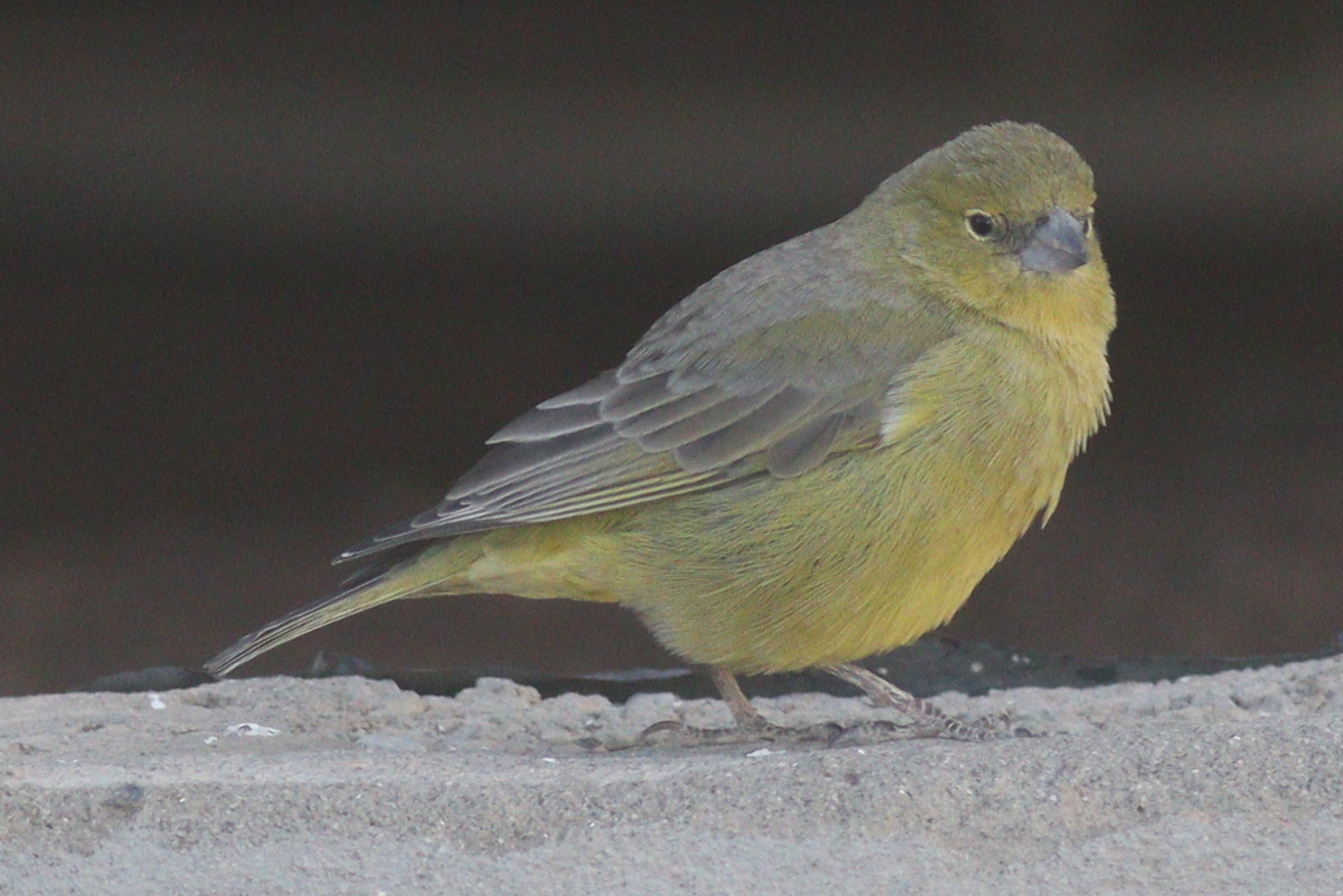
The Greenish Yellow Finch is the most olive-coloured yellow finch of the Andes. It lives in dry scrub, fields and villages at middle elevations from Peru to Argentina, often in flocks. The male sings from a shrub, post or roof.
Voice
The song is a short series of chipping, twittering and buzzy notes. Flocks keep up a constant chirping.
Recording: Ross Gallardy — CC BY-NC-SA 4.0 · xeno-canto
Identification
14 cm, with a short, conical bill. The male is olive-green above with faint dark streaks on the mantle, a slightly yellower forehead and a greenish-yellow rump; the underparts are olive-yellow, greener on the breast and flanks. The wings and tail are dark with olive-green edges. The female is greyer olive and duller, with fine streaks on the head and mantle. Juveniles are browner and more heavily streaked.
Confusion species
Puna Yellow Finch Sicalis lutea is much brighter yellow and lives higher, on the puna. Bright-rumped Yellow Finch Sicalis uropygialis has a grey back and a bright yellow rump. Raimondi's Yellow Finch Sicalis raimondii is greyer above and lives lower, on the dry western slopes. Female Hooded Siskin Spinus magellanicus has a yellow wing-bar and a more pointed bill.
Habitat
Dry montane scrub, fields, hedgerows, gardens and villages, mostly between about 2000 and 4000 m. It feeds on the ground on seeds, often in flocks, and outside the breeding season also with other seed-eaters. The nest is usually in a cavity, for example in a wall or bank.
Where the bird is most at home, classified by the vegetation units of the Andes and the west coast.


Range and movements
Absent from Colombia, Ecuador and the Galápagos. In Peru in the central and southern Andes, mainly on the western slopes and in dry inter-Andean valleys. In Bolivia in the dry valleys and on the slopes of the western and central Andes. Outside the guide area in northern Chile and western Argentina.
- Resident
- dark = core range, pale = thinly spread
How and when to look
Search dry montane valleys along fields, hedgerows and villages, for example around Arequipa and in the valleys of Cochabamba, for small groups on the ground.
Conservation status
Least Concern. The species is locally common and also lives in farmland and villages.
Scientific name
Sicalis olivascens | (d'Orbigny, ACVMD & de Lafresnaye, 1837)
D'Orbigny, ACVMD & de Lafresnaye described the species in 1837 as Emberiza olivascens; because it was later moved to another genus, the author and year stand in brackets. The genus Sicalis was introduced in 1828 by Boie. The genus name comes from Greek sikalis, a small black-headed bird, perhaps a warbler of the genus Sylvia. The species name comes from Latin olivascens, 'becoming olive', for the greenish-yellow plumage. The specimen the first description was based on came from La Paz, Bolivia.