All species › Passerines › Tanagers and allies › Orange-fronted Yellow Finch
Orange-fronted Yellow Finch | Sicalis columbiana
Dwergsaffraangors | Chirigüe frentinaranja | Canário-do-amazonas
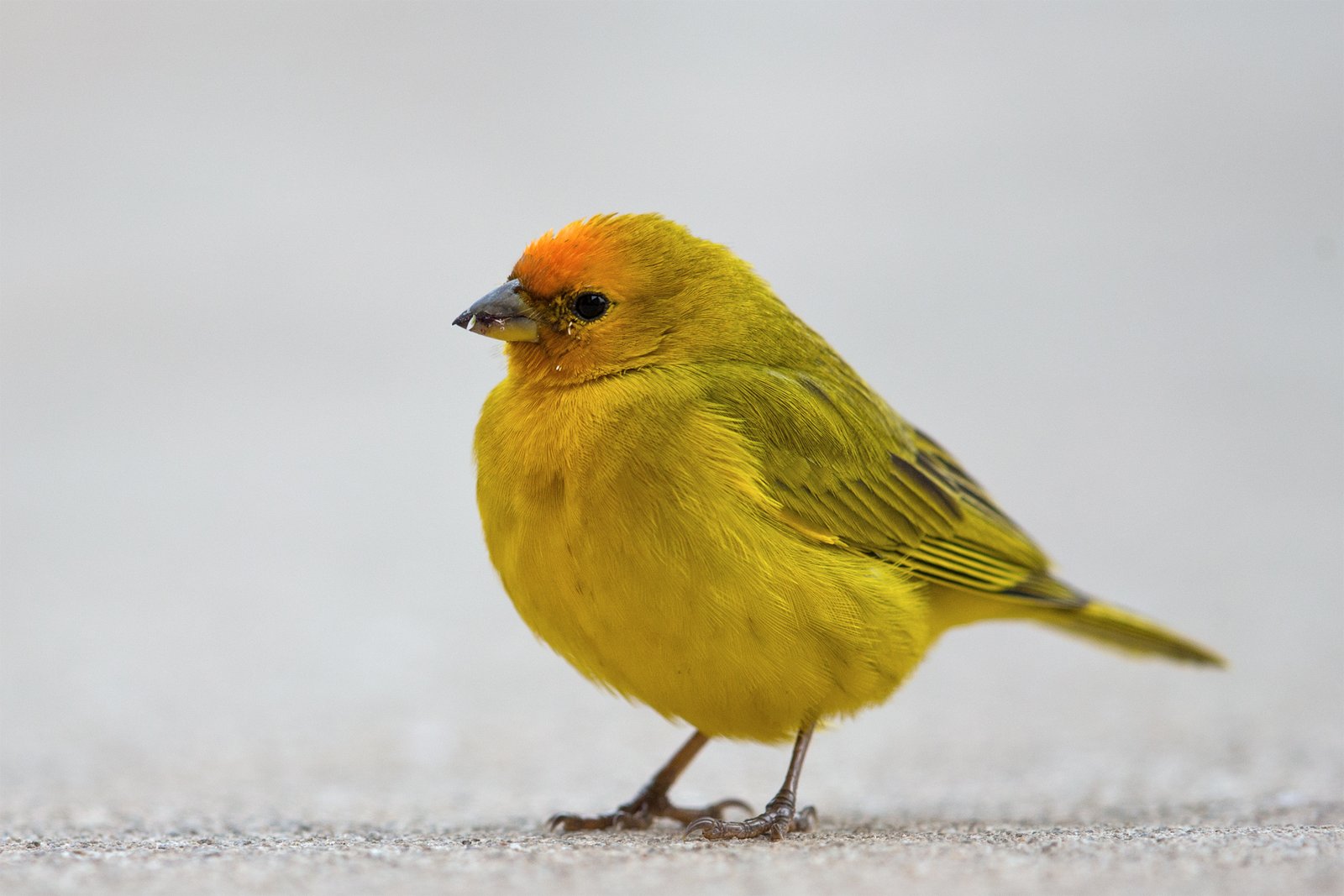
The Orange-fronted Yellow Finch is the smallest yellow finch of the guide area, a bird of open country along the large rivers of Amazonia and in the Llanos. The male resembles a small Saffron Finch, with an orange forehead. It often occurs in villages and around houses along the rivers.
Voice
The song is a short series of dry chips and trills. The call is a short tsip.
Recording: JAYRSON ARAUJO DE OLIVEIRA — CC BY-NC-SA 4.0 · xeno-canto
Identification
11–12 cm, with a short, conical bill. The male is yellowish olive above and barely streaked, with an orange forehead and bright yellow underparts. The female is grey-brown above and dull white to pale grey below, unstreaked and at most with a yellow tinge at the bend of the wing. Juveniles resemble the female.
Confusion species
Saffron Finch Sicalis flaveola is larger, with a larger orange cap extending onto the crown; its female is yellow in most of the guide area. Grassland Yellow Finch Sicalis luteola is heavily streaked above. Stripe-tailed Yellow Finch Sicalis citrina has white in the tail and lives in hilly and mountainous country. Female seedeaters Sporophila have a thicker, curved bill.
Habitat
Open, grassy riverbanks, sandbars and river islands, yards and villages along rivers, and in the Llanos also savanna and pasture, in the lowlands up to about 500 m. It lives in pairs and small groups and feeds on the ground on seeds. The nest is in a cavity, for example in a tree, post or building.
Where the bird is most at home, classified by the vegetation units of the Andes and the west coast.


Range and movements
In Colombia in the Llanos east of the Andes and along the large rivers in the east, including the Amazon at Leticia. In Ecuador rare, with a few records along the Napo in the east. In Peru in the north-east along the Amazon and the lower Napo and Ucayali, including around Iquitos. Absent from Bolivia and the Galápagos. Outside the guide area in Venezuela and in Amazonian and eastern Brazil.
- Resident
- dark = core range, pale = thinly spread
How and when to look
Search in and around villages and on open banks along the Amazon, for example around Iquitos and Leticia, and in the Llanos around farmyards and pastures.
Conservation status
Least Concern. The species lives in open country along rivers and around settlements and locally benefits from deforestation.
Scientific name
Sicalis columbiana | Cabanis, 1851
Cabanis described the species in 1851 and placed it straight away in the genus where it still stands. The genus Sicalis was introduced in 1828 by Boie. The genus name comes from Greek sikalis, a small black-headed bird, perhaps a warbler of the genus Sylvia. The species name refers to Colombia, after the stated type locality Porto Cabello, 'Colombia'; this was erroneous and is in fact Ciudad Bolívar on the Orinoco in Venezuela. The specimen the first description was based on came from Ciudad Bolívar, Venezuela.