All species › Passerines › Wrens › Hermit Wood Wren
Hermit Wood Wren | Henicorhina anachoreta
Santamartaboswinterkoning | Cucarachero anacoreta | Corruíra-eremita
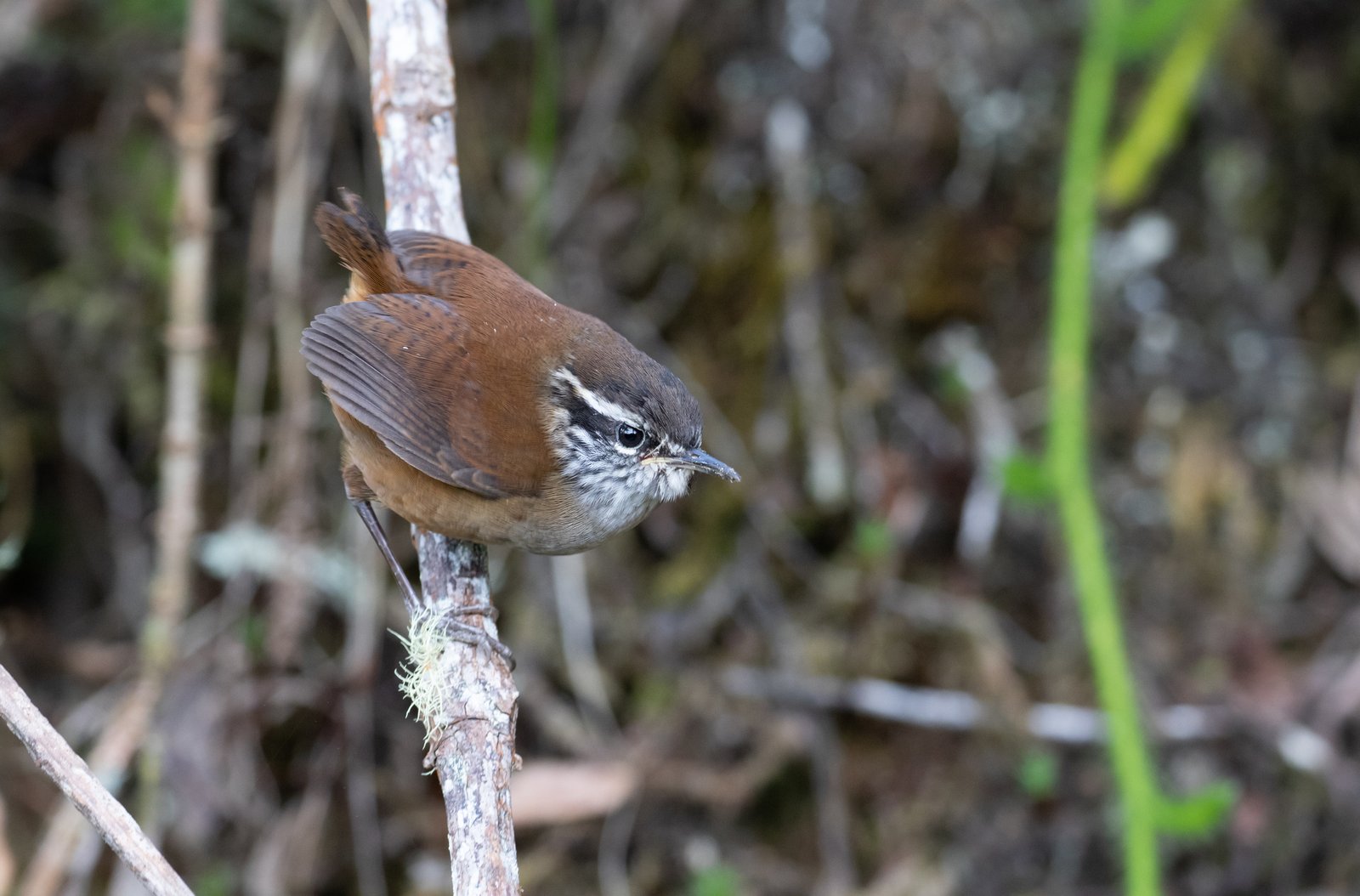
The Hermit Wood Wren is a wood wren found only in the Sierra Nevada de Santa Marta in northern Colombia. For a long time it was treated as a subspecies of Grey-breasted Wood Wren, until it was recognised as a separate species in 2016, mainly on the basis of its song. In the mountains it occupies the higher forests, above the zone of Grey-breasted Wood Wren.
Voice
Series of clear whistled phrases, related to those of Grey-breasted Wood Wren, but higher and with a greater difference between the highest and lowest notes. Calls with dry rattles.
Recording: Niels Krabbe — CC BY-NC-SA 4.0 · xeno-canto
Identification
10–11 cm, with a very short, often cocked tail. The crown and nape are olive-brown, with a whitish supercilium and a dark eyestripe; the sides of the head are streaked black and white. The upperparts are sooty brown to rusty brown, the wings and tail barred dark. The throat is greyish white with faint streaks, the breast mid-grey, the flanks rufous-brown. The sexes are alike.
Confusion species
Grey-breasted Wood Wren Henicorhina leucophrys, represented in the Sierra Nevada de Santa Marta by the subspecies bangsi, is very similar and lives lower on the same slopes, with some overlap; it has a whiter, more sharply marked throat, and its song is lower and spans a narrower pitch range. Santa Marta Wren Troglodytes monticola has a longer tail, no streaked face and lives even higher, at the treeline and in páramo. Mountain Wren Troglodytes solstitialis is plainer rufous-brown and forages more often higher in the trees.
Habitat
Understorey of humid upper montane forest and cloud forest, forest edges with dense bamboo (Chusquea) and elfin forest near the treeline, roughly from 2000 m to about 3600 m. It forages alone or in small groups, from the ground up to about 2 m, for insects and other invertebrates. Little has been published on its nesting; presumably a globular nest as in related species.
Where the bird is most at home, classified by the vegetation units of the Andes and the west coast.

Range and movements
Occurs only in Colombia, in the Sierra Nevada de Santa Marta. Absent from Ecuador, Peru, Bolivia and the Galápagos. Does not occur outside the guide area.
- Resident
- dark = core range, pale = thinly spread
How and when to look
Along the upper parts of the road over the Cuchilla de San Lorenzo, above Minca, in forest with bamboo above about 2200 m; the birds keep low in dense vegetation and are mostly detected by song.
Conservation status
Near Threatened. The range is small and the population is thought to be declining through deforestation, fires and farming in the mountains. The species tolerates some forest disturbance and occurs in protected areas.
Scientific name
Henicorhina anachoreta | Bangs, 1899
Bangs described the species in 1899 and placed it straight away in the genus where it still stands. The genus Henicorhina was introduced in 1868 by Sclater & Salvin. The genus name comes from Greek henikos, 'singular', and rhis, rhinos, 'nostrils'. It replaced Baird's name Heterorhina, which was already in use for a beetle genus. The species name is Latin anachoreta, 'hermit', from Greek anakhōrētēs, 'hermit, recluse', and anakhōreō, 'to retire'; possibly for its isolated range high in the Sierra Nevada de Santa Marta. The specimen the first description was based on came from Páramo de Chirugua, Sierra Nevada de Santa Marta, Colombia.