All species › Passerines › Wrens › Munchique Wood Wren
Munchique Wood Wren | Henicorhina negreti
Munchiqueboswinterkoning | Cucarachero de Munchique | Corruíra-de-munchique
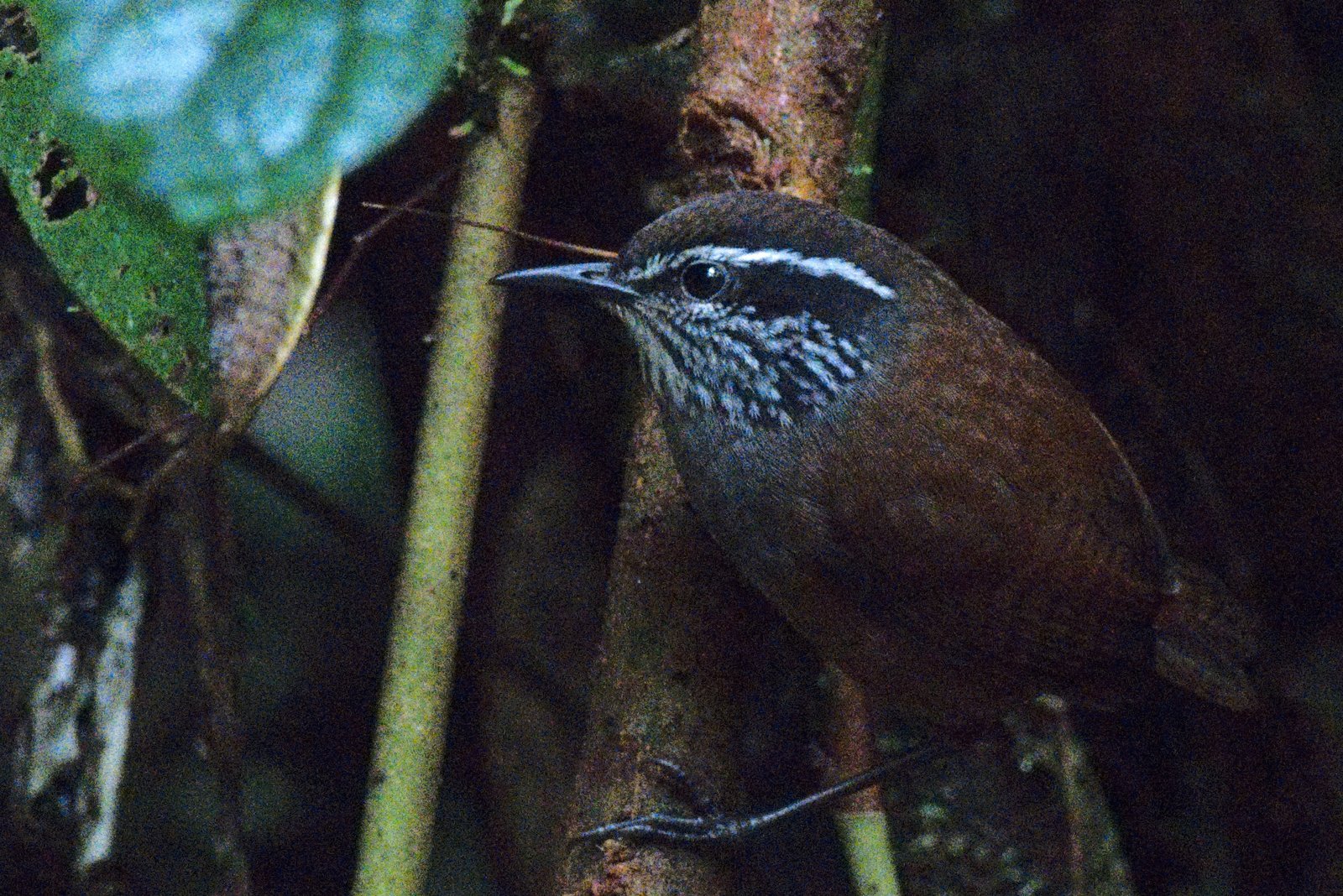
The Munchique Wood Wren is a wood wren described only in 2003, from a few ridges in the Western Andes of Colombia. It lives in very wet, stunted cloud forest that is almost permanently in fog, above the zone of Grey-breasted Wood Wren, from which it probably derives. It was recognised by its distinctive song.
Voice
Phrases of pure, clear whistled notes, usually repeated more than ten times in succession, differently structured from the song of Grey-breasted Wood Wren. Calls are mainly dry rattles, as in related species.
Recording: Brian Cox — CC BY-NC-SA 4.0 · xeno-canto
Identification
11 cm, with a very short, often cocked tail. The crown is dark brown with blackish markings, with a thin white supercilium and a dull black eyestripe; the cheeks are blackish with white mottling. The upperparts are slightly warmer brown than the crown, the tail brown with black bars. The throat is white, streaked black at its lower edge; the breast is mid-grey, the belly paler grey, the flanks and vent brown, with dark grey to black barring on the belly and flanks. The sexes are alike; young birds are much darker and lack the belly barring.
Confusion species
Grey-breasted Wood Wren Henicorhina leucophrys is very similar, but paler and without dark barring on the belly and flanks; it lives lower on the same slopes, and song is the best distinction. Mountain Wren Troglodytes solstitialis has a longer tail and no streaked face, and forages more often higher in the trees.
Habitat
Very wet, low, mossy cloud forest on ridges, rich in epiphytes and almost always in fog, between about 2250 and 2650 m. It forages low in the vegetation for insects and spiders. Little is known of its nesting; presumably a globular nest as in related species.
Where the bird is most at home, classified by the vegetation units of the Andes and the west coast.

Range and movements
Occurs only in Colombia, on the Pacific side of the Western Andes, in a few isolated areas: the Munchique massif in Cauca and, further north, a few ridges where Chocó, Antioquia and Risaralda meet, such as in Tatamá. Absent from Ecuador, Peru, Bolivia and the Galápagos. Does not occur outside the guide area.
- Resident
- dark = core range, pale = thinly spread
How and when to look
In Munchique National Park and on the highest parts of the road to Cerro Montezuma in Tatamá, in foggy elfin forest above about 2300 m; the birds keep low in dense vegetation and are mostly detected by song.
Conservation status
Vulnerable. Suitable habitat is very small and fragmented; even inside national parks forest is cleared and settled. The species was formerly listed as Critically Endangered.
Scientific name
Henicorhina negreti | Salaman, Coopmans, Donegan, Mulligan, Cortés D, Hilty & Ortega, 2003
Salaman, Coopmans, Donegan, Mulligan, Cortés D, Hilty & Ortega described the species in 2003 and placed it straight away in the genus where it still stands. The genus Henicorhina was introduced in 1868 by Sclater & Salvin. The genus name comes from Greek henikos, 'singular', and rhis, rhinos, 'nostrils'. It replaced Baird's name Heterorhina, which was already in use for a beetle genus. The species name honours the Colombian ornithologist Álvaro José Negret (died 1998). The specimen the first description was based on came from Munchique, Cauca, Colombia.