All species › Passerines › Antpittas › Jocotoco Antpitta
Jocotoco Antpitta | Grallaria ridgelyi
Jocotocomierpitta | Tororoí jocotoco | Tovacuçu-jocotoco
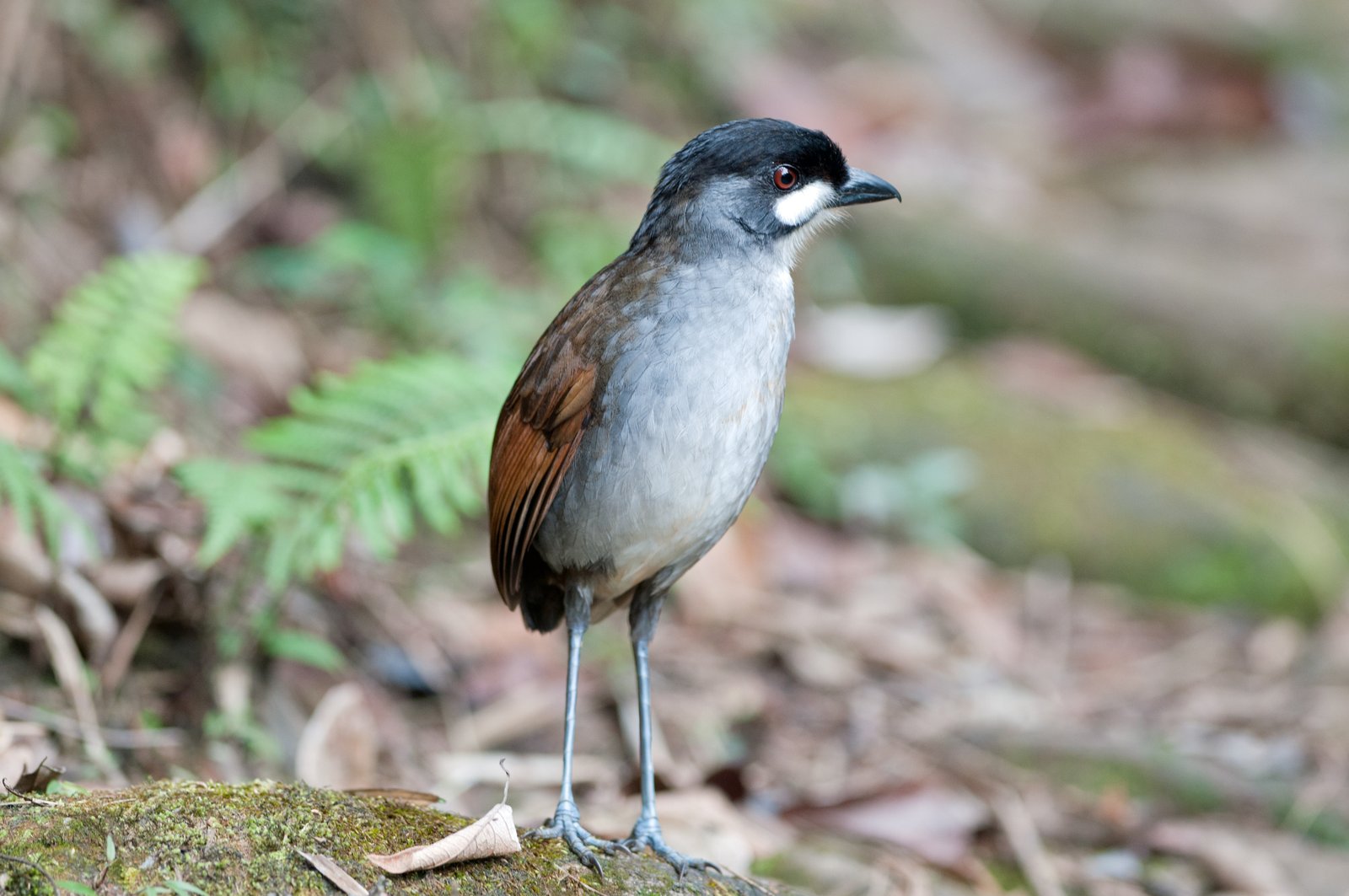
The Jocotoco Antpitta is a large, round-bodied antpitta with a striking white cheek patch, discovered only in 1997 in the cloud forest of southern Ecuador. Its discovery led to the founding of a conservation organisation named after the bird, which creates reserves for threatened species. Its world range is small and the species is endangered.
Voice
A low, hollow, owl-like call of one or two notes, hoo or hoo-hoo, repeated at intervals, mainly in the early morning. It carries far, but the direction of the call is often unclear.
Recording: Leonardo Ordóñez-Delgado — CC BY-NC-SA 4.0 · xeno-canto
Identification
20–23 cm, a heavy, tailless-looking antpitta on long legs, with a powerful black bill. The crown and nape are black and contrast sharply with a large white patch from the lores across the ear coverts. The upperparts are brown, the underparts greyish white with greyer flanks. The sexes are alike; young birds are duller, with a less sharply marked head.
Confusion species
The black-and-white head makes the species unmistakable within its range. Undulated Antpitta Grallaria squamigera occurs in the same altitudinal zone but has ochre underparts scalloped with black and a white throat. Chestnut-naped Antpitta Grallaria nuchalis is dark slate-grey below with a rufous nape and lacks the white cheek patch.
Habitat
Humid cloud forest with a dense understorey of Chusquea bamboo, in a narrow altitudinal zone at around 2300 to 2700 m. It lives on or just above the forest floor, where it hops and pauses, searching the leaf litter for earthworms, insects and other invertebrates.
Where the bird is most at home, classified by the vegetation units of the Andes and the west coast.

Range and movements
In Ecuador only in the south, on the eastern slope of the Andes in the provinces of Zamora-Chinchipe and Loja. Also found in a small adjacent area in the far north of Peru. Absent from Colombia, Bolivia and the Galápagos, and not found outside the guide area.
- Resident
- dark = core range, pale = thinly spread
How and when to look
In the reserve where the species was discovered, in the cloud forest of southern Ecuador, the birds are lured with earthworms to a fixed spot in the forest, where they can be seen well. Elsewhere the species is shy and usually only heard.
Conservation status
Endangered. The world range is very small and fragmented, and the cloud forest it inhabits is being cleared for pasture. Part of the range is protected in a reserve and a national park.
Scientific name
Grallaria ridgelyi | Krabbe, Agro, Rice, Jácome, Navarrete & Sornoza-Molina, 1999
Krabbe, Agro, Rice, Jácome, Navarrete & Sornoza-Molina described the species in 1999 and placed it straight away in the genus where it still stands. The genus Grallaria was introduced in 1816 by Vieillot. The genus name comes from New Latin grallarius, 'stilt-walker', referring to the long legs. The species name honours Robert S. Ridgely (born 1946), American ornithologist and co-founder of the Fundación Jocotoco. The specimen the first description was based on came from Quebrada Honda, Zamora-Chinchipe, Ecuador.