All species › Passerines › Antpittas › Stripe-headed Antpitta
Stripe-headed Antpitta | Grallaria andicolus
Streepkopmierpitta | Tororoí andino | Tovacuçu-de-cabeça-listrada
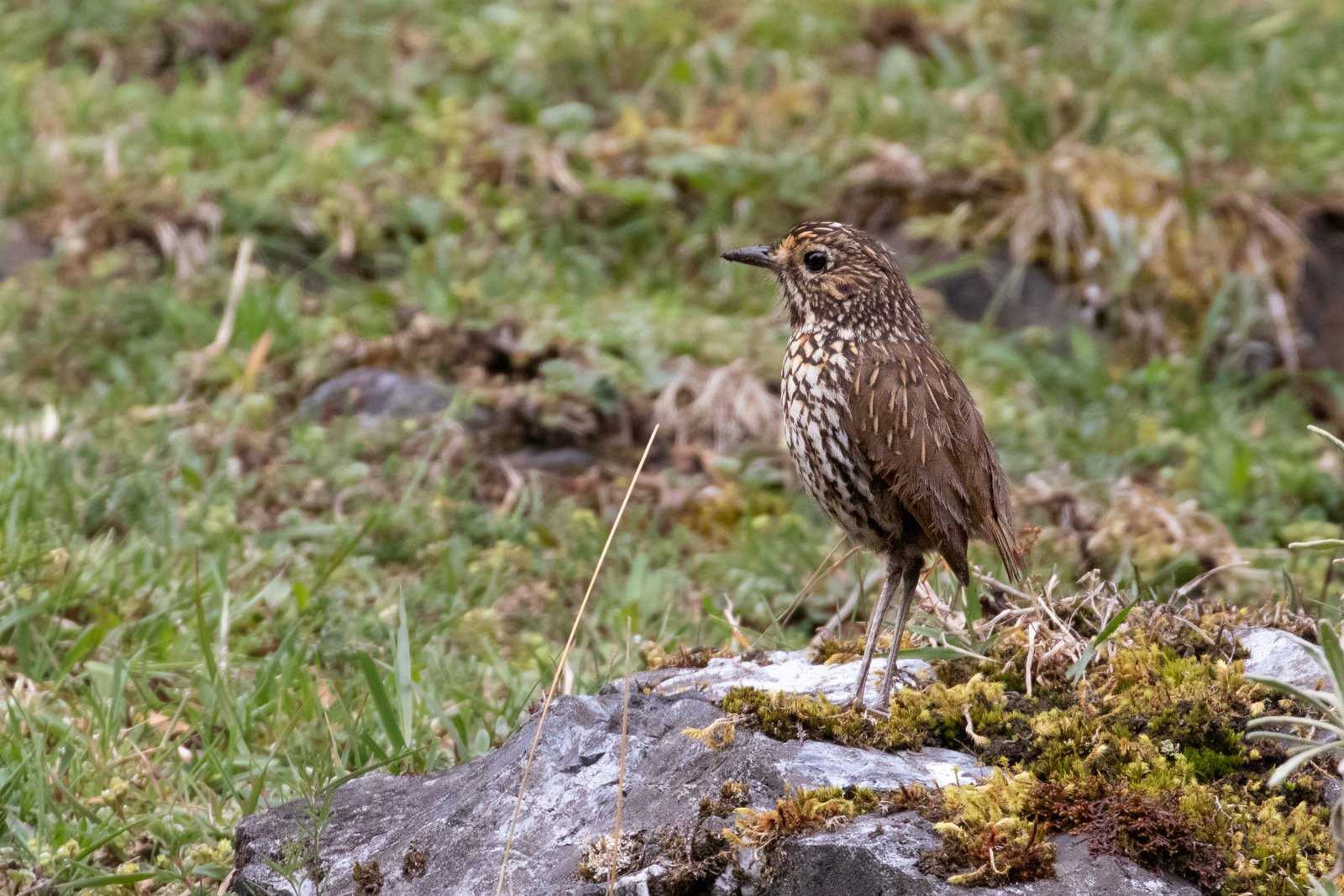
The Stripe-headed Antpitta is a small antpitta of the high Andes of Peru and Bolivia, with a streaked head and a scaled, spotted breast. It lives higher than almost any other antpitta, in Polylepis groves and scrub up to above the treeline. The southern form punensis differs in plumage and calls and is sometimes regarded as a separate species.
Voice
The song is a low, grinding, frog-like trill that rises and falls, sometimes introduced by a stutter. The call of the nominate form is a single, slightly wheezy, faintly descending note; punensis gives one or two mellower notes.
Recording: Étienne Leroy — CC BY-NC-SA 4.0 · xeno-canto
Identification
16 cm, round and short-tailed, on blue-grey legs, with a black bill. The forecrown is blackish, the hindcrown olive-brown, both streaked white or buff. Pale lores merge into a white eye-ring. The back is greyish olive with black and whitish streaks. The throat is whitish to buff, the breast scaled black and buff, the belly spotted. The form punensis in the south has a blacker crown with orange-buff streaks, an unstreaked back and more heavily streaked underparts. The sexes are alike.
Confusion species
Antpittas of the Muisca Antpitta group, such as Junin Antpitta Grallaria obscura and Puno Antpitta Grallaria sinaensis, are plain rufous-brown without streaks and live in wetter forest. Undulated Antpitta Grallaria squamigera is much larger, with a white throat and buff, finely scaled underparts. Atuen Antpitta Grallaria atuensis in northern Peru is plain brown with a pale belly.
Habitat
Polylepis and Gynoxys woodland, shrubby puna grassland and sometimes the edge of treeline forest, mostly between 3500 and 4600 m, locally from 3000 m. It takes insects on the ground and sometimes on branches just above it. The breeding season probably runs from December to May; almost nothing is known about the nest.
Where the bird is most at home, classified by the vegetation units of the Andes and the west coast.


Range and movements
In Peru in the Andes: the nominate form in the Western Andes from southern Cajamarca to Ayacucho and in the Central Andes from southern Amazonas to Apurímac; punensis in Cusco and Puno. In Bolivia only in western La Paz. Absent from Colombia, Ecuador and the Galápagos. Does not occur outside the guide area.
- Resident
- dark = core range, pale = thinly spread
How and when to look
Search Polylepis groves in the high mountains of Peru, for example in the Cordillera Blanca or at Abra Málaga in Cusco. Listen in the early morning for the grinding trill and check the edges of the groves, where the bird hops on rocks or on the ground among the shrubs.
Conservation status
Least Concern. The species does depend on Polylepis groves, which are declining through cutting for firewood, burning and grazing.
Scientific name
Grallaria andicolus | (Cabanis, 1873)
Cabanis described the species in 1873 as Hypsibamon andicolus; because it was later moved to another genus, the author and year stand in brackets. The genus Grallaria was introduced in 1816 by Vieillot. The genus name comes from New Latin grallarius, 'stilt-walker', referring to the long legs. The species name comes from the Andes and Latin -cola, 'dweller': dweller of the Andes. The specimen the first description was based on came from Maraynioc, Junín, Peru.