All species › Passerines › Tapaculos › Junin Tapaculo
Junin Tapaculo | Scytalopus gettyae
Juníntapaculo | Churrín de Junín | Tapaculo-de-junín
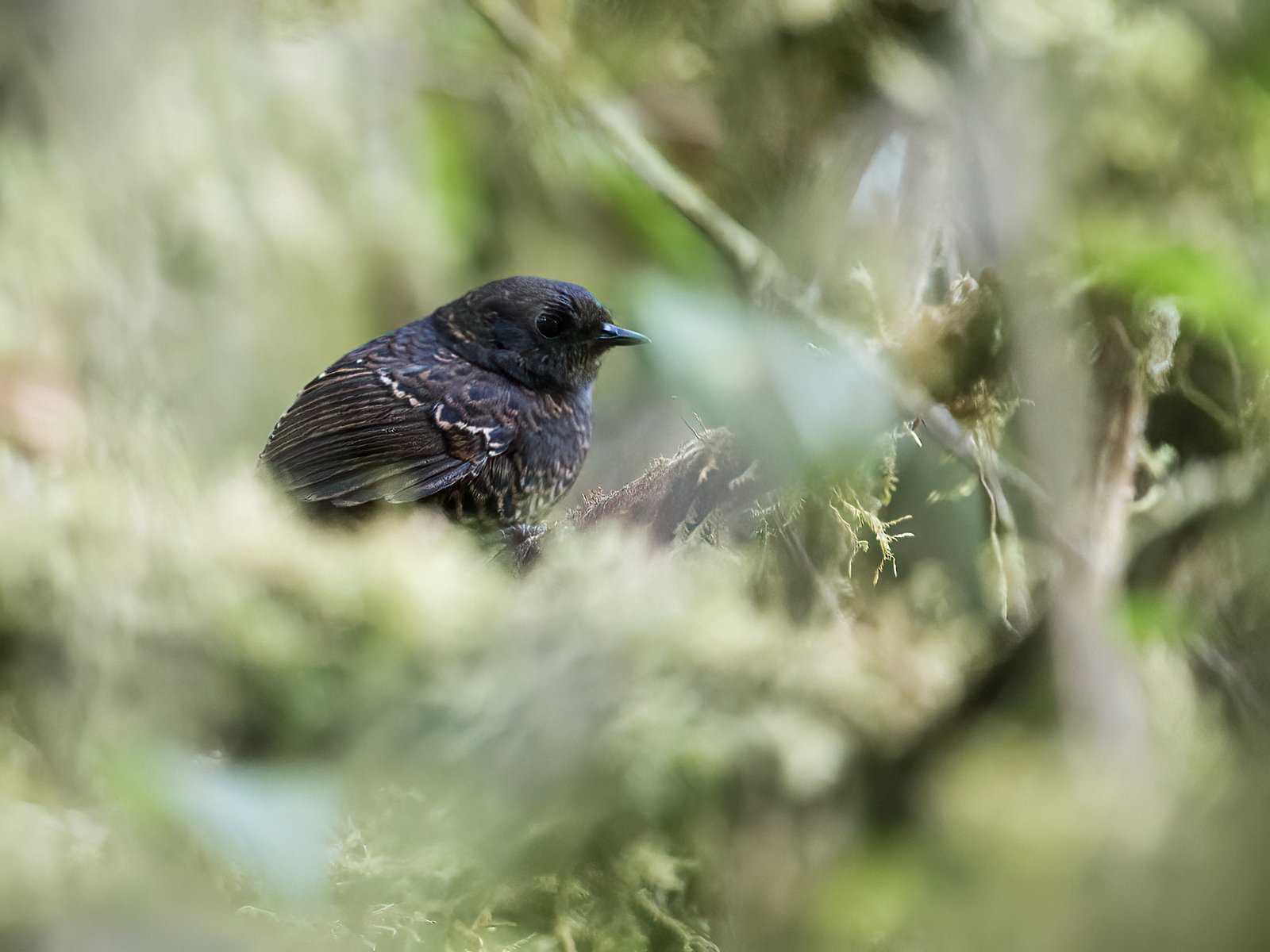
The Junin Tapaculo is a small grey tapaculo of cloud forest on the eastern slope of the Andes in the department of Junín in central Peru. It was described as a new species only in 2013. Its song, a rapidly repeated series of rising phrases, separates it from all other Scytalopus.
Voice
The song is a rapidly repeated series of short, rising phrases, unlike that of any other tapaculo in the area.
Recording: Gunnar Engblom — CC BY-NC-SA 4.0 · xeno-canto
Identification
11–12 cm. Adults are plain grey, with a variable amount of rufous on the flanks and rump. The female resembles the male but shows more rufous. Juveniles are browner, with dark barring.
Confusion species
In the field the song is the only reliable feature. Rufous-vented Tapaculo Scytalopus femoralis lives lower and has cinnamon, broadly black-barred flanks. Tschudi's Tapaculo Scytalopus acutirostris is darker grey, with a pointed bill, and lives mainly higher, up to the treeline. Large-footed Tapaculo Scytalopus macropus is much larger and lives along streams. Jalca Tapaculo Scytalopus frankeae lives higher, in scrub and forest at the treeline.
Habitat
Dense undergrowth of humid cloud forest, between about 2300 and 3400 m. It searches on and just above the ground for small insects and other invertebrates. Nothing is known about its breeding.
Where the bird is most at home, classified by the vegetation units of the Andes and the west coast.


Range and movements
Only in Peru, on the eastern slope of the Andes in Junín. When described, the species was known from two sites in a single drainage; since then it has been found at more sites in Junín. Absent from Colombia, Ecuador, Bolivia and the Galápagos. Does not occur outside the guide area.
- Resident
- dark = core range, pale = thinly spread
How and when to look
Listen in cloud forest along the roads that descend from the Junín highlands to the eastern slope for the rapidly repeated, rising phrases. Use the song as the key feature: the grey tapaculos of the area look very much alike.
Conservation status
Near Threatened. The known range is very small, and cloud forest on the eastern slope of Junín is locally cleared and burned for agriculture.
Scientific name
Scytalopus gettyae | Hosner, Robbins, Valqui H & Peterson, 2013
Hosner, Robbins, Valqui H & Peterson described the species in 2013 and placed it straight away in the genus where it still stands. The genus Scytalopus was introduced in 1837 by Gould. The genus name combines Greek skutalē or skutalon, 'stick', with pous, 'foot'. The species name gettyae honours Caroline Marie Getty, conservationist with the National Fish and Wildlife Foundation and granddaughter of J. Paul Getty. The specimen the first description was based on came from Cordillera Huaytapallana, Junín, Peru.