All species › Passerines › Tapaculos › Large-footed Tapaculo
Large-footed Tapaculo | Scytalopus macropus
Grootpoottapaculo | Churrín patudo | Tapaculo-de-pé-grande
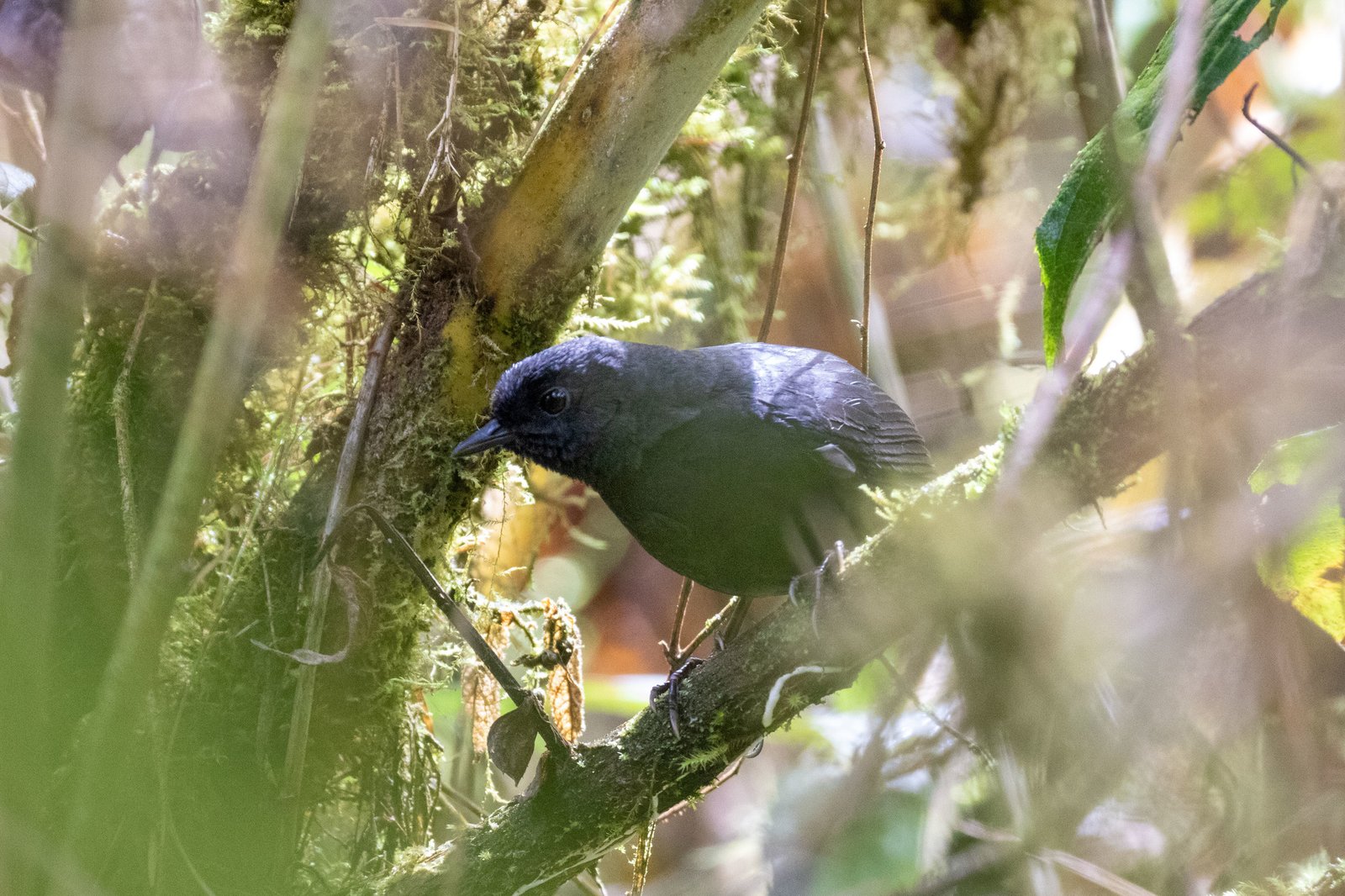
The Large-footed Tapaculo is the largest Scytalopus, a plain dark grey bird with heavy legs that inhabits mossy streams in high-elevation forest of the Peruvian Andes. It is little studied and known only from the eastern slope between Amazonas and Junín. Its closest relative is the much smaller Utcubamba Tapaculo.
Voice
A monotonous series of identical notes at a fairly slow pace, usually ending with a different, often higher note.
Recording: Daniel Lane — CC BY-NC-SA 3.0 · xeno-canto
Identification
14 cm, heavily built, with a fairly long tail, strong legs and large feet. Adults are plain dark slate grey, without barring on the flanks. The sexes are alike. Juveniles are slightly paler grey, with dark brown feather edges on the upperparts and pale brown to off-white feather tips on the underparts.
Confusion species
All other tapaculos in its range are clearly smaller. Tschudi's Tapaculo Scytalopus acutirostris and Utcubamba Tapaculo Scytalopus intermedius are equally dark grey but much smaller; Utcubamba Tapaculo has a similar but faster song. Rufous-vented Tapaculo Scytalopus femoralis lives lower and has cinnamon, black-barred flanks.
Habitat
Mossy undergrowth along streams and brooks in cloud forest and elfin forest, between about 2400 and 3500 m. It forages on the ground and among mossy stones and roots at the water's edge for invertebrates. Almost nothing is known about its breeding.
Where the bird is most at home, classified by the vegetation units of the Andes and the west coast.


Range and movements
Only in Peru, on the eastern slope of the Andes, from southern Amazonas south to Junín. Absent from Colombia, Ecuador, Bolivia and the Galápagos. Does not occur outside the guide area.
- Resident
- dark = core range, pale = thinly spread
How and when to look
Follow streams through mossy cloud forest on the eastern slope and listen for the slow series of notes above the sound of the water. The bird walks over stones and roots right along the water.
Conservation status
Least Concern. The range is restricted, the species is poorly known and it occurs in only one protected area.
Scientific name
Scytalopus macropus | Berlepsch & Sztolcman, 1896
Berlepsch & Sztolcman described the species in 1896 and placed it straight away in the genus where it still stands. The genus Scytalopus was introduced in 1837 by Gould. The genus name combines Greek skutalē or skutalon, 'stick', with pous, 'foot'. The species name comes from Greek makros, 'large, long', and pous, 'foot': large-footed. The specimen the first description was based on came from Maraynioc, Junín, Peru.