All species › Passerines › Tapaculos › Utcubamba Tapaculo
Utcubamba Tapaculo | Scytalopus intermedius
Utcubambatapaculo | Churrín de Utcubamba | Tapaculo-de-utcubamba
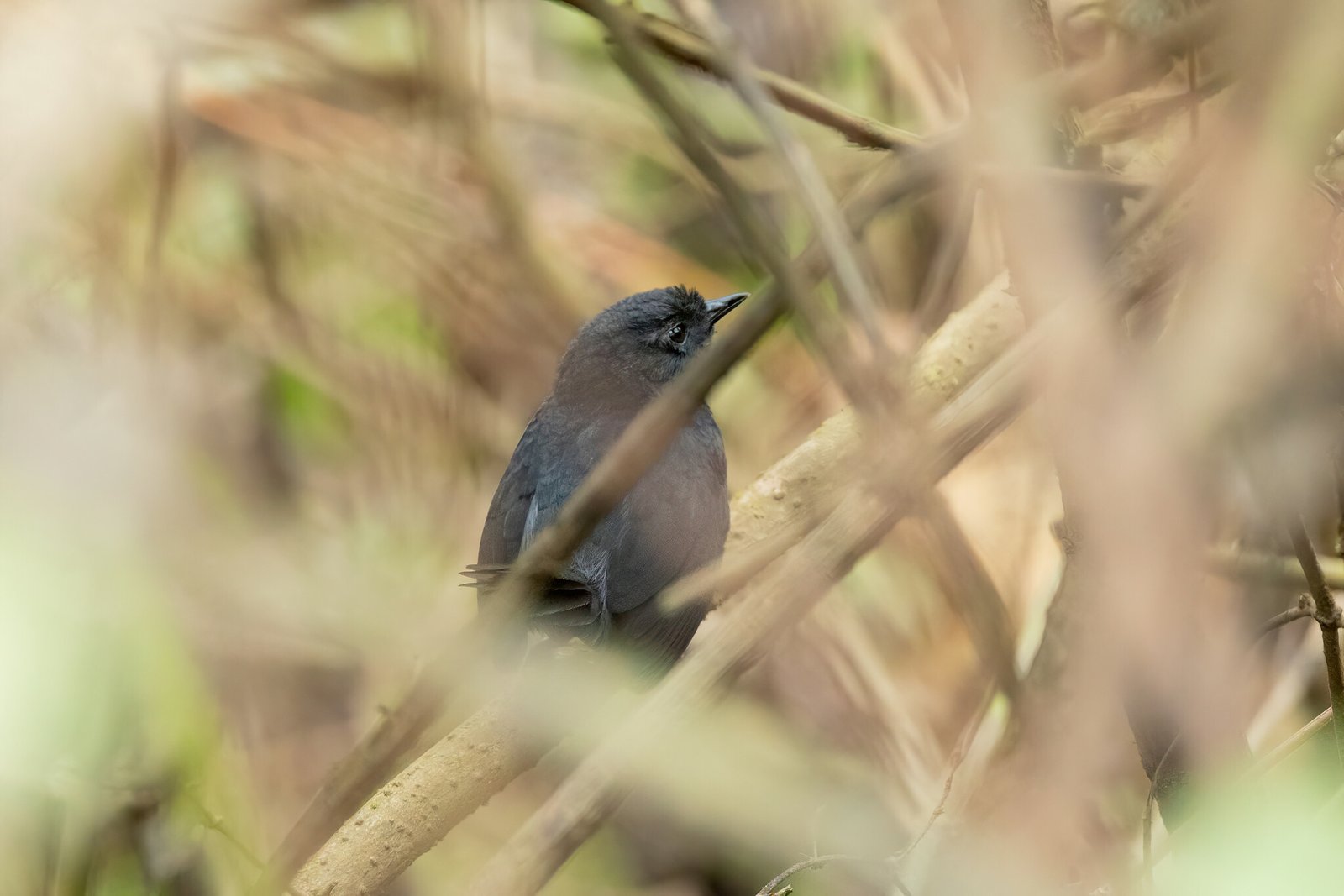
The Utcubamba Tapaculo is a small, plain dark grey tapaculo of high-elevation cloud forest in northern Peru, mainly in the Utcubamba drainage. It was long treated as a subspecies of Blackish Tapaculo, but song and DNA show that its closest relative is Large-footed Tapaculo. In the field it is identified mainly by its song.
Voice
The song is a monotonous series of identical notes at a fairly fast pace, similar to that of Large-footed Tapaculo but faster. Clearly different from the song of Blackish Tapaculo.
Recording: Guy Kirwan — CC BY-NC-SA 4.0 · xeno-canto
Identification
About 11 cm, with a fairly heavy bill that is slightly concave above the nostrils and convex towards the tip. Adults are plain dark slate grey, with at most a brownish tinge on the rear flanks. The sexes are nearly alike. Juveniles are browner, with dark barring.
Confusion species
Tschudi's Tapaculo Scytalopus acutirostris occurs alongside it at a few sites, is slightly smaller and has a thinner, more pointed bill and a different song. Large-footed Tapaculo Scytalopus macropus is much larger and lives mainly along streams; its song is very similar but slower. Trilling Tapaculo Scytalopus parvirostris replaces it lower on the eastern slope and sings a long trill. Neblina Tapaculo Scytalopus altirostris replaces it higher on the ridge between the Marañón and the Utcubamba.
Habitat
Undergrowth of humid cloud forest and elfin forest and their edges, between about 2550 and 3600 m, on average around 3000 m. It searches on and just above the ground among moss, ferns and shrubs for small insects and other invertebrates. Almost nothing is known about its breeding.
Where the bird is most at home, classified by the vegetation units of the Andes and the west coast.


Range and movements
Only in Peru, in the north: mainly in the Utcubamba drainage in Amazonas, west to above the right bank of the Marañón and east to above the Huallaga, south to central San Martín. Absent from Colombia, Ecuador, Bolivia and the Galápagos. Does not occur outside the guide area.
- Resident
- dark = core range, pale = thinly spread
How and when to look
Search forest remnants and cloud forest above Leymebamba and elsewhere in the Utcubamba valley, and listen early in the morning for the fast series of identical notes. Pay attention to the song: Tschudi's Tapaculo may be in the same forest.
Conservation status
Not Evaluated: the species has only recently been recognised as a separate species. The range is small, and high-elevation forest is locally under pressure from logging, burning and grazing.
Scientific name
Scytalopus intermedius | Zimmer, 1939
Zimmer described the species in 1939 and placed it straight away in the genus where it still stands. The genus Scytalopus was introduced in 1837 by Gould. The genus name combines Greek skutalē or skutalon, 'stick', with pous, 'foot'. The species name comes from Latin intermedius, 'intermediate', as the form was seen as intermediate between other tapaculos. The specimen the first description was based on came from La Lejía, Chachapoyas, Amazonas, Peru.