All species › Passerines › Tapaculos › Rufous-vented Tapaculo
Rufous-vented Tapaculo | Scytalopus femoralis
Roodbuiktapaculo | Churrín ventrirrufo | Tapaculo-de-crisso-ruivo
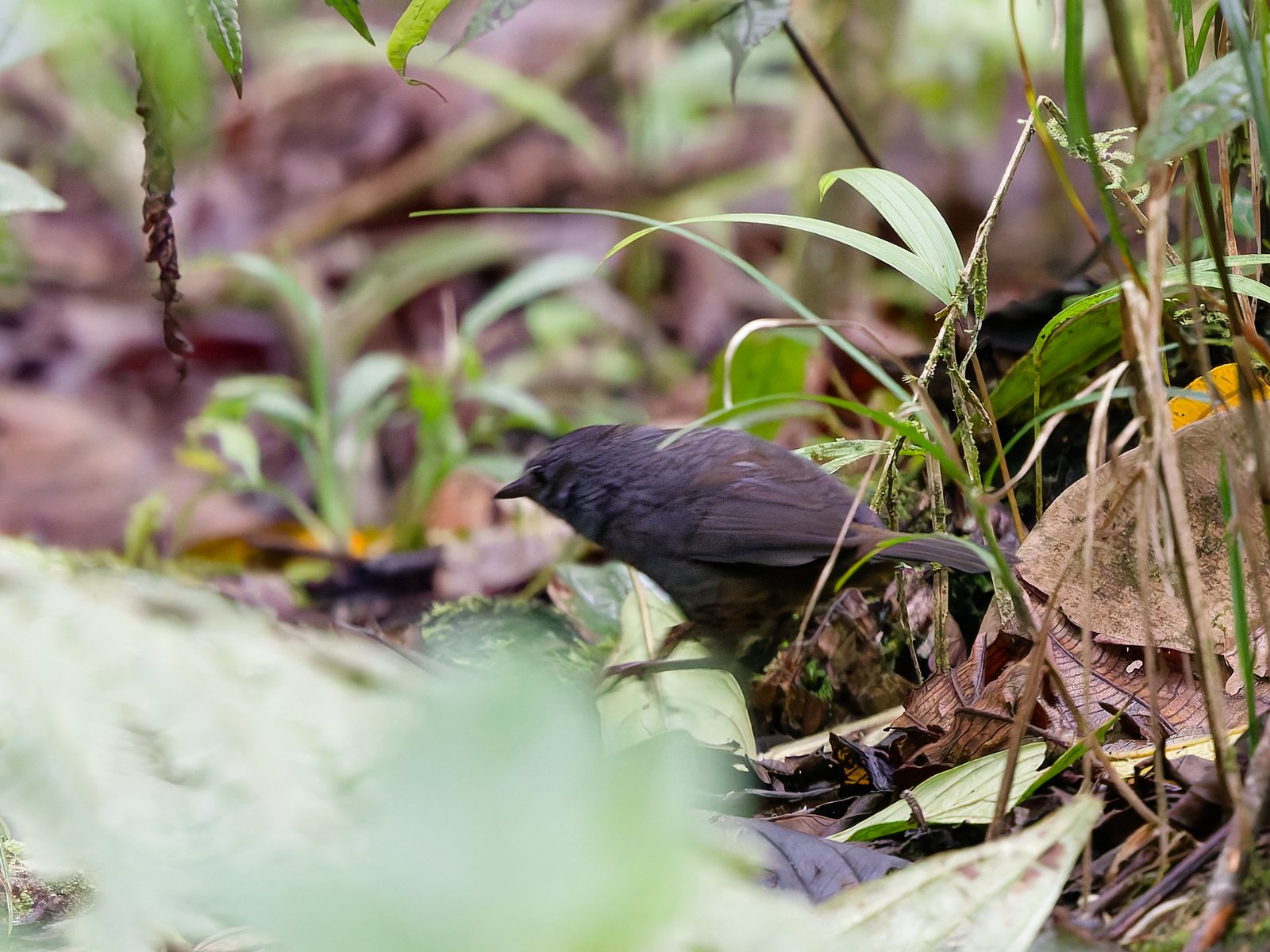
The Rufous-vented Tapaculo is a dark tapaculo of humid montane forest on the eastern slope of the Andes in Peru, with cinnamon, broadly black-barred flanks and vent. It is the sister species of the Long-tailed Tapaculo, which replaces it north of the Marañón. The song, an endlessly repeated single note, separates it from the other tapaculos in its elevational band.
Voice
The song is a single descending note repeated at an even pace, often for minutes on end. It sings mainly in the early morning, but also later in the day.
Recording: Fabrice Schmitt — CC BY-NC-SA 4.0 · xeno-canto
Identification
12.5 cm, medium-sized for the genus. The head and back are dark greyish brown, the rump dark rufous-brown. The throat, breast and belly are grey, paler than the upperparts. The flanks and undertail coverts are cinnamon with broad black bars. The sexes are nearly alike. Juveniles are brown with faint barring above and yellowish buff with dark bars below.
Confusion species
Large-footed Tapaculo Scytalopus macropus is larger and plain dark grey, without barred flanks, and lives higher along streams. Tschudi's Tapaculo Scytalopus acutirostris and Utcubamba Tapaculo Scytalopus intermedius are smaller and greyer and live higher, in cloud forest up to the treeline. Long-tailed Tapaculo Scytalopus micropterus is very similar, but has a longer tail and a different song and lives north of the Marañón.
Habitat
Undergrowth of humid primary and secondary montane forest, often in dense ferns and shrubs in ravines, mostly between 1600 and 2050 m, overall from about 1000 m to locally 2550 m. It searches on and just above the ground for small insects and other invertebrates. Little is known about the nest.
Where the bird is most at home, classified by the vegetation units of the Andes and the west coast.


Range and movements
Only in Peru, on the eastern slope of the Andes south of the Marañón, from southern Amazonas and San Martín south to Junín. Absent from Colombia, Ecuador, Bolivia and the Galápagos. Does not occur outside the guide area.
- Resident
- dark = core range, pale = thinly spread
How and when to look
Listen along mountain roads through humid forest at middle elevations on the eastern slope, for example in San Martín or Huánuco, for the long-repeated single note. The bird moves low in dense shrubbery and sometimes appears briefly at the edge of an open patch.
Conservation status
Least Concern. The population is considered fairly large and stable, and the species also occurs in secondary forest.
Scientific name
Scytalopus femoralis | (Tschudi, 1844)
Tschudi described the species in 1844 as Pteroptochus femoralis; because it was later moved to another genus, the author and year stand in brackets. The genus Scytalopus was introduced in 1837 by Gould. The genus name combines Greek skutalē or skutalon, 'stick', with pous, 'foot'. The species name comes from Latin femoralis, 'of the thighs' (femur, 'thigh'), after the rufous flanks and thighs. The specimen the first description was based on came from Vitoc Valley, Junín, Peru.