All species › Passerines › Tapaculos › Long-tailed Tapaculo
Long-tailed Tapaculo | Scytalopus micropterus
Langstaarttapaculo | Churrín colilargo | Tapaculo-de-cauda-longa
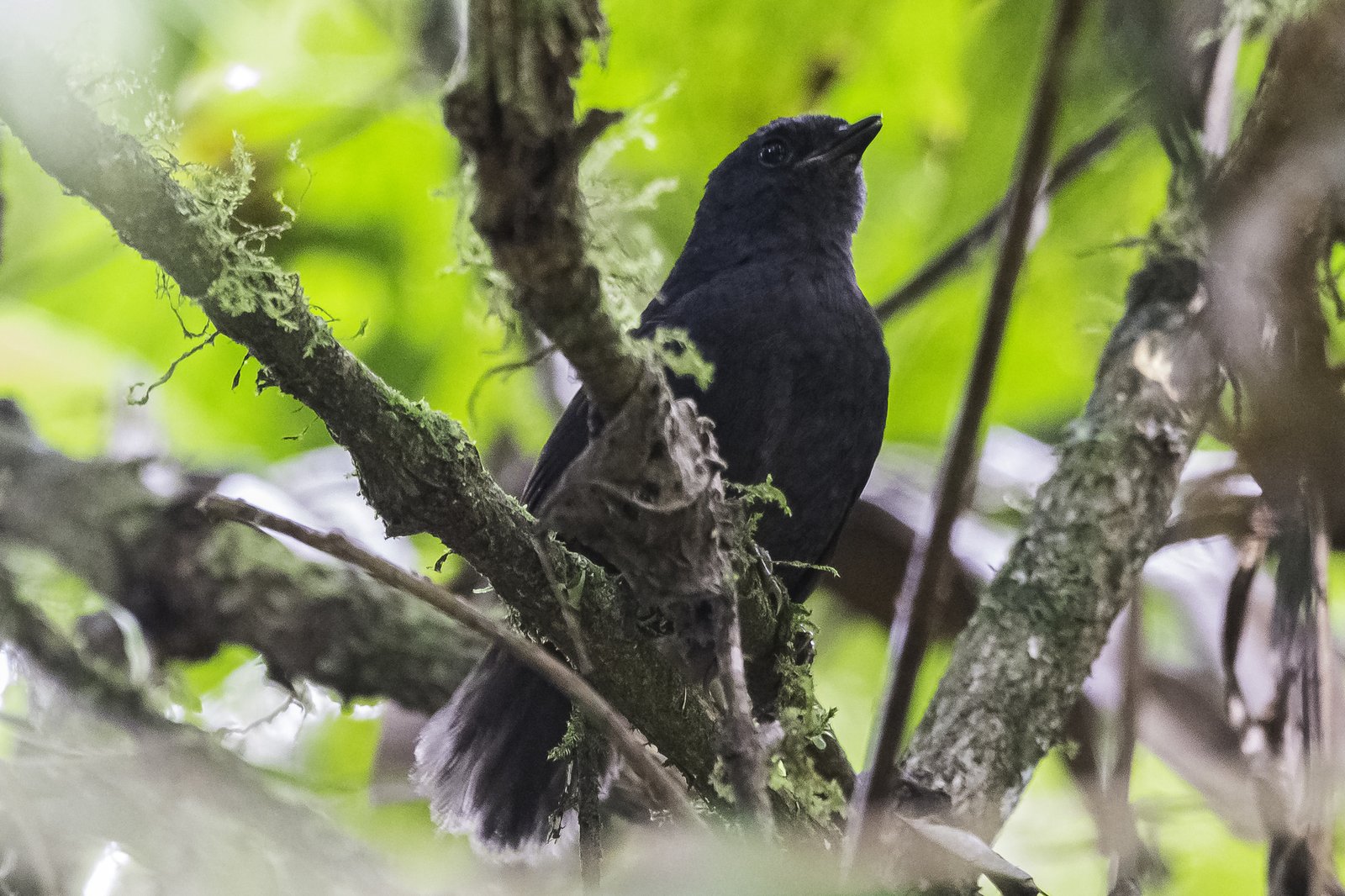
The Long-tailed Tapaculo is a dark grey tapaculo with rufous-brown, black-barred flanks and a tail that is long for the genus. It lives in dense undergrowth of humid montane forest on the eastern slope of the Andes, from southern Colombia to the far north of Peru. As in all Scytalopus, the song is the key feature.
Voice
The song starts with a few single notes and then changes into a long series of two-note phrases, sometimes kept up for minutes. When alarmed, a descending series of sharp notes.
Recording: Daan van der Hoeven — CC BY-NC-SA 4.0 · xeno-canto
Identification
12.5–13.5 cm, one of the larger tapaculos of the genus, with a tail clearly longer than in most relatives. The male is dark slate grey, slightly paler on the throat and breast, with rufous-brown, black-barred flanks, rump and undertail coverts. The female is duller, with more brown on the upperparts. Juveniles are brown with dark barring. The bill is dark, the legs brownish.
Confusion species
Spillmann's Tapaculo Scytalopus spillmanni usually lives higher, has a shorter tail and less rufous on the flanks, and sings differently. Blackish Tapaculo Scytalopus latrans is plain blackish in the male, without barred flanks, and favours forest edges and scrub. Ash-colored Tapaculo Myornis senilis is paler ash grey, with a long tail, and lives higher in bamboo. South of the Marañón the closely related Rufous-vented Tapaculo Scytalopus femoralis takes its place.
Habitat
Dense undergrowth of humid montane forest and cloud forest, often in ravines and along streams and forest edges, mostly between 1250 and 2300 m; in Peru only between about 1650 and 1950 m. It walks and hops over the forest floor, among fallen trunks and mossy roots, searching for small insects and other invertebrates. Little is known about the nest; in related species it is a ball of moss in a hole in a bank or among roots.
Where the bird is most at home, classified by the vegetation units of the Andes and the west coast.


Range and movements
In Colombia in the south, on the eastern slope of the Andes and at the head of the Magdalena valley. In Ecuador along the whole eastern slope. In Peru only in the far north, north of the Marañón. Absent from Bolivia and the Galápagos. Does not occur outside the guide area.
- Resident
- dark = core range, pale = thinly spread
How and when to look
Listen early in the morning along mountain roads on the eastern slope, for example over the Cordillera de Guacamayos in Ecuador, for the long series of two-note phrases. The bird stays low in dense vegetation and sometimes briefly crosses an open patch in the undergrowth.
Conservation status
Least Concern. The range is a narrow elevational band, but the species also uses forest edges and older secondary forest.
Scientific name
Scytalopus micropterus | (Sclater, 1858)
Sclater described the species in 1858 as Agathopus micropterus; because it was later moved to another genus, the author and year stand in brackets. The genus Scytalopus was introduced in 1837 by Gould. The genus name combines Greek skutalē or skutalon, 'stick', with pous, 'foot'. The species name comes from Greek mikros, 'small', and pteron, 'wing': small-winged. The specimen the first description was based on came from Río Napo, Ecuador.