All species › Passerines › Tapaculos › Santa Marta Tapaculo
Santa Marta Tapaculo | Scytalopus sanctaemartae
Santamartatapaculo | Churrín de Santa Marta | Macuquinho-de-santa-marta
The Santa Marta Tapaculo occurs only in the isolated Sierra Nevada de Santa Marta in northern Colombia. It lives hidden in the dense undergrowth of humid montane forest at lower and middle elevations of the massif. It was formerly treated as a subspecies of Rufous-vented Tapaculo; mainly its song led to its recognition as a separate species.
Voice
The song is a fast trill lasting up to about 15 seconds. The call is a repeated, sharp squeak.
Recording: Ross Gallardy — CC BY-NC-SA 4.0 · xeno-canto
Identification
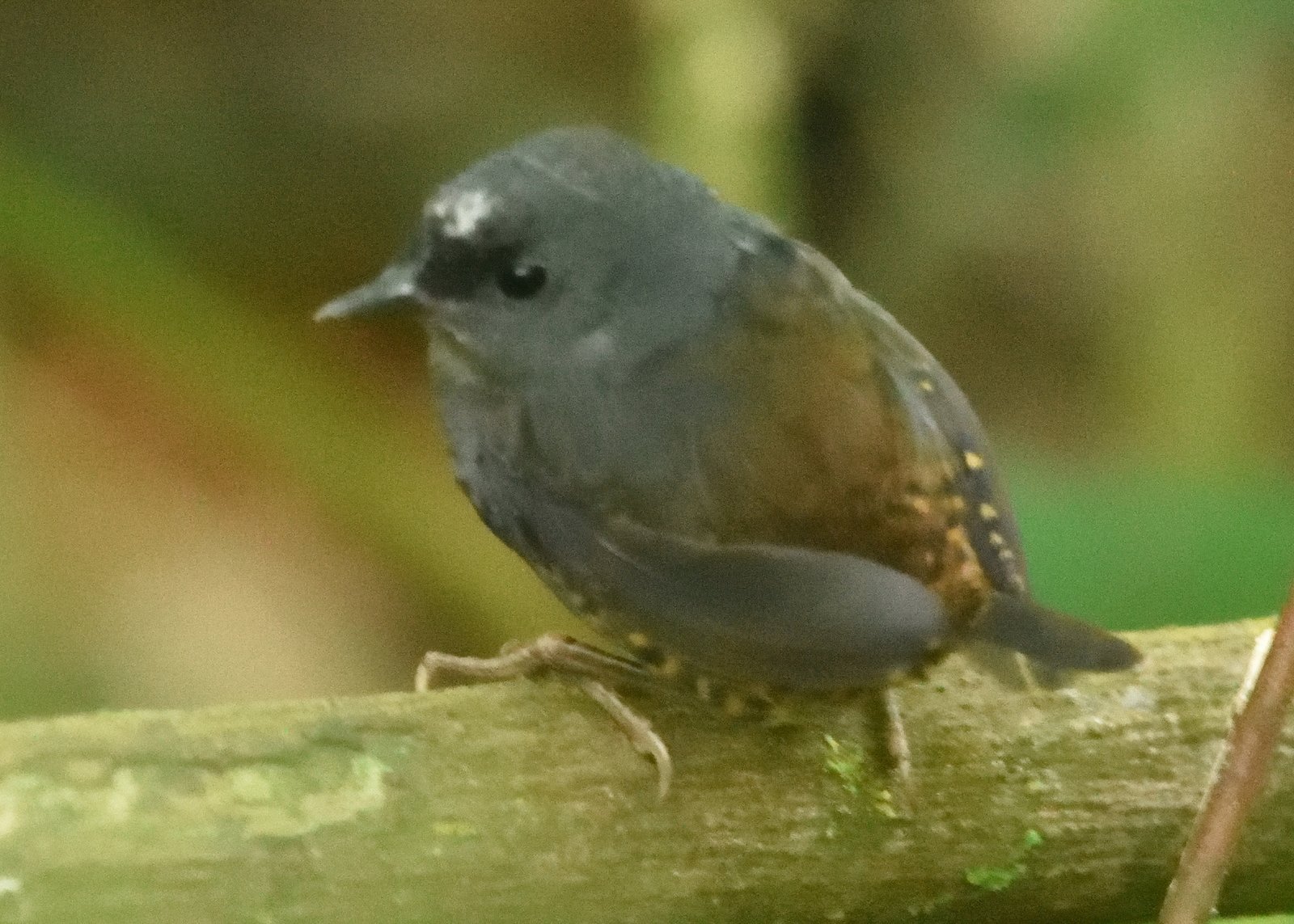
11 cm, round and short-tailed. The male has a medium grey head and back, a paler grey throat and breast and a white crown patch. The rump is tawny with black bars; the flanks and undertail coverts are rusty with black barring. The female is washed brown above and paler below, with a small or no white crown patch. Juveniles are densely barred and scaled.
Confusion species
Brown-rumped Tapaculo Scytalopus latebricola, also confined to the Sierra Nevada de Santa Marta, lives higher in the massif, mainly above about 2000 m, lacks a white crown patch and sings differently. White-crowned Tapaculo Scytalopus atratus of the Andes is similar but does not occur in the Sierra Nevada.
Habitat
Dense undergrowth of humid montane forest and forest edges, at roughly 900 to 1700 m, locally higher. It lives on the ground and presumably feeds on small invertebrates. Little is known about its breeding; a juvenile was collected in July.
Where the bird is most at home, classified by the vegetation units of the Andes and the west coast.


Range and movements
Only in Colombia, in the Sierra Nevada de Santa Marta. Absent from Ecuador, Peru, Bolivia and the Galápagos. Does not occur outside the guide area.
- Resident
- dark = core range, pale = thinly spread
How and when to look
Listen along the road from Minca up towards the Cuchilla de San Lorenzo, at lower and middle elevations, for the long trill from dense undergrowth in forested ravines. Birds sing most in the early morning.
Conservation status
Near Threatened. The range is small and confined to a single massif, where much forest on the lower slopes has been cleared for agriculture, including coffee.
Scientific name
Scytalopus sanctaemartae | Chapman, 1915
Chapman described the species in 1915 and placed it straight away in the genus where it still stands. The genus Scytalopus was introduced in 1837 by Gould. The genus name combines Greek skutalē or skutalon, 'stick', with pous, 'foot'. The species name sanctaemartae refers to the Sierra Nevada de Santa Marta in northern Colombia; this is not necessarily the type locality. The specimen the first description was based on came from Valparaíso, Sierra Nevada de Santa Marta, Colombia.