All species › Passerines › Tapaculos › White-crowned Tapaculo
White-crowned Tapaculo | Scytalopus atratus
Witkruintapaculo | Churrín coroniblanco | Macuquinho-de-coroa-branca
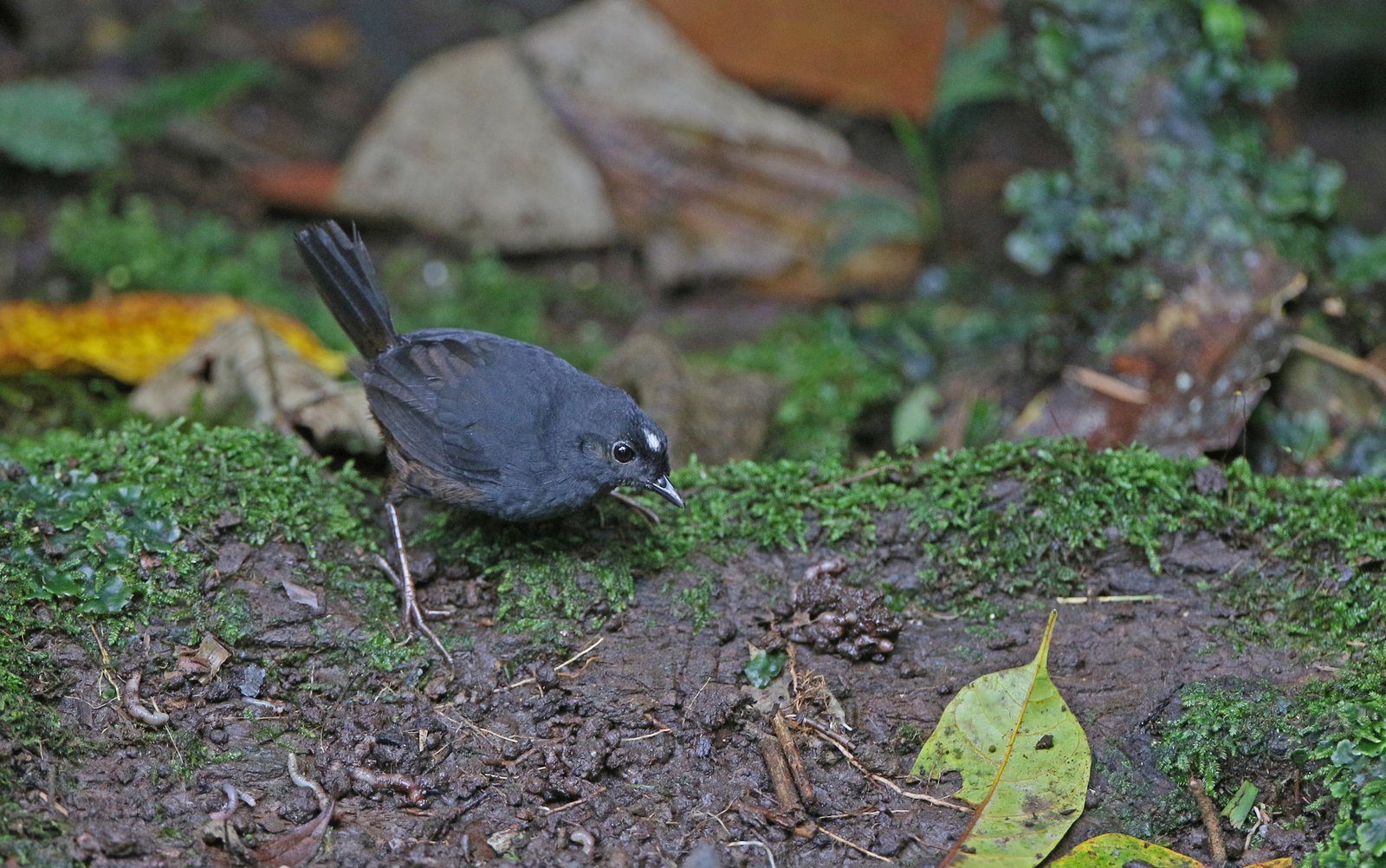
The White-crowned Tapaculo is a fairly large, almost black tapaculo with a white crown patch, found in the undergrowth of humid montane forest from Venezuela to central Peru. It was formerly treated as a subspecies of Rufous-vented Tapaculo. The song differs strongly between populations, which may indicate that more than one species is involved.
Voice
The song varies greatly between populations; usually a long series of rapidly repeated short notes or a trill, from dense undergrowth. There are also sharp single call notes.
Recording: GABRIEL LEITE — CC BY-NC-SA 4.0 · xeno-canto
Identification
12 cm, round and short-tailed. The male of the nominate form is blackish above and slightly paler below, with a white patch on the crown; the flanks and undertail coverts are rufous-brown with black bars. The female is paler, washed brown above and with more rufous flanks. Juveniles are rusty and densely barred. The form confusus of the Western and Central Andes of Colombia is slate-grey, with a brownish lower back and more extensive, more heavily barred rufous on the flanks and undertail.
Confusion species
Spillmann's Tapaculo Scytalopus spillmanni lives higher, in cloud forest, and lacks the white crown patch. Stiles's Tapaculo Scytalopus stilesi of the Central and Western Andes of Colombia also lacks the white crown and sings differently. Choco Tapaculo Scytalopus chocoensis lives lower on the western slope, in the Chocó, without a white crown patch. Bolivian Tapaculo Scytalopus bolivianus replaces it in south-eastern Peru and Bolivia.
Habitat
Undergrowth in the interior and at the edges of humid montane forest, also in old secondary forest, at roughly 850 to 1900 m, locally higher. It forages on and just above the ground for insects and is territorial year-round. Little is known about its breeding; in Ecuador a juvenile has been found in January.
Where the bird is most at home, classified by the vegetation units of the Andes and the west coast.


Range and movements
In Colombia in all three Andean ranges. In Ecuador on the eastern slope. In Peru on the eastern slope south to Cusco. Not reliably recorded in Bolivia, where Bolivian Tapaculo occurs. Absent from the Galápagos. Outside the guide area in western Venezuela, in the Sierra de Perijá and the Andes of Táchira and Mérida.
- Resident
- dark = core range, pale = thinly spread
How and when to look
Listen at middle elevations on the eastern slope of Ecuador, for example around Sumaco, and in forested ravines in the Colombian Andes for the long series of notes. The bird sometimes appears briefly on a fallen log or at the edge of a trail.
Conservation status
Least Concern. The range is large and the population is considered stable; the species also lives in old secondary forest.
Scientific name
Scytalopus atratus | Hellmayr, 1922
Hellmayr described the species in 1922 and placed it straight away in the genus where it still stands. The genus Scytalopus was introduced in 1837 by Gould. The genus name combines Greek skutalē or skutalon, 'stick', with pous, 'foot'. The species name comes from Latin atratus, 'clothed in black', after the dark plumage. The specimen the first description was based on came from Río Negro, Boyacá, Colombia.