All species › Passerines › Ovenbirds and woodcreepers › Line-cheeked Spinetail
Line-cheeked Spinetail | Cranioleuca antisiensis
Streepwangstekelstaart | Curutié cariestriado | Arredio-de-bochecha-listrada
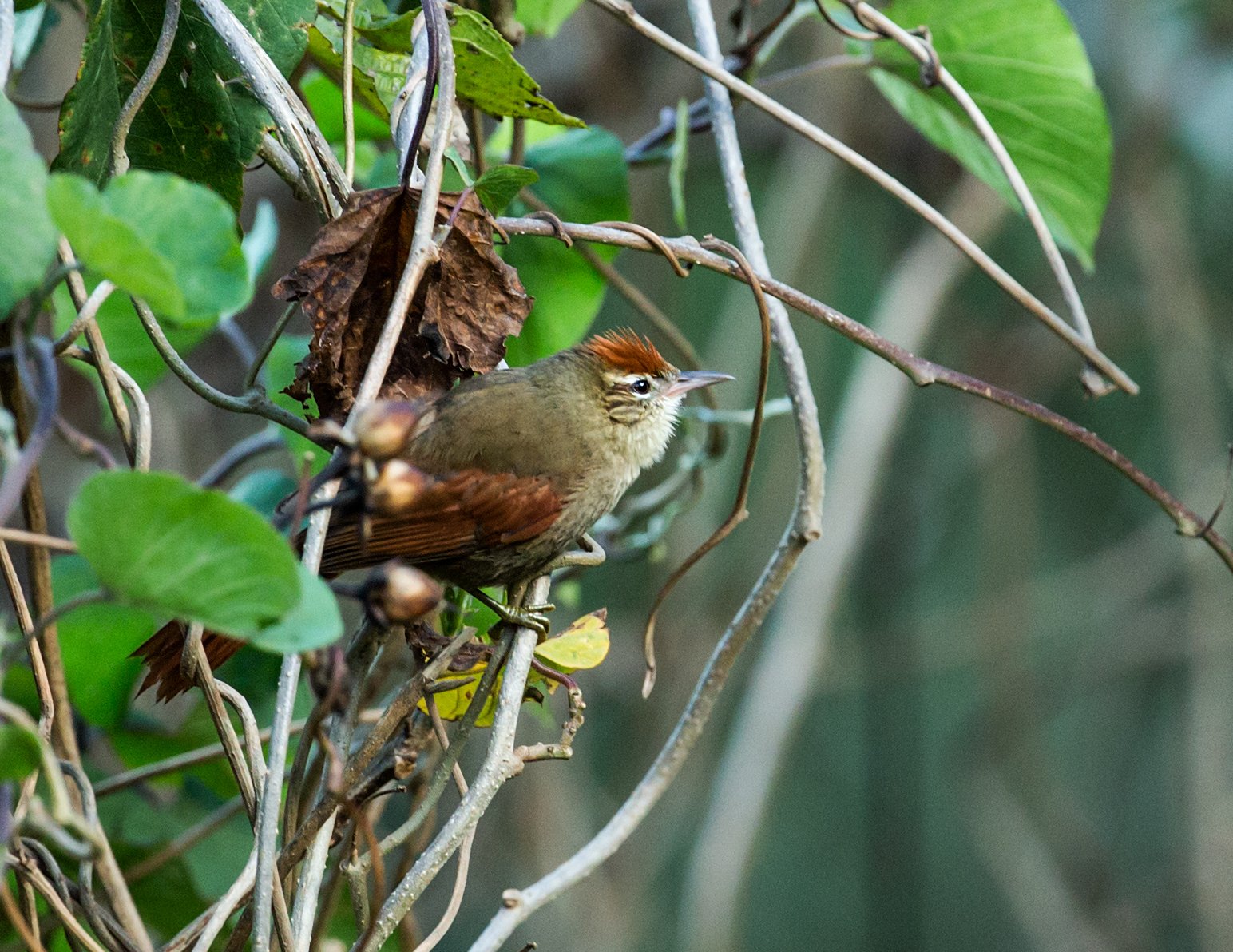
The Line-cheeked Spinetail is an ovenbird of semi-humid montane scrub and forest edges on the western slope of the Andes, from south-western Ecuador to central Peru. Fine pale streaks on the cheeks and a white eyebrow below the rufous crown mark it out. The larger form baroni of northern and central Peru was formerly treated as a separate species.
Voice
Chattering and scolding calls, including a tsi-chik. The song is a series of loud, shrill notes usually ending in a trill. It sings mainly in the early morning and at dusk.
Recording: Jerome Fischer — CC BY-NC-SA 4.0 · xeno-canto
Identification
14–16 cm; the Peruvian forms are larger than those in Ecuador. A pointed bill and a rufous tail with spiny tips. The crown is rufous, with a sharply defined white eyebrow; the ear coverts are finely streaked pale and the throat is pale. The upperparts are brown to olive-grey, the wings rufous. Breast and belly are greyish brown. The sexes are alike.
Confusion species
Ash-browed Spinetail Cranioleuca curtata lives on the eastern slope and in wetter forest, with a dingy grey eyebrow and no streaked cheeks. Red-faced Spinetail Cranioleuca erythrops has a rufous face; juveniles with a buff eyebrow can resemble this species in south-western Ecuador. Creamy-crested Spinetail Cranioleuca albicapilla in central Peru is larger, with a creamy-white crown and crest.
Habitat
Semi-humid to humid montane scrub, forest edges and dense evergreen woodland, drier than cloud forest, but not in dry deciduous forest or desert; in central Peru also in Polylepis and alder woodland. In Ecuador from about 800 m, up to about 3000 m near the treeline, locally higher. It forages in pairs or with mixed flocks along branches, moss and epiphytes for insects. The nest is a ball of moss hanging from a branch.
Where the bird is most at home, classified by the vegetation units of the Andes and the west coast.


Range and movements
In Ecuador in the south-west, in Azuay, El Oro and Loja. In Peru on the western slope and in the western Andes from Piura and Cajamarca south to Huánuco, Pasco and Lima. Absent from Colombia, Bolivia and the Galápagos. Does not occur outside the guide area.
- Resident
- dark = core range, pale = thinly spread
How and when to look
Search shrubby forest edges and ravines on the western slope, in Ecuador in Loja province, in Peru in the higher valleys of Cajamarca and Ancash; the bird is most vocal in the early morning.
Conservation status
Least Concern. Semi-humid forest on the western slope is heavily fragmented by farming, grazing and logging.
Scientific name
Cranioleuca antisiensis | (Sclater, 1859)
Sclater described the species in 1859 as Synallaxis antisiensis; because it was later moved to another genus, the author and year stand in brackets. The genus Cranioleuca was introduced in 1853 by Reichenbach. The genus name comes from Greek kranion, 'skull', and leukos, 'white'. The species name is New Latin antisiensis, 'of the Andes', from Inca anti, 'copper', which was mined there. The specimen the first description was based on came from Cuenca, Ecuador.