All species › Passerines › Ovenbirds and woodcreepers › Pacific Tuftedcheek
Pacific Tuftedcheek | Pseudocolaptes johnsoni
Pacifische pluimoor | Barbablanca del Pacífico | Barba-branca-do-pacífico
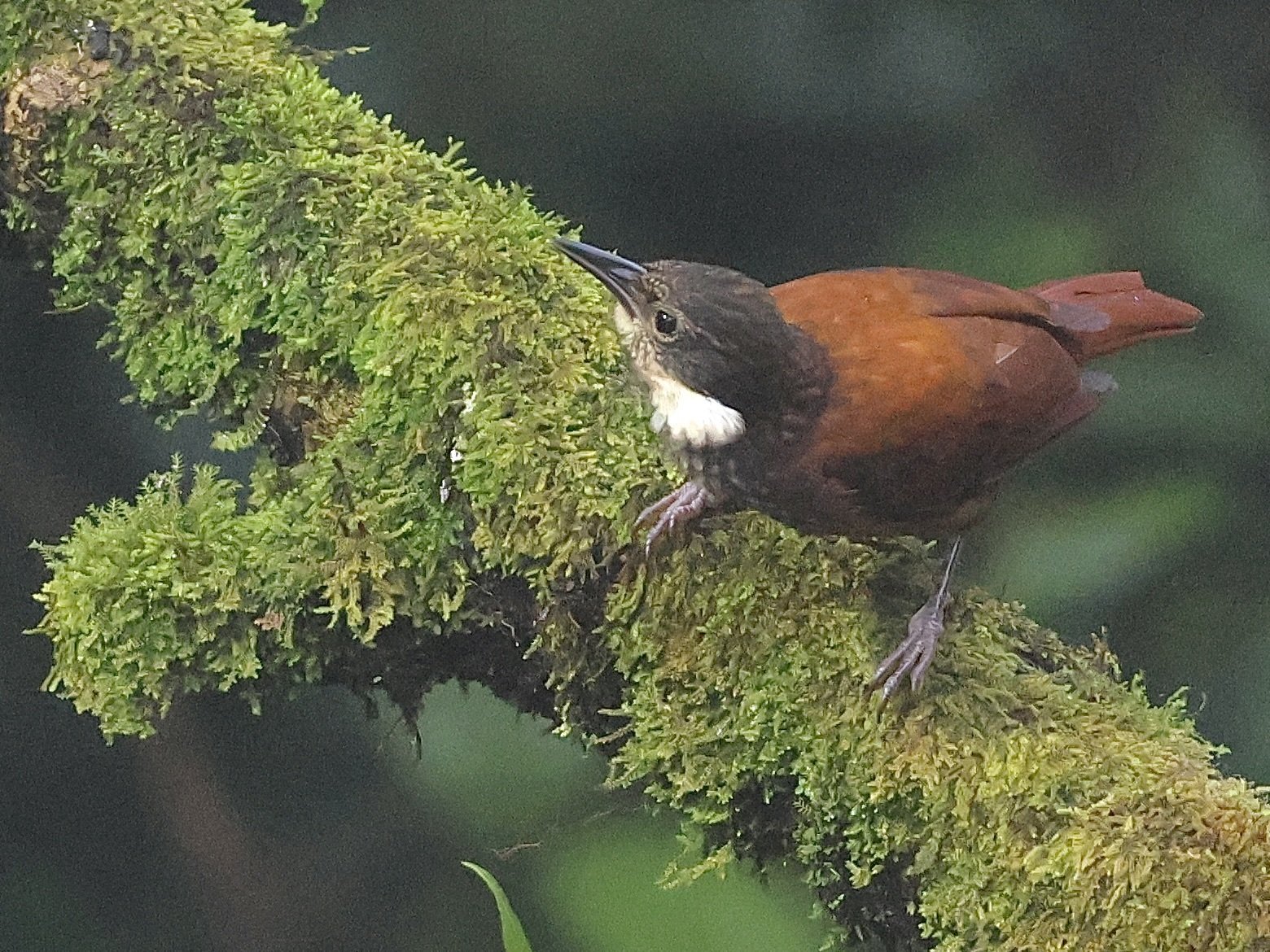
The Pacific Tuftedcheek is a large ovenbird with fluffy, creamy-white tufts on the sides of the neck, of humid montane forest on the Pacific side of the Andes. It searches bromeliads and other epiphytes in the middle storey and canopy. It was long treated as a subspecies of the Central American Buffy Tuftedcheek Pseudocolaptes lawrencii.
Voice
Gives loud, sharp chek notes; the song is a series of hard notes running into a dry trill.
Recording: Olaf Jahn — CC BY-NC-SA 4.0 · xeno-canto
Identification
21 cm, with a straight, fairly strong bill and a long, rufous tail. The crown is dark blackish brown, the mantle warm brown with little streaking, the wings and tail rufous. The throat and the long feathers on the sides of the neck form a fluffy, creamy-white tuft. The breast and belly are warm ochre to cinnamon-brown, the breast with narrow, faint pale streaks. The sexes are alike.
Confusion species
Streaked Tuftedcheek Pseudocolaptes boissonneautii has a more heavily streaked mantle and breast and paler, greyish-buff underparts, and lives higher in the mountains; where both occur, Pacific Tuftedcheek is found lower. Flammulated Treehunter Thripadectes flammulatus lacks the white neck tuft, is heavily streaked and has a heavier bill.
Habitat
Humid, epiphyte-rich montane forest and cloud forest on the Pacific slope, roughly between 700 and 2100 m. It searches bromeliads, moss and dead leaves in the middle storey and canopy for insects and other invertebrates, often with mixed flocks. It nests in a tree cavity.
Where the bird is most at home, classified by the vegetation units of the Andes and the west coast.


Range and movements
Colombia: on the Pacific slope of the Western Andes. Ecuador: on the western slope of the Andes, south to the south-west of the country. Absent from Peru, Bolivia and the Galápagos. Does not occur outside the guide area.
- Resident
- dark = core range, pale = thinly spread
How and when to look
Search cloud forest on the western slope, for example around Mindo, for mixed flocks in the middle storey and watch for a large brown bird rummaging in bromeliads, which shows the white neck tuft.
Conservation status
Least Concern. The range is limited and montane forest on the Pacific side is being cleared in many places.
Scientific name
Pseudocolaptes johnsoni | Lönnberg & Rendahl, 1922
Lönnberg & Rendahl described the species in 1922 and placed it straight away in the genus where it still stands. The genus Pseudocolaptes was introduced in 1853 by Reichenbach. The genus name combines Greek pseudos, 'false', and kolaptēs, 'chiseller' or 'woodpecker'. The species name honours Axel Axelson Johnson (1876–1958), a Swede who was Consul-General for Thailand in 1911–1912. The specimen the first description was based on came from Baeza, Napo, Ecuador.