All species › Passerines › Ovenbirds and woodcreepers › Streaked Tuftedcheek
Streaked Tuftedcheek | Pseudocolaptes boissonneautii
Andespluimoor | Barbablanca rayada | Barba-branca-listrado
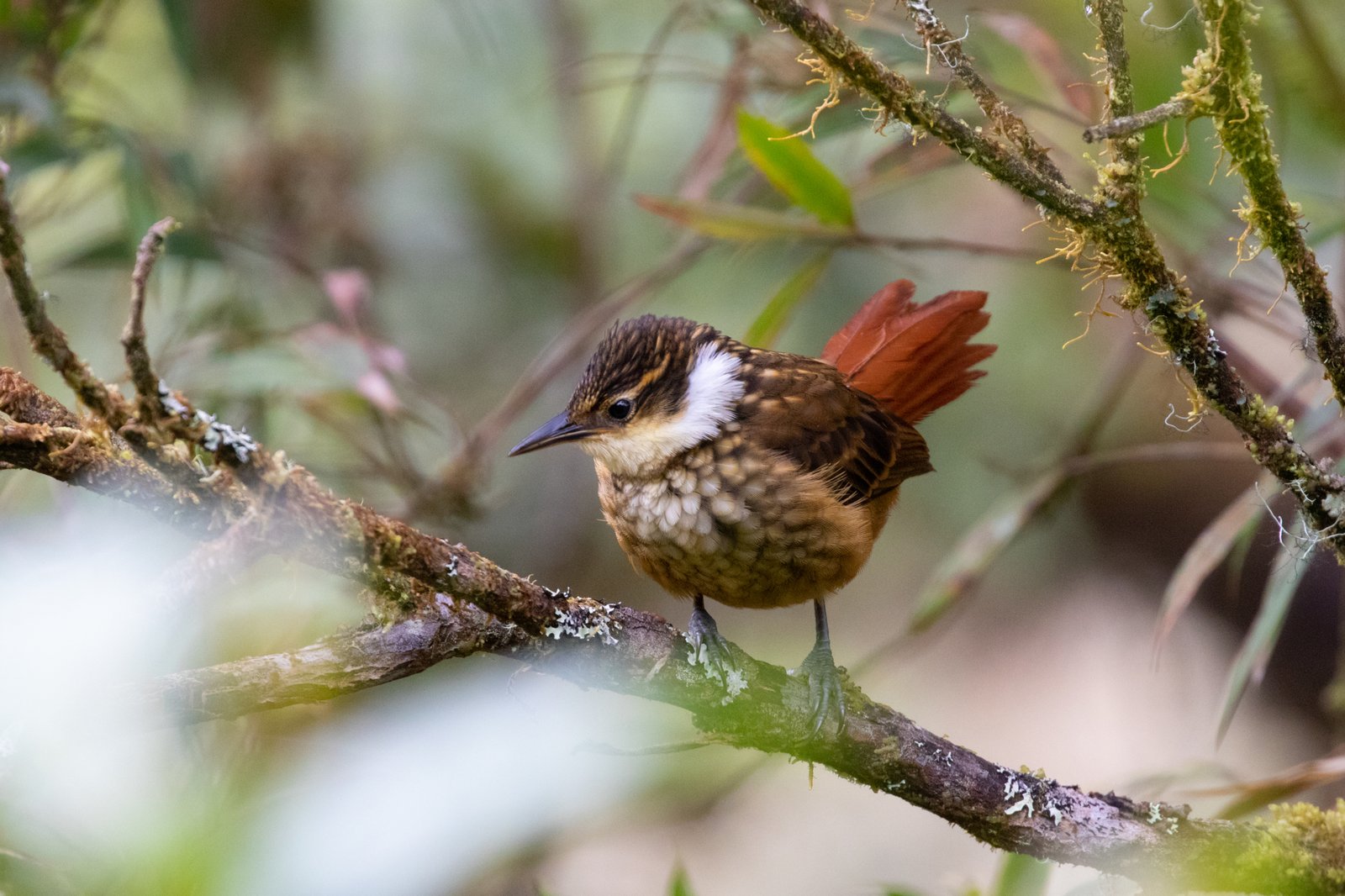
The Streaked Tuftedcheek is a large ovenbird of higher montane forest in the Andes, with fluffy white tufts on the sides of the neck. It searches bromeliads and mossy branches and is often a regular member of mixed flocks. It is the more widespread of the two tuftedcheeks in the guide area.
Voice
Gives loud, sharp chek notes. The song is a series of sharp notes running into a dry, rattling trill.
Recording: Juan Freile — CC BY-NC-SA 4.0 · xeno-canto
Identification
21–22 cm, with a straight, fairly strong bill and a long, rufous tail. The crown is blackish with fine pale streaks, the mantle brown with buff streaks, the wings and tail rufous. The throat and the long feathers on the sides of the neck form a fluffy, white tuft. The breast is greyish buff with dark-edged pale streaks, the belly plainer ochre-brown. The sexes are alike.
Confusion species
Pacific Tuftedcheek Pseudocolaptes johnsoni is warmer ochre to cinnamon-brown below, with less streaking on the mantle and breast, and lives lower on the Pacific slope. Flammulated Treehunter Thripadectes flammulatus lacks the white neck tuft, is more heavily streaked and has a heavier bill. Lineated Foliage-Gleaner Syndactyla subalaris is smaller and lacks the neck tuft.
Habitat
Humid montane forest and cloud forest, often with many bromeliads and much moss and locally with bamboo, mostly between 1800 and 3400 m. It searches bromeliads, moss and clusters of dead leaves in the middle storey and canopy for insects and other invertebrates. It nests in a tree cavity, often an old woodpecker hole.
Where the bird is most at home, classified by the vegetation units of the Andes and the west coast.


Range and movements
Colombia: in all three Andean ranges. Ecuador: on both slopes of the Andes. Peru: along the eastern slope throughout the country and locally on the western slope in the north. Bolivia: on the eastern slope, from La Paz to Cochabamba and western Santa Cruz. Absent from the Galápagos. Outside the guide area in the Andes of Venezuela.
- Resident
- dark = core range, pale = thinly spread
How and when to look
Follow mixed flocks in cloud forest above 2000 m and watch for a large brown bird half buried in a bromeliad, which shows the white neck tuft.
Conservation status
Least Concern. The species is fairly common in continuous montane forest, but disappears where the forest becomes fragmented.
Scientific name
Pseudocolaptes boissonneautii | (de Lafresnaye, 1840)
De Lafresnaye described the species in 1840 as Anabates Boissonneautii; because it was later moved to another genus, the author and year stand in brackets. The genus Pseudocolaptes was introduced in 1853 by Reichenbach. The genus name combines Greek pseudos, 'false', and kolaptēs, 'chiseller' or 'woodpecker'. The species name honours the French natural history dealer and ornithologist Auguste Boissonneau, who spelled his own name Boissonneau. The specimen the first description was based on came from Bogotá, Colombia.