All species › Passerines › Ovenbirds and woodcreepers › Line-fronted Canastero
Line-fronted Canastero | Asthenes urubambensis
Urubambacanastero | Canastero del Urubamba | Lenheiro-de-testa-riscada
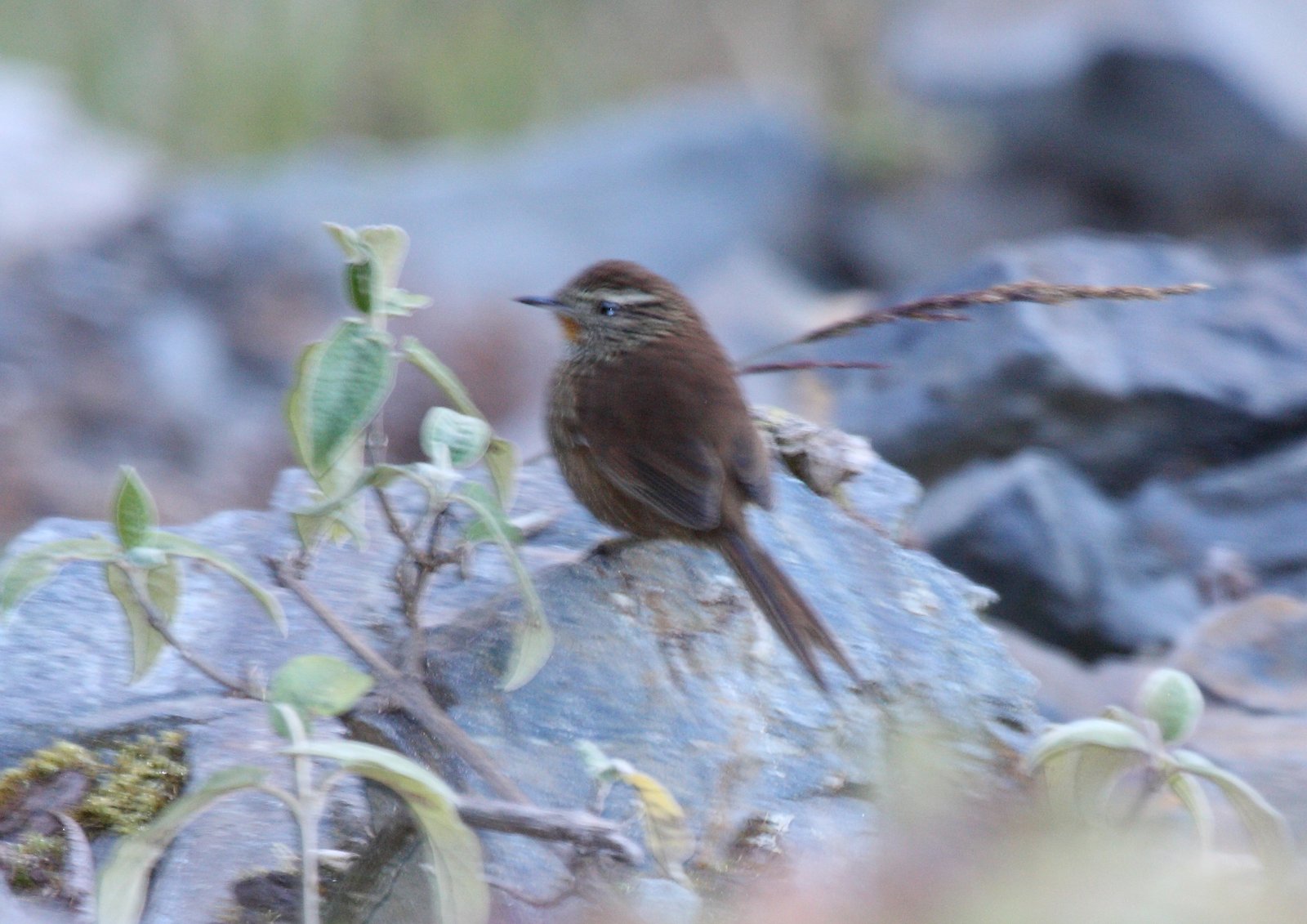
The Line-fronted Canastero is a dark, streaked canastero of Polylepis woodland and treeline scrub in the Andes of Peru and Bolivia. It is closely tied to humid Polylepis groves, which are fragmented throughout its range. The narrow pale streaks on the forehead and cheeks gave it its English name.
Voice
Often silent. The song is a high, rising trill; calls with thin tsip notes.
Recording: Jacob Wijpkema — CC BY-NC-SA 4.0 · xeno-canto
Identification
16–17 cm, with a thin, straight bill and a long, narrow, slightly frayed tail. The upperparts are dark olive-brown, with fine buff streaks on the forehead and cheeks and a long, pale eyebrow. The throat has a small orange-rufous patch. The underparts are greyish brown, faintly streaked pale on the breast. The tail is dark brown. The sexes are alike.
Confusion species
Puna Thistletail Asthenes helleri is plain brown, without streaks, with a longer, forked tail and an orange chin patch. Scribble-tailed Canastero Asthenes maculicauda is heavily streaked on the back and head, with a rufous forehead, and lives in open puna grassland. Junin Canastero Asthenes virgata is warmer brown and more heavily streaked, and also lives in grassland. Many-striped Canastero Asthenes flammulata is more heavily and contrastingly streaked and lives in páramo further north.
Habitat
Humid Polylepis groves, mossy shrubs and treeline scrub, and the border of scrub and puna, mostly between 3500 and 4500 m. It forages alone or in pairs among moss, twigs and leaves for insects, often with mixed flocks. The nest is in dense vegetation or among rocks.
Where the bird is most at home, classified by the vegetation units of the Andes and the west coast.


Range and movements
In Peru locally along the eastern Andes, from La Libertad and Huánuco south to Cusco and Puno. In Bolivia in the Andes of La Paz and Cochabamba. Absent from Colombia, Ecuador and the Galápagos.
- Resident
- dark = core range, pale = thinly spread
How and when to look
Search humid Polylepis groves above 3500 m, for example around Abra Málaga near Cusco, and watch for birds in mixed flocks with tit-spinetails and tanagers.
Conservation status
Near Threatened. Its habitat is restricted to fragmented Polylepis groves, which are cut, burned and grazed.
Scientific name
Asthenes urubambensis | (Chapman, 1919)
Chapman described the species in 1919 as Siptornis urubambensis; because it was later moved to another genus, the author and year stand in brackets. The genus Asthenes was introduced in 1853 by Reichenbach. The genus name comes from Ancient Greek asthenēs, 'insignificant', 'weak'. The species name refers to the Urubamba (valley) in Peru. The specimen the first description was based on came from Machu Picchu, Cusco, Peru.