All species › Passerines › Ovenbirds and woodcreepers › Short-billed Canastero
Short-billed Canastero | Asthenes baeri
Kortsnavelcanastero | Canastero chaqueño | Lenheiro-de-bico-curto
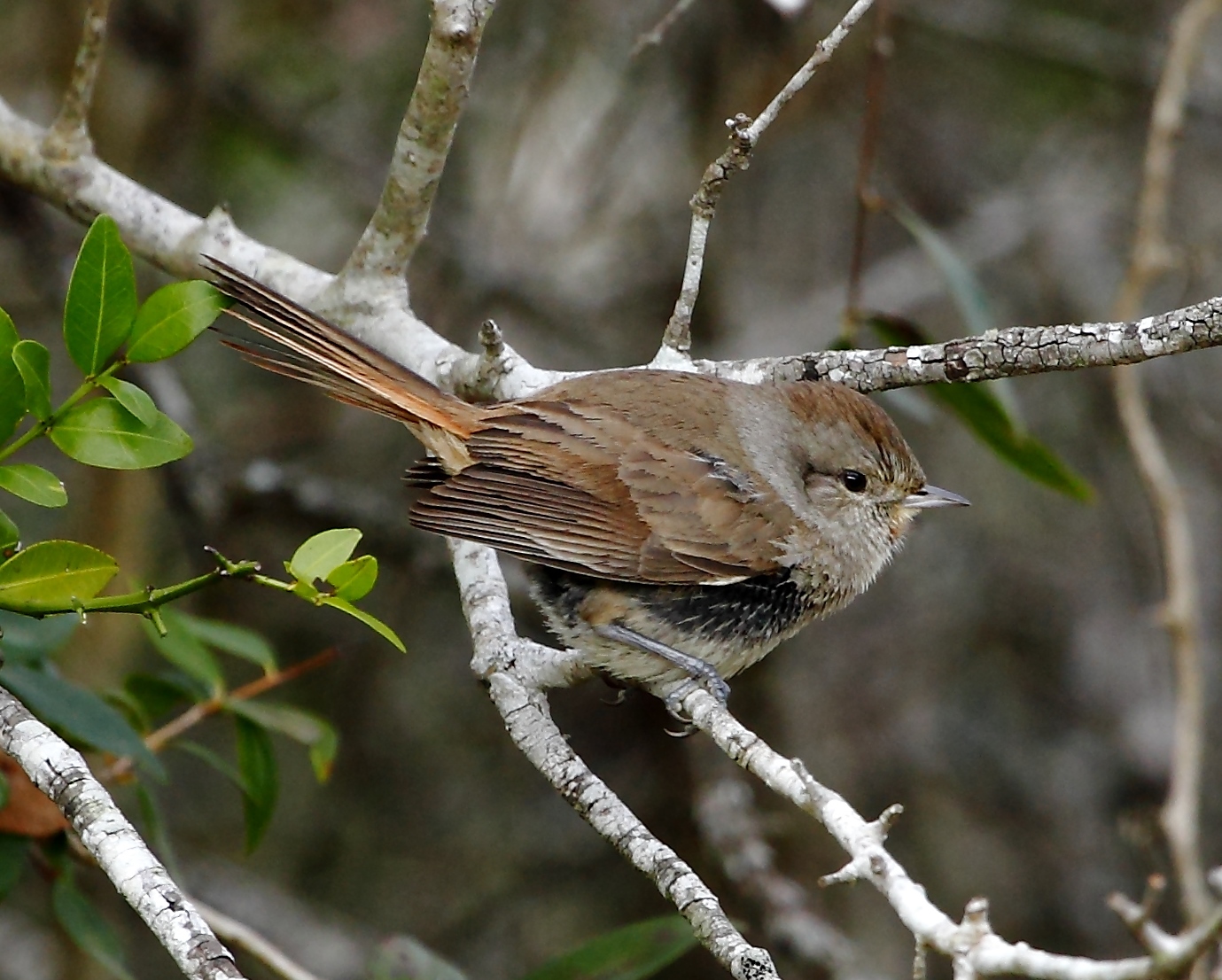
The Short-billed Canastero is a small, greyish-brown canastero of dry Chaco woodland and thorn scrub in south-eastern Bolivia. Unlike most canasteros it lives in the lowlands and low hills. The short, fairly thick bill separates it from related species.
Voice
The song is a fast, dry trill that drops at the end. Calls with short, sharp chip notes.
Recording: Guy Kirwan — CC BY-NC-SA 4.0 · xeno-canto
Identification
14–15 cm, with a short, straight, fairly thick bill and a medium-length tail. The upperparts are greyish brown, with a greyer head, a pale eyebrow and a rufous wing patch. The throat has a small orange-rufous patch, the underparts are greyish white. The central tail feathers are dark, the outer ones rufous. The sexes are alike.
Confusion species
Sharp-billed Canastero Asthenes pyrrholeuca has a longer, thinner bill and a longer tail, and arrives in the same area from the south in winter. Stripe-crowned Spinetail Cranioleuca pyrrhophia has a streaked crown and a rufous tail, and creeps along branches. Little Thornbird Phacellodomus sibilatrix has a rufous forehead and keeps mainly to trees.
Habitat
Dry Chaco woodland, thorn scrub and shrubby, open country in the lowlands and low hills, up to about 1500 m. It forages in pairs low in shrubs and on the ground for insects. It builds a closed nest of thorny twigs in a shrub.
Where the bird is most at home, classified by the vegetation units of the Andes and the west coast.


Range and movements
In Bolivia in the Chaco of the south-east, in Santa Cruz, Chuquisaca and Tarija. Absent from Colombia, Ecuador, Peru and the Galápagos. Outside the guide area in western Paraguay, Argentina, Uruguay and extreme southern Brazil.
- Resident
- dark = core range, pale = thinly spread
How and when to look
Search open Chaco woodland and thorn scrub in south-eastern Bolivia and listen in the early morning for the dry trill from a bush top.
Conservation status
Least Concern. Clearing of the Chaco for farming and ranching degrades the habitat.
Scientific name
Asthenes baeri | (Berlepsch, 1906)
Berlepsch described the species in 1906 as Siptornis baeri; because it was later moved to another genus, the author and year stand in brackets. The genus Asthenes was introduced in 1853 by Reichenbach. The genus name comes from Ancient Greek asthenēs, 'insignificant', 'weak'. The species name honours Gustave Adolphe Baer (1838–1918), a French natural history dealer and collector in Peru, Chile and Brazil. The specimen the first description was based on came from Cosquín, Córdoba, Argentina.