All species › Passerines › Ovenbirds and woodcreepers › Berlepsch's Canastero
Berlepsch's Canastero | Asthenes berlepschi
Berlepsch' canastero | Canastero de Berlepsch | Lenheiro-de-berlepsch
Berlepsch's Canastero is a warm brown canastero found only in a small area in the Andes of the department of La Paz in Bolivia. It lives in scrub, hedgerows and Polylepis groves in the dry valleys around Illampu. It is closely related to Rusty-vented Canastero and was sometimes treated as a subspecies of it.
Voice
The song is a dry, accelerating trill that drops slightly, like that of Rusty-vented Canastero. Calls with sharp chik notes.
Recording: Ross Gallardy — CC BY-NC-SA 4.0 · xeno-canto
Identification
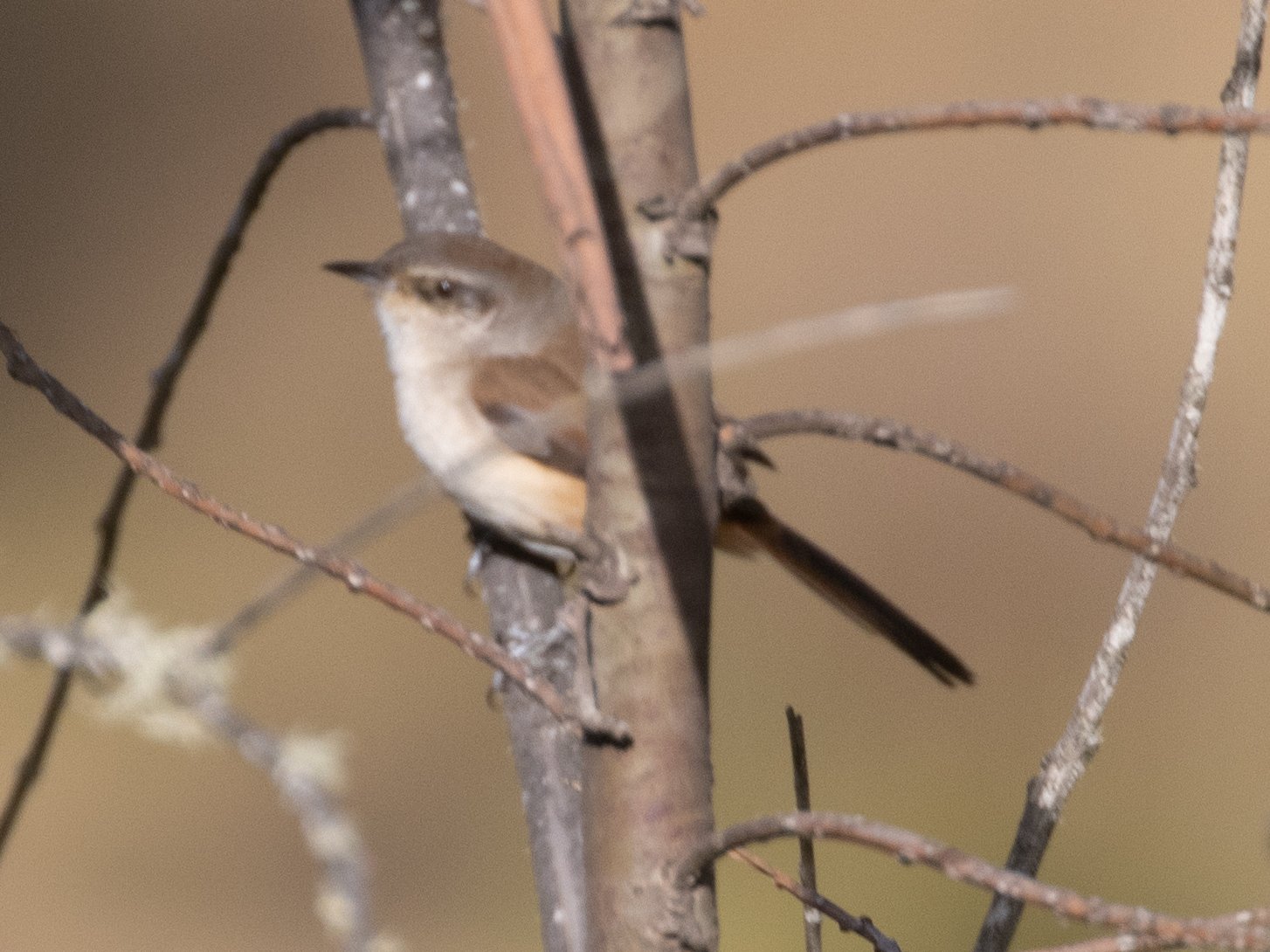
16 cm, with a straight, pointed bill and a fairly long tail. The upperparts are warm brown, with a rufous wing patch and a pale eyebrow. The throat has an orange-rufous patch; the breast and flanks are buff to pale rufous, the belly paler. The outer tail feathers are rufous. The sexes are alike.
Confusion species
Rusty-vented Canastero Asthenes dorbignyi is greyer, with greyish-white underparts, and occurs elsewhere in the Bolivian Andes. Cordilleran Canastero Asthenes modesta is plain greyish brown, without an obvious wing patch, and lives on the ground in open grassland. Streak-fronted Thornbird Phacellodomus striaticeps has a streaked rufous forehead and a plain rufous tail.
Habitat
Scrub, hedgerows, shrubby field edges and Polylepis groves in dry mountain valleys, roughly between 2700 and 4200 m. It forages in pairs in shrubs and on the ground for insects. It builds a closed nest of thorny twigs in a shrub.
Where the bird is most at home, classified by the vegetation units of the Andes and the west coast.


Range and movements
Endemic to Bolivia: only in the department of La Paz, in the valleys on the western side of the Cordillera Real around Illampu and Sorata. Absent from Colombia, Ecuador, Peru and the Galápagos.
- Resident
- dark = core range, pale = thinly spread
How and when to look
Search scrub and hedgerows along fields in the valleys above Sorata, in the early morning when the birds sing.
Conservation status
Near Threatened. The range is very small, and the scrub and Polylepis groves are cut, burned and grazed.
Scientific name
Asthenes berlepschi | (Hellmayr, 1917)
Hellmayr described the species in 1917 as Siptornis berlepschi; because it was later moved to another genus, the author and year stand in brackets. The genus Asthenes was introduced in 1853 by Reichenbach. The genus name comes from Ancient Greek asthenēs, 'insignificant', 'weak'. The species name honours Hans von Berlepsch (1850–1915), a German ornithologist who described many South American birds. The specimen the first description was based on came from Chicani, La Paz, Bolivia.