All species › Passerines › Ovenbirds and woodcreepers › Pale-tailed Canastero
Pale-tailed Canastero | Asthenes huancavelicae
Bleekstaartcanastero | Canastero de cola pálida | Lenheiro-de-rabo-pálido
The Pale-tailed Canastero is a canastero of the dry valleys in the Andes of central and southern Peru, where it lives in cactus scrub and on rocky slopes. It was formerly included in Rusty-vented Canastero and has only recently been treated as a separate species. The pale outer part of the tail separates it from its relatives.
Voice
The song is a dry, accelerating trill, similar to that of Rusty-vented Canastero. Calls with sharp chik notes.
Recording: Josh Beck — CC BY-NC-SA 4.0 · xeno-canto
Identification
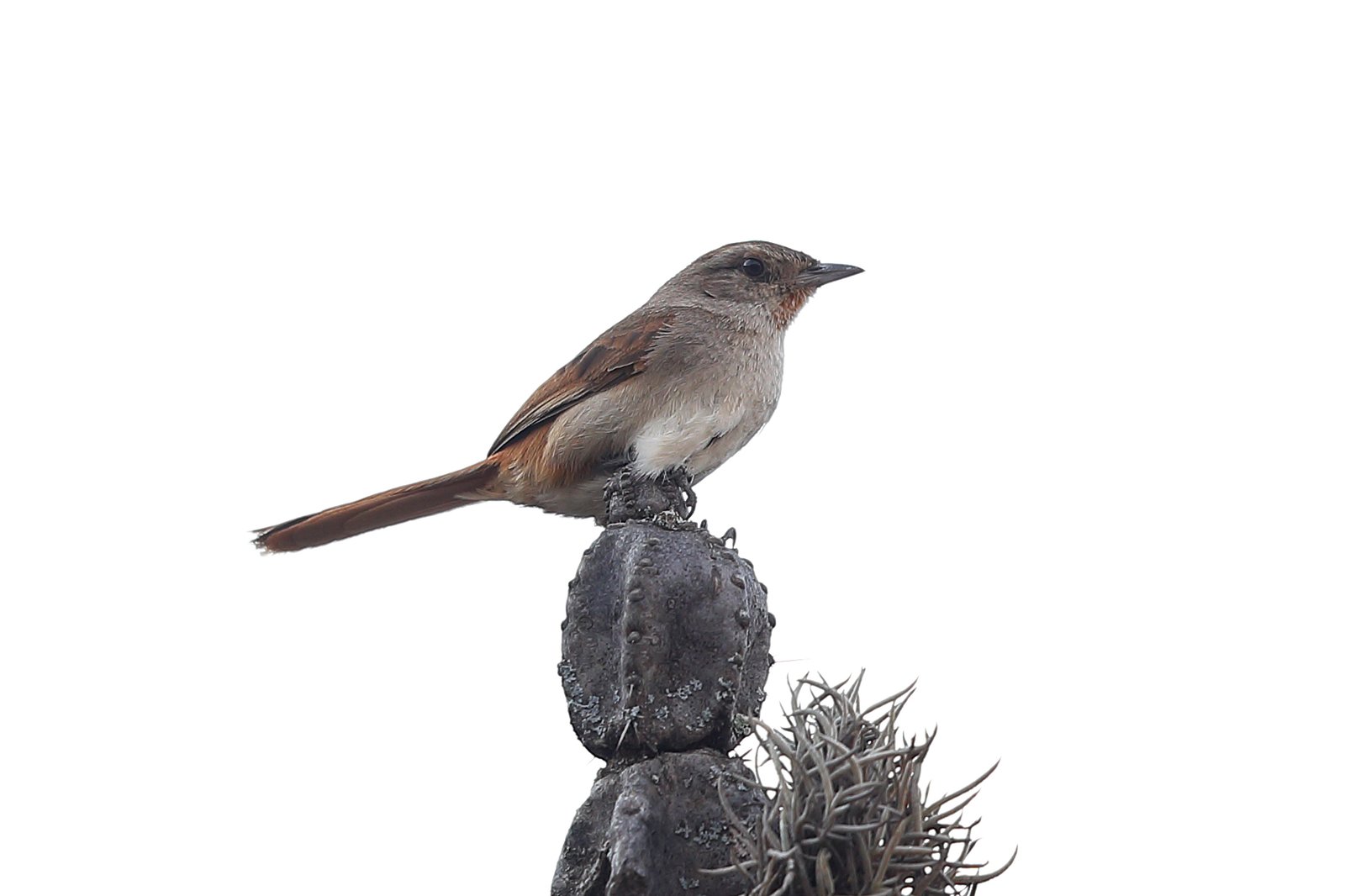
16 cm, with a straight, pointed bill and a fairly long tail. The upperparts are greyish brown, with a rufous wing patch and a faint, pale eyebrow. The throat has a small orange-rufous patch; the underparts are greyish white, with buff flanks. The outer tail feathers are pale buff to whitish, the central ones dark. The sexes are alike.
Confusion species
Rusty-vented Canastero Asthenes dorbignyi of southern Peru and Bolivia has rufous outer tail feathers and rufous undertail coverts. Canyon Canastero Asthenes pudibunda is more rufous, with a plain rufous tail. Rusty-fronted Canastero Asthenes ottonis has a rufous forehead and a rufous tail.
Habitat
Dry scrub with cacti and thorn bushes, rocky slopes and field edges in the dry inter-Andean valleys, roughly between 2500 and 3900 m. It forages in pairs in shrubs and on the ground for insects. It builds a closed nest of thorny twigs in a shrub or cactus.
Where the bird is most at home, classified by the vegetation units of the Andes and the west coast.


Range and movements
Endemic to Peru: in the dry Andean valleys of Ancash, Huánuco, Lima, Huancavelica, Ayacucho and Apurímac. Absent from Colombia, Ecuador, Bolivia and the Galápagos.
- Resident
- dark = core range, pale = thinly spread
How and when to look
Search dry, shrubby slopes with cacti in the valleys of Huancavelica and Ayacucho, in the early morning when the birds sing.
Conservation status
Not Evaluated, because the species has only recently been split. The range is small; clearing of scrub and overgrazing degrade the habitat locally.
Scientific name
Asthenes huancavelicae | Morrison, 1938
Morrison described the species in 1938 and placed it straight away in the genus where it still stands. The genus Asthenes was introduced in 1853 by Reichenbach. The genus name comes from Ancient Greek asthenēs, 'insignificant', 'weak'. The species name refers to Huancavelica in Peru. The specimen the first description was based on came from Yauli, Huancavelica, Peru.