All species › Nightjars › Nightjars and nighthawks › Little Nightjar
Little Nightjar | Setopagis parvula
Kleine nachtzwaluw | Chotacabras chico | Bacurau-chintã
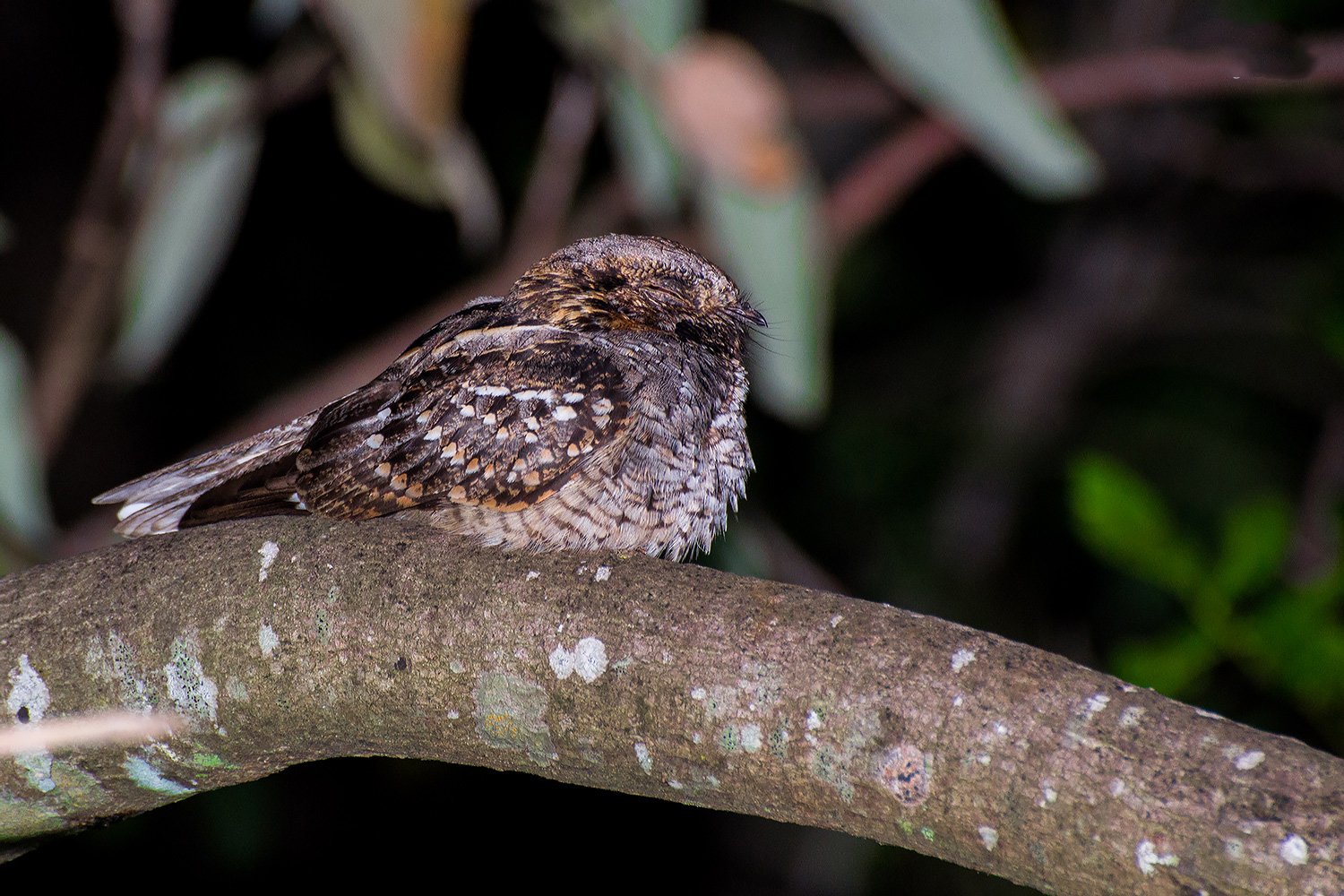
The Little Nightjar is a small, grey-brown nightjar of brushy savanna and open woodland in eastern Bolivia and Peru. Its song is a rattling, clacking sound that is rather unbirdlike. In the south of its range it is largely migratory.
Voice
The song is a rattling, clacking, rather unbirdlike sound in a rapidly repeated pattern, mainly at dusk and at night.
Recording: JAYRSON ARAUJO DE OLIVEIRA — CC BY-NC-SA 4.0 · xeno-canto
Identification
19–21 cm. The male is grey-brown with buff, brown and blackish-brown spots and streaks, a buff belly barred with brown, a white throat, a white wing band and white in the tail. The female is similar, but has a buff throat and lacks the white in the wing and tail.
Confusion species
Spot-tailed Nightjar Antiurus maculicaudus has a tawny face with a broad buff supercilium and white spots on the outer tail feathers, and lives in wet savanna. Pauraque Nyctidromus albicollis is larger and longer-tailed. The male White-winged Nightjar Eleothreptus candicans has largely white wings and tail. Todd's Nightjar Setopagis heterura is very similar to Little Nightjar, but lives in northern Colombia.
Habitat
Brushy savanna, cerrado, Chaco woodland and the interior and edges of open forest; also eucalyptus plantations. From the lowlands to about 1500 m in Bolivia. It hunts flying insects at night. The eggs are laid without a nest on the ground.
Where the bird is most at home, classified by the vegetation units of the Andes and the west coast.


Range and movements
In Bolivia in the lowlands and on the lower slopes of the east and south; birds from the south probably move north in the austral winter. In Peru in the east, possibly partly as a migrant. Absent from Colombia, Ecuador and the Galápagos. Outside the guide area in Brazil, Paraguay, Uruguay and Argentina.
- Resident
- dark = core range, pale = thinly spread
How and when to look
Listen at dusk in the dry woodland and savannas of eastern and southern Bolivia, especially in the austral spring and summer, for the rattling song.
Conservation status
Least Concern. The species occurs over a very large area and also uses man-made landscapes such as plantations.
Scientific name
Setopagis parvula | (Gould, 1837)
Gould described the species in 1837 as Caprimulgus parvulus; because it was later moved to another genus, the author and year stand in brackets. The genus Setopagis was introduced in 1912 by Ridgway. The genus name comes from Greek sēs, 'moth', and pagis, 'trap', so 'moth trap'. The species name comes from Latin parvulus, 'very small'. The specimen the first description was based on came from Santa Fe, Paraná River, Argentina.