All species › Nightjars › Nightjars and nighthawks › Blackish Nightjar
Blackish Nightjar | Nyctipolus nigrescens
Roetnachtzwaluw | Chotacabras negruzco | Bacurau-de-lajeado
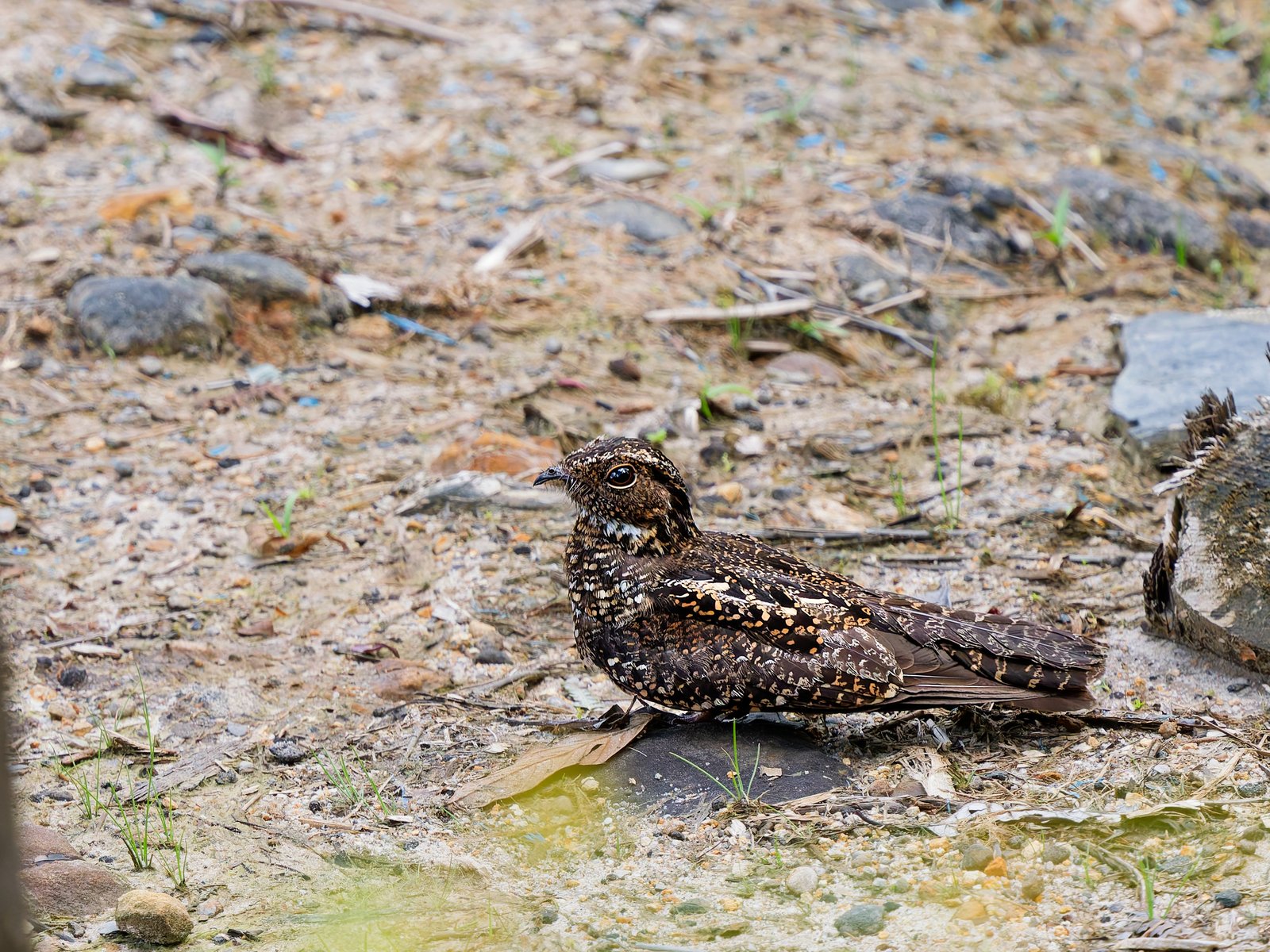
The Blackish Nightjar is a small, very dark nightjar of Amazonia, tied to bare rock outcrops, gravel and sand bars along small rivers and openings in the forest. Its blackish, finely spotted plumage blends with dark rock. The egg is laid in a hollow on bare rock.
Voice
A short, soft, purring trill, roughly pu'r'r'r'r't or qu'r'r'r'rt, mainly at dusk from a rock; both sexes sing during display. Also a clucking ptink as an alarm call and a guttural hissing when threatened.
Recording: Bobby Wilcox — CC BY-NC-SA 4.0 · xeno-canto
Identification
19–22 cm, small, with a fairly short tail. The upperparts are blackish brown with small buff, greyish-white and cinnamon spots; overall it looks much darker than other lowland nightjars. The underparts are also dark and finely barred. Males have small white spots on the throat and on some primaries and a white tip to the outer tail feathers, which they show in display; females have little or no white.
Confusion species
Little Nightjar Setopagis parvula is paler greyish brown, with a clear pale nuchal collar and more white in the tail, and lives in drier, open areas. Ladder-tailed Nightjar Hydropsalis climacocerca also lives along rivers, but is paler and more rufous, and the male has much white in the long tail. Band-tailed Nighthawk Nyctiprogne leucopyga has a white band across the middle of the tail and hunts in small groups over water.
Habitat
Evergreen lowland forest, but almost always at open rock outcrops or on sand and gravel bars along small rivers, also at treefalls and bare patches; up to about 1200 m in the foothills. It makes short sallies from the ground or a rock after flying insects. The single egg is usually laid in a hollow on bare rock, sometimes on sand or bare soil; birds nest singly or in small, loose colonies, mainly in the dry season.
Where the bird is most at home, classified by the vegetation units of the Andes and the west coast.


Range and movements
In Colombia in the lowlands of the south-east. In Ecuador in the eastern lowlands and foothills. In Peru in the eastern lowlands and foothills. In Bolivia locally in the north. Absent west of the Andes and from the Galápagos. Outside the guide area in southern Venezuela, the Guianas and northern Brazil.
- Resident
- dark = core range, pale = thinly spread
How and when to look
At dusk, scan rock outcrops and gravel bars along clear streams in Amazonia; by day the birds rest on the rock and flush only at your feet.
Conservation status
Least Concern. The species is locally common where suitable rocks and gravel bars occur.
Scientific name
Nyctipolus nigrescens | (Cabanis, 1849)
Cabanis described the species in 1849 as Caprimulgus nigrescens; because it was later moved to another genus, the author and year stand in brackets. The genus Nyctipolus was introduced in 1912 by Ridgway. The genus name comes from Greek nuktipolos, 'roaming by night'. The species name comes from Latin nigrescens, 'blackish'. The specimen the first description was based on came from lower Essequibo River, Guyana.