All species › Passerines › Tapaculos › Loja Tapaculo
Loja Tapaculo | Scytalopus androstictus
Lojatapaculo | Churrín de Loja | Macuquinho-de-loja
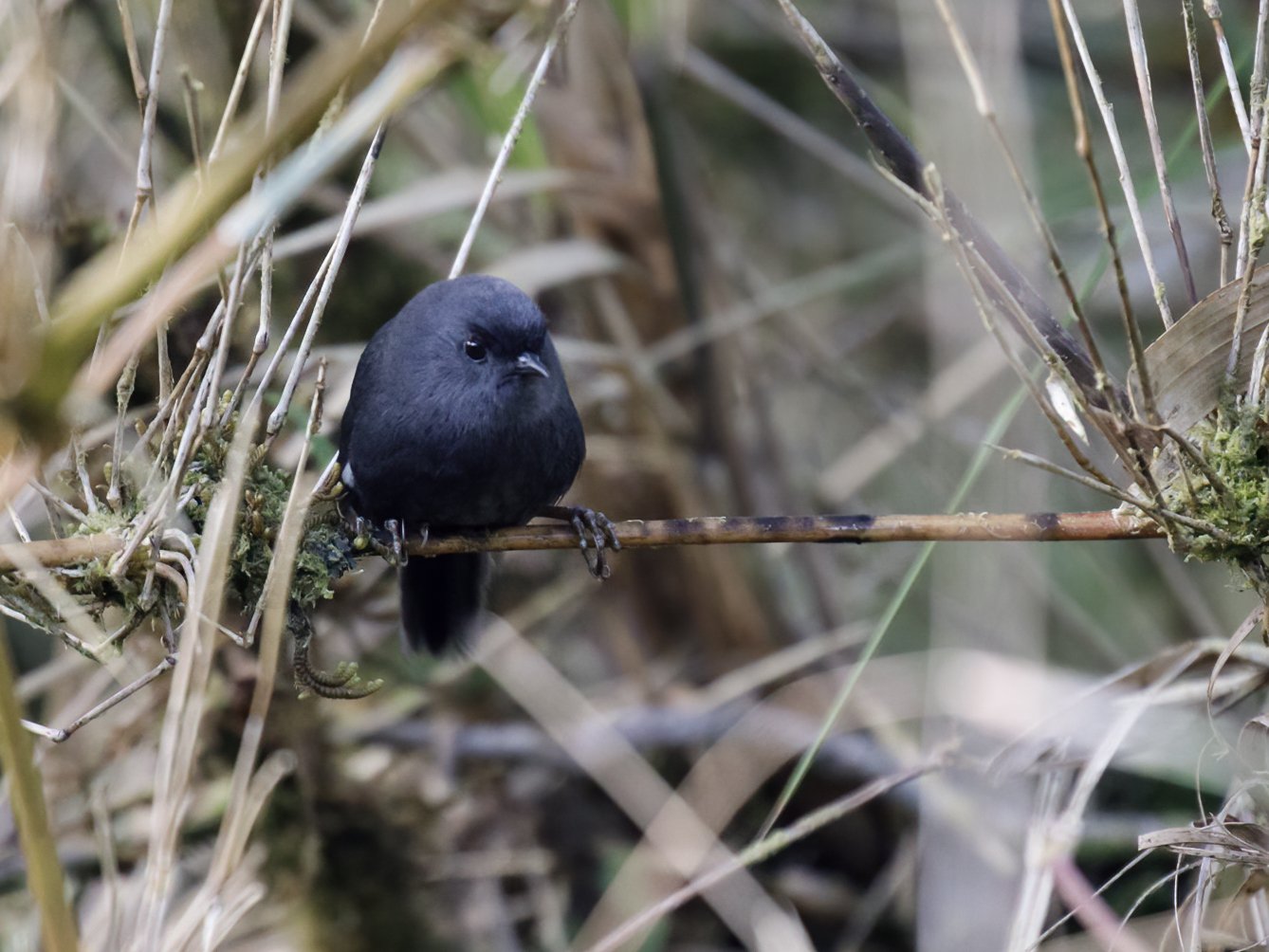
The Loja Tapaculo is a small, dark tapaculo of the treeline in southern Ecuador and the far north of Peru. It was long treated as a subspecies of Paramo Tapaculo, but differs in voice, genetics and plumage and has been treated as a separate species since 2020. The scientific name literally means 'spotted male' and refers to the small white spot on the male's wing.
Voice
As in related tapaculos, the song consists of series of short, repeated notes delivered from dense vegetation; it differs clearly from that of Paramo Tapaculo, which was one of the reasons for splitting the species. Also short, sharp calls.
Recording: Dan Lane — CC BY-NC-SA 4.0 · xeno-canto
Identification
11 cm, round, with a short, often cocked tail, short wings, a thin bill and fairly long legs. The male is very dark grey above and medium to dark grey below; the flanks and undertail are tawny to dark brown with dark barring. Most males have white primary coverts, which show as a small white spot on the folded wing. The female is brown above and paler grey below, with the same brown, barred flanks. Juveniles are variable, usually brown and barred above and grey and buff below.
Confusion species
Paramo Tapaculo Scytalopus opacus, further north, is very similar, but lacks the white wing spot and has a different song. Chusquea Tapaculo Scytalopus parkeri lives slightly lower, mainly in bamboo of the upper montane forest, and is more uniformly grey. Blackish Tapaculo Scytalopus latrans is almost entirely blackish and usually lives lower. In tapaculos the song is the main identification feature.
Habitat
Scrub and dense shrubbery at and above the treeline, elfin forest, Polylepis groves and high humid montane forest, mostly between about 2600 and 3500 m. It forages on or just above the ground, among moss, roots and leaf litter, for small arthropods. Little is known about its breeding.
Where the bird is most at home, classified by the vegetation units of the Andes and the west coast.


Range and movements
In Ecuador only in the south, in the Andes around the border of Loja and Zamora-Chinchipe. In Peru in northern Cajamarca, north of the Marañón. Absent from Colombia, Bolivia and the Galápagos. Does not occur outside the guide area.
- Resident
- dark = core range, pale = thinly spread
How and when to look
In the early morning, listen along the treeline in the high part of Podocarpus National Park for the song from dense shrubbery. The bird stays low in the vegetation; wait quietly near a gap in the scrub.
Conservation status
Not Evaluated: as a recently split species it has not yet been assessed separately for the Red List. The range is small but lies partly within protected areas; fire and grazing around the treeline degrade the habitat locally.
Scientific name
Scytalopus androstictus | Krabbe & Cadena, 2010
Krabbe & Cadena described the species in 2010 and placed it straight away in the genus where it still stands. The genus Scytalopus was introduced in 1837 by Gould. The genus name combines Greek skutalē or skutalon, 'stick', with pous, 'foot'. The species name comes from Greek anēr (andros), 'man, male', and stiktos, 'spotted' (from stizō, 'to tattoo'). The specimen the first description was based on came from Cordillera de Las Lagunillas, Loja, Ecuador.