All species › Nightjars › Nightjars and nighthawks › Lyre-tailed Nightjar
Lyre-tailed Nightjar | Uropsalis lyra
Lierstaartnachtzwaluw | Chotacabras colilira | Bacurau-lira
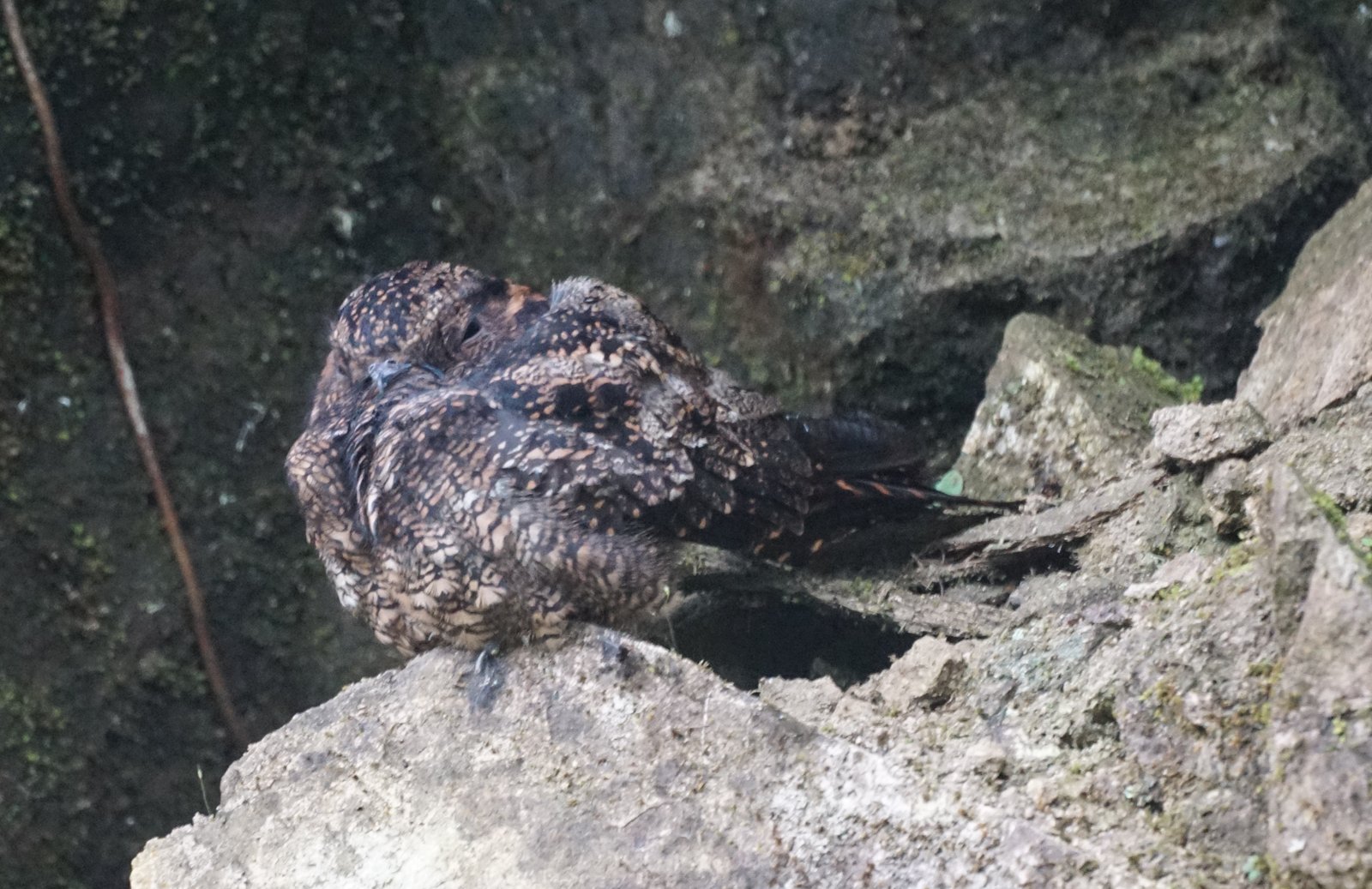
The Lyre-tailed Nightjar is a dark nightjar of humid montane forest in the Andes. The male has two very long, slightly curved outer tail feathers, more than twice the length of the body. By day it rests on ledges of rock faces and road cuts, often near running water; at dusk it hunts from a fixed perch.
Voice
The song is a lively series of about five to eleven rising notes, mainly at dusk, from a perch or the ground, but also in flight or when chasing a female. In display flight the male gives a rapid series of plaintive, squeaky calls.
Recording: Jacob Wijpkema — CC BY-NC-SA 4.0 · xeno-canto
Identification
25–28 cm without the tail streamers; in the male the tail with the elongated outer feathers is more than 60 cm long. The upperparts are brown, spotted with greyish white, buff, tawny and cinnamon, with a broad tawny collar on the nape. The breast is brown with dense tawny barring; the belly and flanks are buff barred with brown. The long tail feathers have greyish-white tips. The female has a greyer crown, a shorter, less graduated tail without streamers and more rufous markings on the primaries. Birds in Peru and Bolivia are slightly redder in tone.
Confusion species
Swallow-tailed Nightjar Uropsalis segmentata usually lives higher, in cloud forest up to the treeline; the male has shorter, straighter tail streamers. Females of the two species are very similar; elevation and habitat help to separate them. Band-winged Nightjar Systellura longirostris of open country has a white (male) or buff (female) band across the primaries. Scissor-tailed Nightjar Hydropsalis torquata also has a long tail, but lives in open lowlands.
Habitat
Humid montane forest, especially along edges and openings, at rock faces and ravines along streams and rivers, and at road cuts through forest. Mostly between 1100 and 2100 m, with records from about 800 to 3500 m. It catches flying insects in short sallies from a perch. As in other nightjars, the eggs are laid without a nest on the bare surface.
Where the bird is most at home, classified by the vegetation units of the Andes and the west coast.


Range and movements
In Colombia in the Andes. In Ecuador on both slopes of the Andes. In Peru along the eastern slope of the Andes. In Bolivia on the eastern slope south to the centre of the country. Absent from the Galápagos. Outside the guide area in the Andes of western Venezuela and north-western Argentina.
- Resident
- dark = core range, pale = thinly spread
How and when to look
Search at dusk along roads through montane forest with rock faces and streams. Males then sing from a fixed perch and make short foraging flights along the face; by day a bird sometimes sits on a ledge of a road cut.
Conservation status
Least Concern. The species is local, but occurs over a large area; deforestation of mountain slopes reduces its habitat.
Scientific name
Uropsalis lyra | (Bonaparte, 1850)
Bonaparte described the species in 1850 as Hydropsalis lyra; because it was later moved to another genus, the author and year stand in brackets. The genus Uropsalis was introduced in 1915 by Miller. The genus name combines Greek oura, 'tail', with psalis, 'pair of scissors' or 'shears', after the long forked tail of the males. The species name comes from Latin lyra, 'lyre', after the male's long, lyre-shaped outer tail feathers. The specimen the first description was based on came from Bogotá, Colombia.