All species › Nightjars › Nightjars and nighthawks › Anthony's Nightjar
Anthony's Nightjar | Nyctidromus anthonyi
Struiknachtzwaluw | Chotacabras de Anthony | Bacurau-de-anthony
Anthony's Nightjar is a small, greyish-brown nightjar of dry scrub and dry forest in western Ecuador and north-western Peru. It was formerly placed in the genus Caprimulgus and is closely related to the Pauraque. Its range largely coincides with the Tumbesian region.
Voice
The song is simple and is given mainly at dusk and dawn, from the ground or a low perch. Also a rolling call from a perch and a soft, repeated call in flight.
Recording: Paul Coopmans — CC BY-NC-SA 4.0 · xeno-canto
Identification
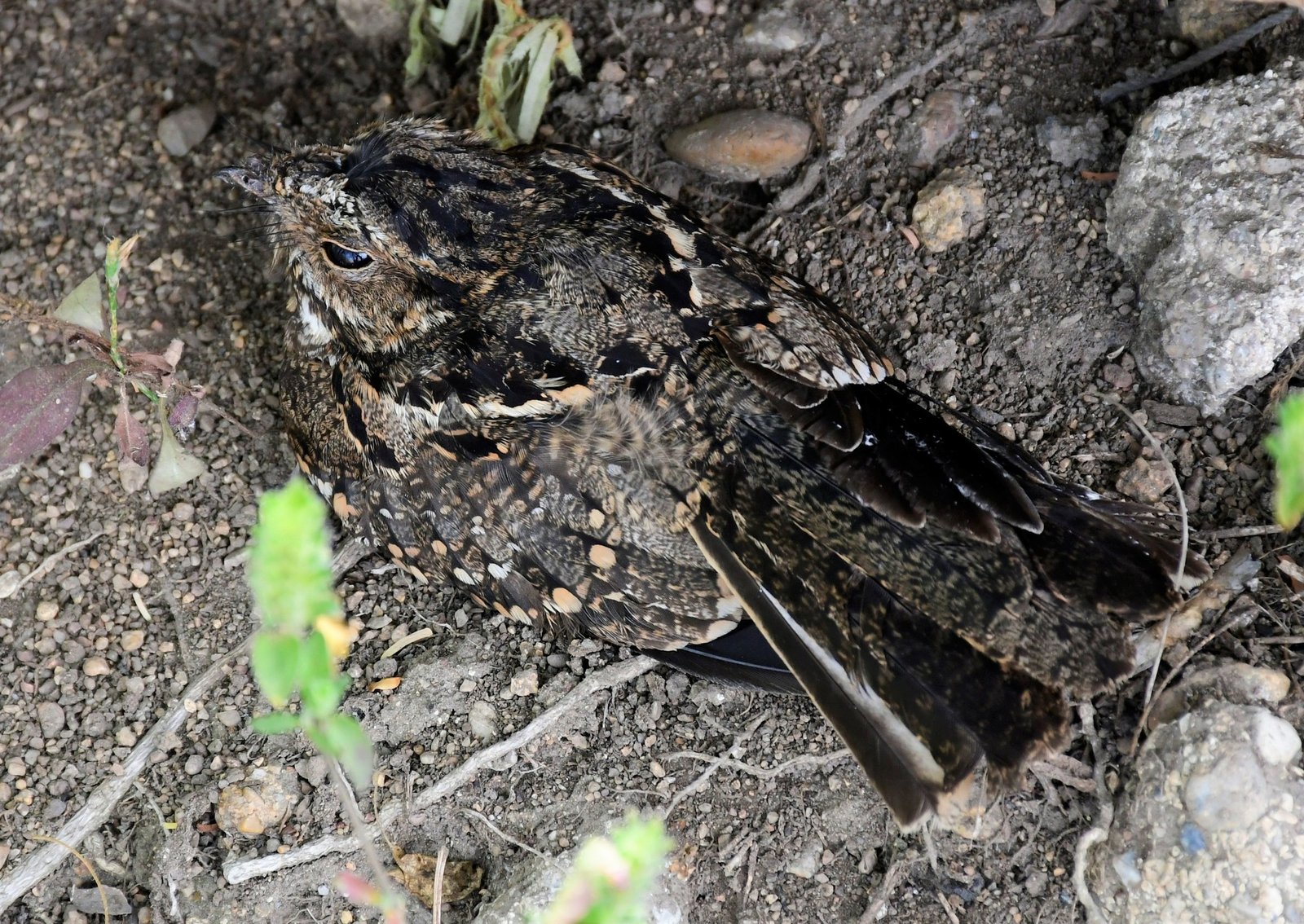
19–21 cm, small, with a medium-length tail. The upperparts are greyish brown with buff speckles and blackish streaks, the crown is darker and a broad buff band crosses the hindneck. The throat is buff with dark bars on the chin and white on the lower throat. The breast is barred greyish brown, the belly buff. In flight a white or buff band across the outer primaries, and much white in the outermost pair of tail feathers. Females have less white in the wings and tail.
Confusion species
Pauraque Nyctidromus albicollis is larger, with a longer tail and a broader white wing band, and lives mainly at more humid forest edges and clearings. Band-winged Nightjar Systellura longirostris is darker, with a rufous nuchal collar, and in western Peru occurs mostly higher or in the coastal desert. Lesser Nighthawk Chordeiles acutipennis has longer, pointed wings, hunts high on the wing and rarely sits on the ground.
Habitat
Dry, open woodland, scrub, thorn scrub and grassland with scattered shrubs, also the edges of fields and pastures, from sea level to about 800 m. It hunts flying insects from the ground or a low perch. By day it rests on the ground among leaf litter and shrubs; the egg is laid without a nest on bare ground.
Where the bird is most at home, classified by the vegetation units of the Andes and the west coast.


Range and movements
In Ecuador in the dry west, from Manabí to El Oro and Loja. In Peru in the north-west, mainly in Tumbes and Piura. Absent from Colombia, Bolivia and the Galápagos. Hardly occurs outside the guide area.
- Resident
- dark = core range, pale = thinly spread
How and when to look
At dusk, drive or walk along dirt roads through dry forest and scrub in south-western Ecuador or north-western Peru; the birds often sit on the road and give themselves away by their eyeshine and song.
Conservation status
Least Concern. Its habitat, Tumbesian dry forest, is locally converted to farmland, but the species tolerates open, shrubby terrain.
Scientific name
Nyctidromus anthonyi | (Chapman, 1923)
Chapman described the species in 1923 as Setopagis anthonyi; because it was later moved to another genus, the author and year stand in brackets. The genus Nyctidromus was introduced in 1838 by Gould. The genus name combines Greek nukti-, 'night-', with -dromos, 'racer', from trekhō 'to run'. The species name probably honours Harold Elmer Anthony (1890–1970), American zoologist at the American Museum of Natural History, who collected in Ecuador in the 1920s. The specimen the first description was based on came from Portovelo, El Oro, Ecuador.