All species › Nightjars › Nightjars and nighthawks › Pauraque
Pauraque | Nyctidromus albicollis
Pauraque | Chotacabras pauraque | Bacurau
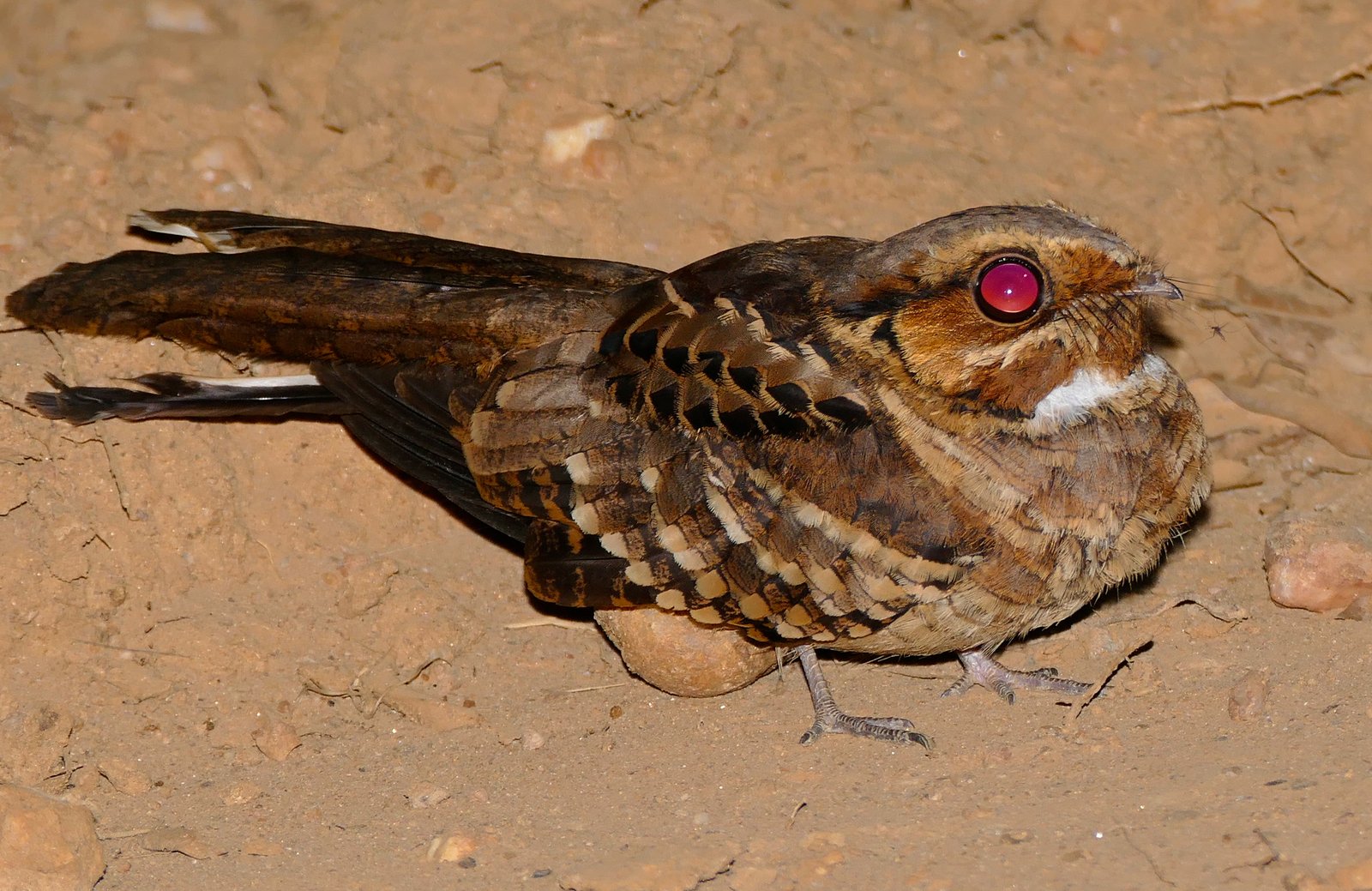
The Pauraque is the most widespread nightjar of the American tropical lowlands and in much of the guide area the most common. It lives at forest edges, in clearings and in semi-open farmland, and at night often sits on dirt roads. Its whistled call is one of the best-known night sounds of the tropics; the name is derived from it.
Voice
The song is a clear, whistled pur-weeeeer, often with one or more short, stuttering introductory notes (pup-pup-pup-pur-weeeeer), repeated from the ground or a road, mainly at dusk and in moonlight. Also short wheek or kweep calls in flight.
Recording: Jonas Nilsson — CC BY-NC-SA 4.0 · xeno-canto
Identification
22–28 cm, with a long, rounded tail and fairly short, rounded wings. The plumage is greyish brown or rufous-brown vermiculated, with a row of large black spots with pale edges on the scapulars and rufous ear-coverts. Males have a broad white band across the primaries, a white throat band and much white in the outer tail feathers. Females have a narrower, buff wing band and only narrow white tips to the outer tail feathers. In the beam of a lamp the eyes shine orange-red.
Confusion species
Anthony's Nightjar Nyctidromus anthonyi in western Ecuador and Peru is smaller and greyer, with a shorter tail. Band-winged Nightjar Systellura longirostris has a rufous nuchal collar and a shorter tail, and usually lives higher in the Andes. Ladder-tailed Nightjar Hydropsalis climacocerca lives along rivers in Amazonia; the male has a stepped tail with much white and no broad white wing band.
Habitat
Forest edges, clearings, secondary forest, scrub, plantations, pastures and gardens in the lowlands and foothills, mostly up to about 1500 m, locally higher. It hunts insects in short sallies from the ground or a road. By day it rests on the ground in leaf litter; the eggs, usually two, are laid without a nest on the ground.
Where the bird is most at home, classified by the vegetation units of the Andes and the west coast.


Range and movements
In Colombia widespread in the lowlands on both sides of the Andes and in the valleys, also in the llanos. In Ecuador in the western and eastern lowlands and foothills. In Peru in the eastern lowlands and foothills and in the far north-west. In Bolivia in the lowlands of the north and east. Absent from the high Andes, the coastal desert of Peru and the Galápagos. Outside the guide area from southern Texas and Mexico through Central America to Brazil and northern Argentina.
- Resident
- dark = core range, pale = thinly spread
How and when to look
After sunset, drive slowly along dirt roads past forest edges and pastures; the birds often sit on the road, where their eyeshine shows in the headlights. Their call is often heard before they are seen.
Conservation status
Least Concern. A common species that benefits from forest edges and semi-open farmland.
Scientific name
Nyctidromus albicollis | (Gmelin, 1789)
Gmelin described the species in 1789 as Caprimulgus albicollis; because it was later moved to another genus, the author and year stand in brackets. The genus Nyctidromus was introduced in 1838 by Gould. The genus name combines Greek nukti-, 'night-', with -dromos, 'racer', from trekhō 'to run'. The species name comes from Latin albus, 'white', and collum, 'neck', after the white throat patch. The specimen the first description was based on came from Cayenne, French Guiana.