All species › Nightjars › Nightjars and nighthawks › Nacunda Nighthawk
Nacunda Nighthawk | Chordeiles nacunda
Nacundanachtzwaluw | Añapero ñacundá | Corucão
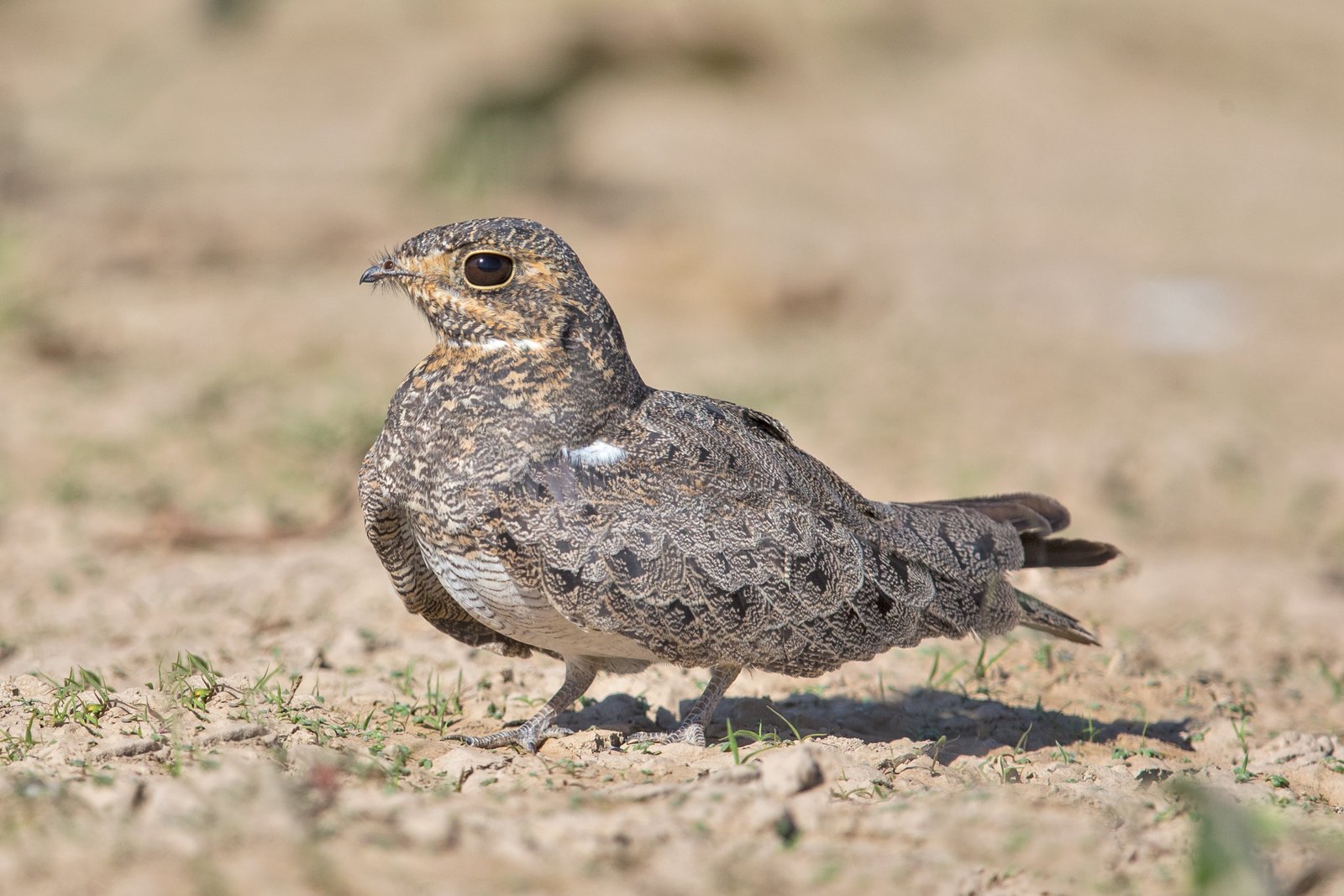
The Nacunda Nighthawk is the largest nighthawk of the Americas, a bulky, pale species of open savanna and riverbanks. It often hunts well before sunset, sometimes in groups, with a slow, rocking flight. On the ground it stands upright on short legs, unlike most nightjars.
Voice
Usually silent. At the nest site and in groups soft, low calls, such as a knocking tuk-tuk-tuk; in the breeding season also a low, rolling purr.
Recording: Bernabe Lopez-Lanus — CC BY-NC-SA 3.0 · xeno-canto
Identification
28–32 cm, heavily built, with long, broad wings and a short, square tail. The upperparts are brown, spotted with buff, black and grey. The breast is mottled brown; the belly and underwing coverts are white. In flight a broad white band across the primaries is visible. The male has a white throat band and broad white tips to the outer tail feathers; the female lacks the white in the tail. Juveniles are paler and greyer.
Confusion species
Common Nighthawk Chordeiles minor and Lesser Nighthawk Chordeiles acutipennis are much smaller, with narrower, pointed wings, a notched tail and a barred belly. Sand-colored Nighthawk Chordeiles rupestris is smaller and paler sandy, with a largely white inner wing and black wingtips, and lives along rivers. Pauraque Nyctidromus albicollis has rounded wings, a long tail and barred brown underparts.
Habitat
Open savanna, grassland, dry and wet meadows, marsh edges, riverbanks and sandbars, also pasture and rice fields, mainly in the lowlands below 1000 m. It hunts flying insects low to high over open ground, at dusk and on overcast days also by day. The eggs are laid without a nest on bare ground.
Where the bird is most at home, classified by the vegetation units of the Andes and the west coast.


Range and movements
In Colombia in the Caribbean lowlands, the Magdalena valley and the llanos east of the Andes, locally in Amazonia. In Ecuador scarce in the eastern lowlands. In Peru in Amazonia, mainly along large rivers, largely as an austral migrant. In Bolivia widespread in the savannas of Beni and in Santa Cruz, where it also breeds. Absent from the high Andes, the Pacific coast and the Galápagos. Outside the guide area in Venezuela, the Guianas, Brazil, Paraguay, Uruguay and northern Argentina.
- Resident
- dark = core range, pale = thinly spread
How and when to look
In the late afternoon and at dusk, watch over savannas, rice fields and rivers with sandbars; in the austral winter groups hunt over the large rivers of Amazonia.
Conservation status
Least Concern. The species is widespread and locally also uses cleared, open land.
Scientific name
Chordeiles nacunda | (Vieillot, 1817)
Vieillot described the species in 1817 as Caprimulgus nacunda; because it was later moved to another genus, the author and year stand in brackets. The genus Chordeiles was introduced in 1832 by Swainson. The genus name comes from Greek chordē, 'string, chord', and deilē, 'evening', after the calls at dusk. The specific name comes from the Guaraní name ñacundá, 'big mouth'; according to Félix de Azara, the Guaraní also called any man or woman with a very large mouth by this name. The specimen the first description was based on came from Paraguay.