All species › Nightjars › Nightjars and nighthawks › Least Nighthawk
Least Nighthawk | Chordeiles pusillus
Kleinste nachtzwaluw | Añapero chico | Bacurauzinho
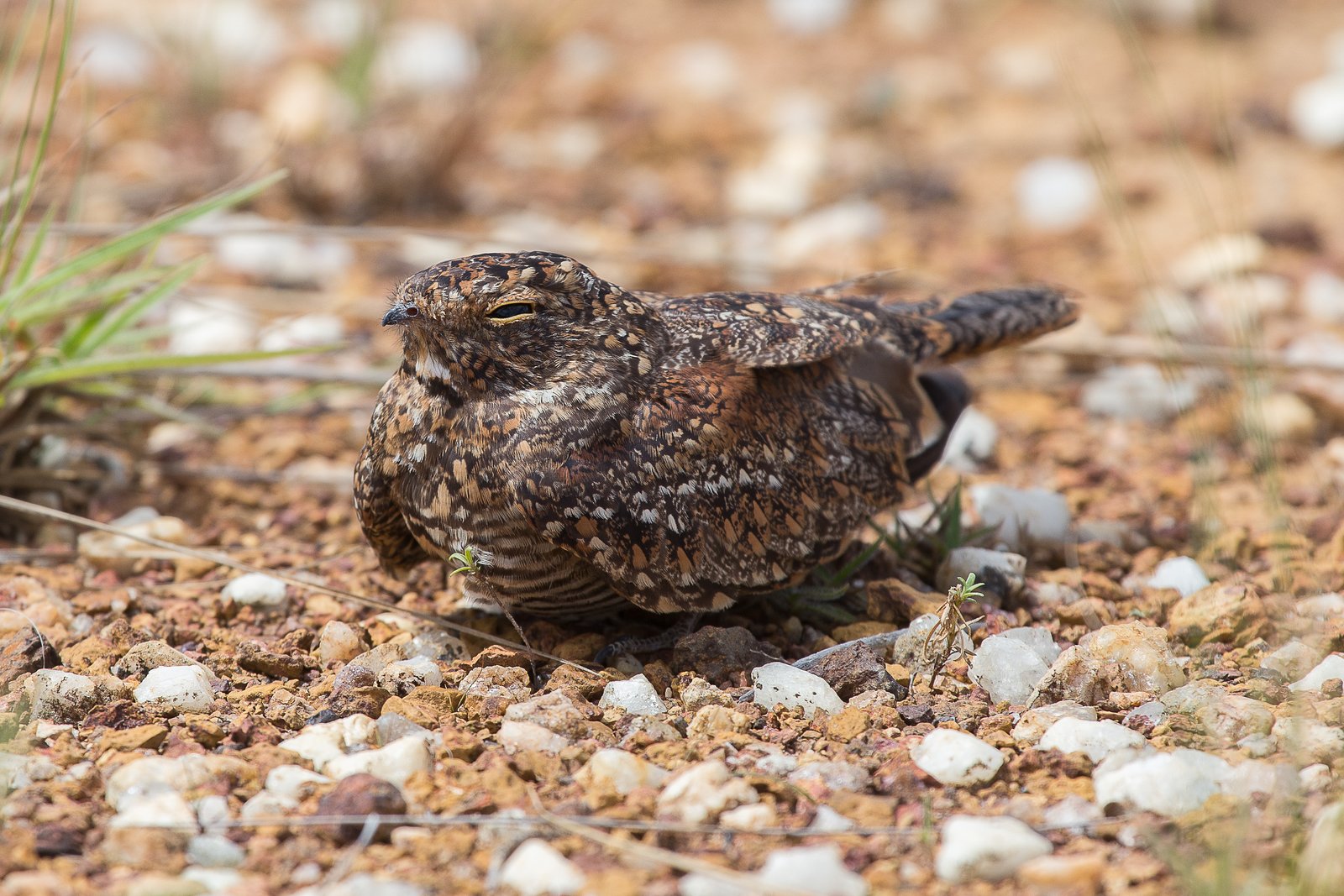
The Least Nighthawk is the smallest species of the genus Chordeiles, a small, dark nighthawk of open savanna and scrub on white sand. It hunts at dusk with a low, fluttering flight over open ground. In the guide area it occurs only east of the Andes, in the northern llanos and in eastern Bolivia.
Voice
Short, high, nasal calls and soft trills, mainly at dusk, in flight and from the ground.
Recording: Jacob Wijpkema — CC BY-NC-SA 4.0 · xeno-canto
Identification
16–19 cm, with narrow, pointed wings and a short, slightly notched tail. The upperparts are greyish brown, densely speckled with black, buff and grey; the underparts are brown with fine pale bars. The throat is white. In flight a white band across the middle of the primaries and a narrow white trailing edge to the secondaries are visible; this trailing edge is lacking in the other Chordeiles species. The male has a narrow white band near the tail tip; in the female it is weaker or absent, and the throat and wing band are sometimes buff.
Confusion species
Lesser Nighthawk Chordeiles acutipennis is clearly larger, lacks the white trailing edge to the secondaries and has the wing band closer to the wingtip. Common Nighthawk Chordeiles minor is larger and longer-winged, with a deeper tail fork. Little Nightjar Setopagis parvula has rounded wings and a longer tail and more often sits on the ground or on trails.
Habitat
Savanna, cerrado and open grassland with scattered shrubs, often on white sand, and openings in scrub and light woodland, in the lowlands up to about 1000 m. It hunts small flying insects at dusk, low over grassland or over the treetops. The eggs are laid without a nest on bare ground or sand.
Where the bird is most at home, classified by the vegetation units of the Andes and the west coast.


Range and movements
In Colombia in the llanos of Meta and Vichada and on the sandy savannas of Guainía and Vaupés. In Bolivia in the savannas and cerrado of the east, mainly in Beni and Santa Cruz. Not confirmed with certainty in Peru; absent from Ecuador and the Galápagos. Outside the guide area in Venezuela, the Guianas and much of Brazil.
- Resident
- dark = core range, pale = thinly spread
How and when to look
At dusk, search over open savanna and sandy plains; the birds hunt low and sometimes pass close along trails and roadsides.
Conservation status
Least Concern. Conversion of savanna and cerrado to farmland locally reduces its habitat.
Scientific name
Chordeiles pusillus | Gould, 1861
Gould described the species in 1861 and placed it straight away in the genus where it still stands. The genus Chordeiles was introduced in 1832 by Swainson. The genus name comes from Greek chordē, 'string, chord', and deilē, 'evening', after the calls at dusk. The specific name is Latin pusillus, 'very small'. The specimen the first description was based on came from Bahia, Brazil.