All species › Nightjars › Nightjars and nighthawks › Sand-colored Nighthawk
Sand-colored Nighthawk | Chordeiles rupestris
Zandkleurige nachtzwaluw | Añapero arenisco | Bacurau-da-praia
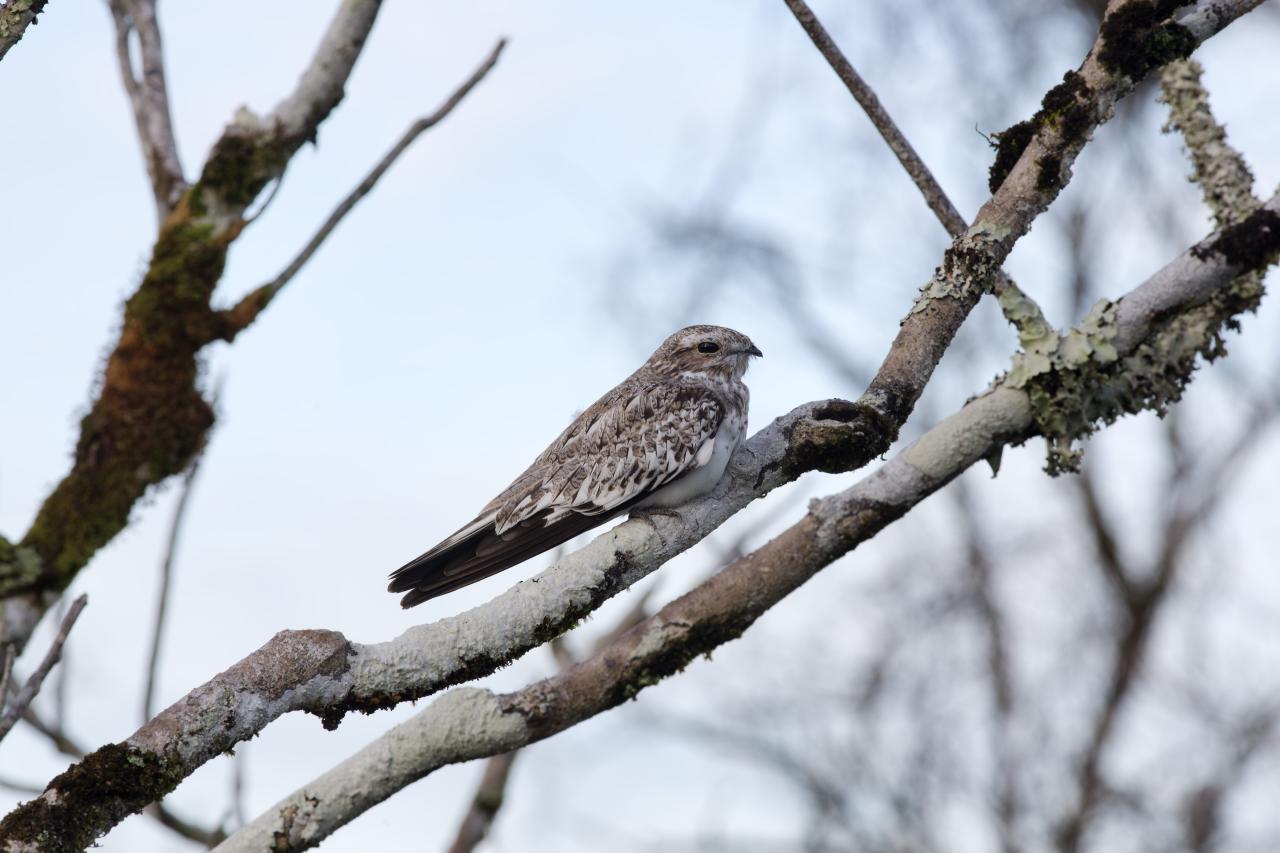
The Sand-colored Nighthawk is a pale nighthawk with much white in the wings, tied to the large rivers of Amazonia. By day it roosts in groups on sandbars, rocks and driftwood in the river. At dusk it hunts low over the water, often dozens at a time.
Voice
Usually silent. In groups and at nest sites soft, croaking or cooing calls and a low, trilled purr.
Recording: Daniel F. Lane — CC BY-NC-SA 4.0 · xeno-canto
Identification
19–22 cm, with long, pointed wings and a short, slightly notched tail. The upperparts are pale sandy greyish brown and finely speckled. The throat and underparts are white, with a narrow, brown-speckled band across the breast. In flight the secondaries and inner primaries are largely white, contrasting with the black outer primaries and the dark leading edge of the wing. The tail is white with dark central feathers and a dark tip. The sexes are similar.
Confusion species
Nacunda Nighthawk Chordeiles nacunda is larger and browner, with a white band across the primaries instead of a white inner wing. Lesser Nighthawk Chordeiles acutipennis and Common Nighthawk Chordeiles minor are much darker, with only a narrow white band across the primaries. Band-tailed Nighthawk Nyctiprogne leucopyga also hunts over rivers, but is dark, with a white band across the tail.
Habitat
Large Amazonian rivers with sandbars, rocky banks and islets, also oxbow lakes, in the lowlands up to about 500 m. From dusk it hunts insects low over the water. It breeds in loose colonies; the eggs are laid without a nest on the sand of river beaches.
Where the bird is most at home, classified by the vegetation units of the Andes and the west coast.


Range and movements
In Colombia along the rivers of the Orinoco and Amazon basins east of the Andes. In Ecuador along the large rivers of the eastern lowlands, such as the Napo. In Peru along the Amazonian rivers throughout the east. In Bolivia along the rivers of the north and east. Absent west of the Andes, from the high Andes and from the Galápagos. Outside the guide area in Venezuela and Amazonian Brazil.
- Resident
- dark = core range, pale = thinly spread
How and when to look
By day, search from a boat on a large river for roosting groups on sandbars and driftwood; at dusk they hunt over the water, also near landings and riverside villages.
Conservation status
Least Concern. The species depends on sandbars exposed at low water; disturbance of breeding sites and changes to river flow may have local effects.
Scientific name
Chordeiles rupestris | (Spix, 1825)
Spix described the species in 1825 as Caprimulgus rupestris; because it was later moved to another genus, the author and year stand in brackets. The genus Chordeiles was introduced in 1832 by Swainson. The genus name comes from Greek chordē, 'string, chord', and deilē, 'evening', after the calls at dusk. The specific name comes from Latin rupestris, 'of the rocks', after the rocky river islands where the species roosts. The specimen the first description was based on came from Rio Negro, Brazil.