All species › Nightjars › Nightjars and nighthawks › Lesser Nighthawk
Lesser Nighthawk | Chordeiles acutipennis
Texasnachtzwaluw | Añapero menor | Bacurau-de-asa-fina
In the guide area the Lesser Nighthawk is the nighthawk of dry, open country, from the coastal desert of Peru to the dry valleys and the lowland savannas. At dusk it hunts with a low, fluttering flight over fields, riverbeds and lit areas. Besides the resident birds, Nearctic winter visitors also occur in the north.
Voice
A long, low, toad-like trill, trrrrrr, from the ground or a low perch, and a nasal, bleating whi-whi-whi in flight. It lacks the nasal peent of Common Nighthawk.
Recording: Rosa Elena Albornoz — CC0 1.0 · xeno-canto
Identification
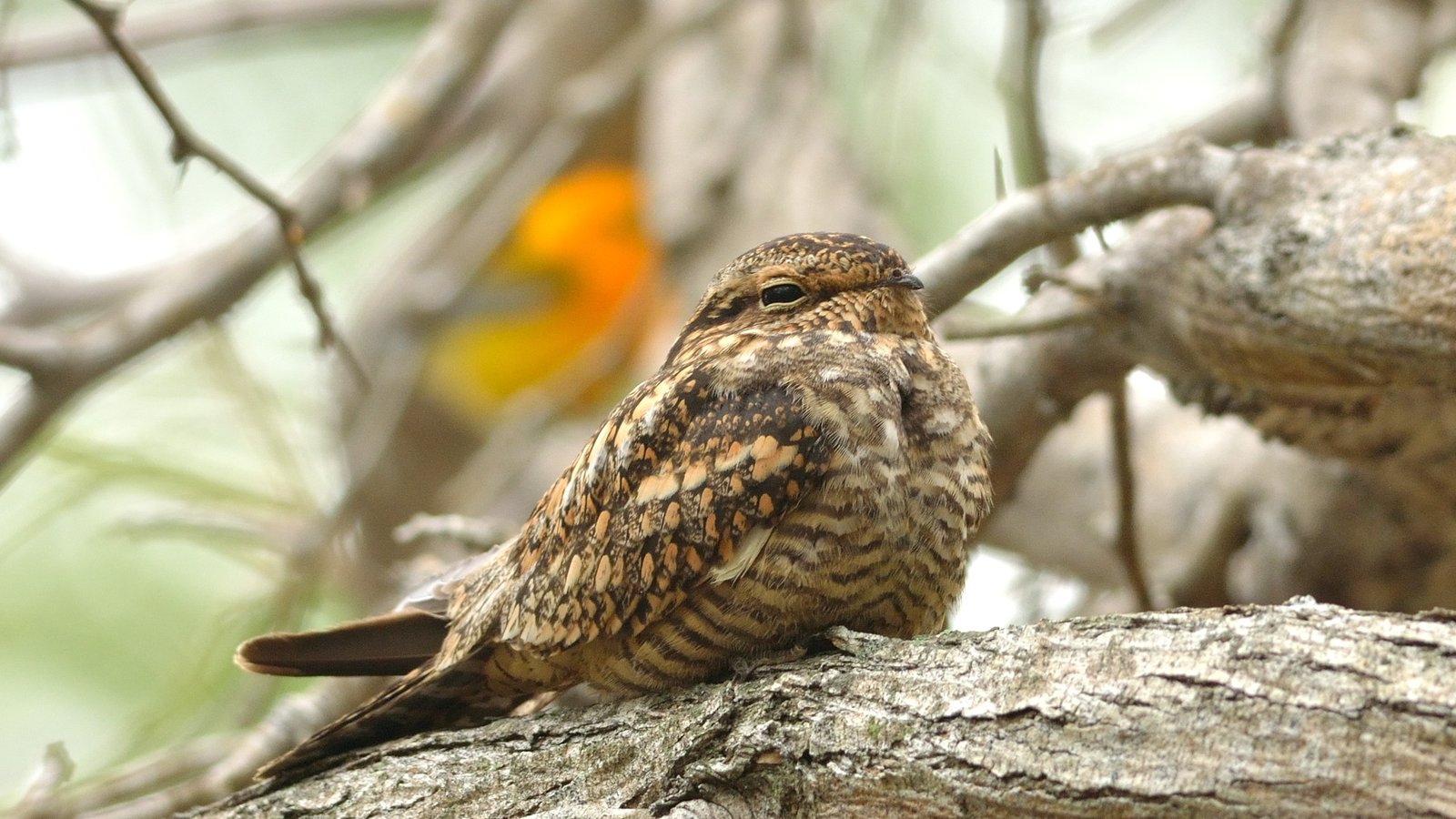
19–23 cm, with long, pointed wings and a notched tail. The upperparts are greyish brown, finely speckled and vermiculated with buff and black. The underparts are barred brown on a buff ground. The male has a white throat patch, a white band across the primaries, closer to the wingtip than in Common Nighthawk, and a white band near the tail tip. The female has a buff throat and wing band and lacks the white tail band. Buff spots are visible on the primaries between the wing band and the base of the wing.
Confusion species
Common Nighthawk Chordeiles minor is slightly larger, with longer, more pointed wings, the white band nearer the middle of the wing and no buff spots on the primaries; it often flies higher. Least Nighthawk Chordeiles pusillus is smaller, with a white trailing edge to the secondaries. Band-winged Nightjar Systellura longirostris and Pauraque Nyctidromus albicollis have rounded wings and longer tails and more often sit on the ground.
Habitat
Coastal desert, dry scrub, open dry forest, riverbeds, fields, rice fields and village edges, also savanna and riverbanks in the lowlands; mainly below 1500 m, locally higher in dry Andean valleys. At dusk it hunts insects low over open ground and around lights. The eggs are laid without a nest on bare ground or gravel.
Where the bird is most at home, classified by the vegetation units of the Andes and the west coast.


Range and movements
In Colombia in the dry Caribbean lowlands, the Magdalena and Cauca valleys and the llanos. In Ecuador in the western lowlands and along the coast, locally in the eastern lowlands. In Peru along the entire coast, in the dry valleys of the western slope and the Marañón, and locally in Amazonia. In Bolivia in the lowlands of the north and east. Absent from the Galápagos. Outside the guide area from the south-western United States through Central America to Venezuela, the Guianas and Brazil; northern birds migrate in winter as far as northern South America.
- Resident
- dark = core range, pale = thinly spread
How and when to look
At dusk, watch over riverbeds, fields and irrigated land on the coast of Peru and Ecuador; birds there often hunt low, also around lights in villages.
Conservation status
Least Concern. The species tolerates farmland well and is widespread along the Pacific coast.
Scientific name
Chordeiles acutipennis | (Hermann, 1783)
Hermann described the species in 1783 as Caprimulgus acutipennis; because it was later moved to another genus, the author and year stand in brackets. The genus Chordeiles was introduced in 1832 by Swainson. The genus name comes from Greek chordē, 'string, chord', and deilē, 'evening', after the calls at dusk. The specific name comes from Latin acutus, 'pointed', and penna, 'feather, wing': pointed-winged. The specimen the first description was based on came from Cayenne, French Guiana.